At Sixes and Sevens Idiom: Meaning, Origin, Usage & Exercises
6 min read
Updated On
-
Copy link
The idiom ‘At Sixes and Sevens’ means ‘in a confused, badly organized, or difficult situation’. Explore its usage and origins in this blog, along with examples and exercises created to help you boost your vocabulary and improve your IELTS band score.
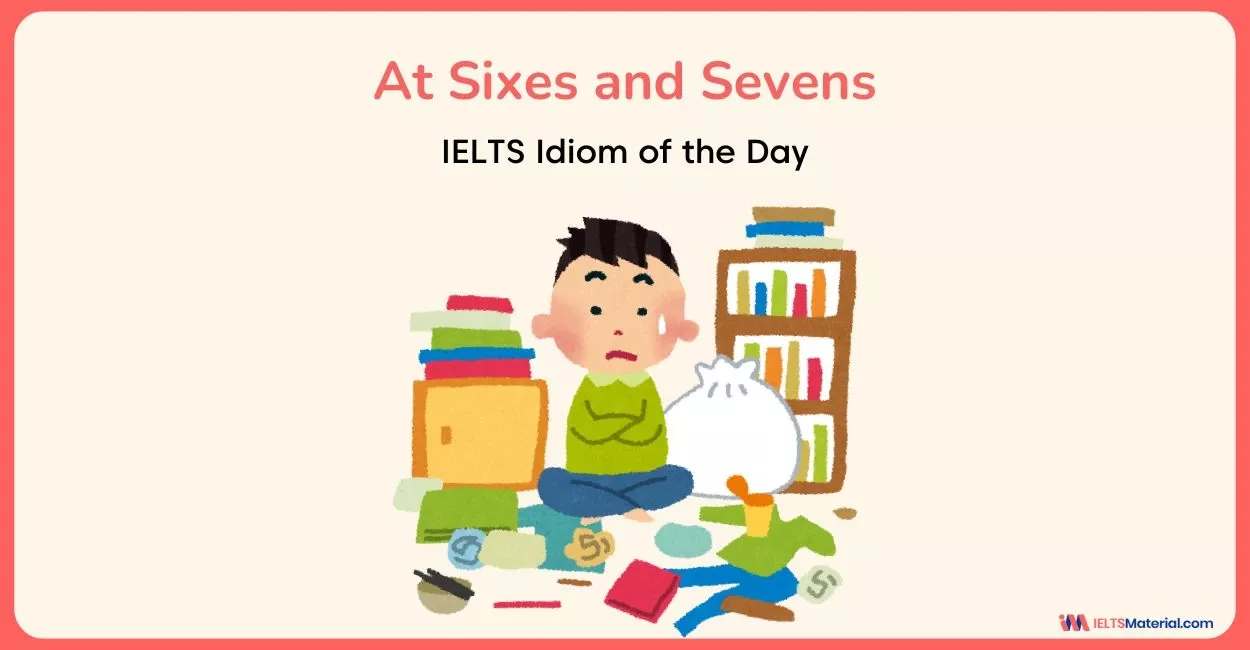
Table of Contents


Limited-Time Offer : Access a FREE 10-Day IELTS Study Plan!
The idiom ‘at sixes and sevens’ is one of those expressions that instantly paints a vivid picture of disorder, confusion, or chaos. Whether someone is overwhelmed by a messy room, an unpredictable project, or an emotional conflict, this idiom captures the feeling of being completely out of order.
In this blog post, we will explore the meaning, origin, and usage of the idiom ‘at sixes and sevens’, one of the common idioms in IELTS Speaking, and take up exercises to cement your understanding.
At Sixes and Sevens Idiom: Meaning
The idiom ‘at sixes and sevens’ means:
- to be in a state of confusion, disorder, or disorganisation
- to be uncertain about what to do next
It can describe a person’s emotions, the condition of a place, or the state of a situation.
Origin of ‘At Sixes and Sevens’ Idiom
The idiom ‘at sixes and sevens’ has an unusual and fascinating origin linked to:
- Medieval English dice games (most popular theory): In medieval times, dice games often involved risky gambles, especially when betting on ‘six’ or ‘seven’. These were considered dangerous moves, often associated with uncertainty and chaos. Thus the phrase started hinting at risky or unpredictable behaviour.
- 14th-century dispute between London trade guilds: Another theory refers to a quarrel between the Merchant Taylors’ Guild and the Skinners’ Guild over who would take sixth and seventh positions in civic ceremonies. Their dispute lasted decades, earning the phrase its association with conflict and disorder.
- Shakespeare’s literary influence: The phrase appears in early forms in Renaissance literature and later became popular in Modern English through literary and conversational use.
Across centuries, ‘at sixes and sevens’ has evolved from references to chance, rivalry, and disorder to become a versatile idiom expressing modern-day confusion.
At Sixes and Sevens Idiom Usage
Below are some examples of how the idiom ‘at sixes and sevens’ can be used in everyday conversations.
- The new budget is at sixes and sevens on the taxes.
- The unpredictable northwest monsoons always keep the farmers at sixes and sevens.
- The new syllabi have left the students at sixes and sevens.
- I’ve been at sixes and sevens this whole morning because I overslept.
- The project was at sixes and sevens after the sudden budget cuts.
- With no strategy in place, the kingdom fell at sixes and sevens during the rebellion.
- He felt at sixes and sevens after the argument, unsure of what to say next.
Idiom scenarios:
Scenario 1:
|
Friend 1: Did you hear the news? The famous actress is about to tie the knot with the richest businessman in the city. Friend 2: That’s old news. She has recently bagged an offer from Hollywood. Friend 1: So is the news about the wedding is a rumour? Friend 2: No one knows. The news must have left the businessman at sixes and sevens for sure. |
Scenario 2:
|
(Two friends on a bike during a procession) Friend 1: Hey, look! The policeman is asking us to take a diversion. Let’s take the left. Friend 2: That’s a better idea. Friend 1: Oh No! There is a policeman here as well. He is asking people to move straight. Friend 2: There aren’t any proper arrangements for the procession. It has left us at sixes and sevens. |
Scenario 3:
|
Brother: From the will, it is not clear as to whom the redwood dining table should go. Sister: I told Father to mention it clearly in the will. But he did not do it. Brother: Yes. The will has left us at sixes and sevens. |
Book IELTS online classes to learn new vocabulary for the IELTS test!
At Sixes and Sevens Idiom: Detailed Usage in IELTS Contexts
The idiom ‘at sixes and sevens’ adds colour, precision, and sophistication to English communication, making it especially useful for learners preparing for IELTS or advanced speaking tasks. You will find a few examples of how you can use this idiom effectively in IELTS Speaking contexts.
IELTS Speaking Part 2
- Cue Card: Describe a time when you faced a difficult situation.
- Answer Excerpt: “When my university suddenly shifted to online exams, I was completely at sixes and sevens. It took me a few days to adapt, but eventually I managed to organise my study schedule.”
IELTS Speaking Part 3
- Question: Why do you think some people struggle to stay organised in their daily lives?
- Sample Answer: “Honestly, I think many people feel at sixes and sevens because modern life is packed with too many responsibilities. When you’re juggling work, family duties, and constant digital distractions, it’s easy to lose track of priorities. Another reason is poor time management—without a clear plan, even simple tasks can pile up and make someone feel completely disoriented. In my view, creating routines and setting boundaries can help people regain control instead of being constantly overwhelmed.”
Join a FREE online webinar to learn how to boost your IELTS vocabulary for success!
At Sixes and Sevens Idiom: Synonyms and Related Phrases
In the table below, you will find the common idioms list for IELTS Speaking related to the idiom ‘at sixes and sevens’.
|
Idiom/Expression |
Meaning |
Example Sentence |
|---|---|---|
|
All over the place |
completely disorganised |
His ideas were all over the place during the meeting. |
|
In a muddle |
in a confused or messy state |
I’m in a muddle about how to prioritise these tasks. |
|
Thrown off balance |
feeling unsettled or confused |
The unexpected announcement threw the staff off balance. |
|
At a loss |
not knowing what to do |
She was at a loss when asked to justify the sudden changes. |
|
In disarray |
in a state of untidiness or disorder |
The documents were in complete disarray after the audit. |
Book a FREE demo to talk to our experts and boost your IELTS vocabulary now!
At Sixes and Sevens Idiom: Practice Exercises
In the following exercises, you will learn how to properly use the idiom 'at sixes and sevens' and apply it appropriately.
Exercise A: Use ‘at sixes and sevens’ to rewrite the following sentences without changing their meaning:
1 The students were extremely confused after the exam instructions changed.
2 The apartment was completely messy after the party.
3 She couldn’t decide what to do after losing her job.
Exercise B: Choose the correct option.
1 The idiom ‘at sixes and sevens’ should NOT be used when describing:
A A chaotic room
B An emotional breakdown
C A well-planned project
D A confused team
2 Which situation best illustrates the idiom?
A A company announces record profits
B A student neatly arranges her notes
C A team panics after losing its leader suddenly
D A family enjoys a quiet dinner
At Sixes and Sevens Idiom: Answer Key for Practice Exercises
|
Exercise A |
Exercise B |
|---|---|
|
1 The students were at sixes and sevens after the exam instructions changed. 2 The apartment was at sixes and sevens after the party. 3 She was at sixes and sevens after losing her job. |
1 C 2 C |
To conclude, the idiom ‘at sixes and sevens’ is a powerful and expressive way to describe confusion, chaos, or disorganisation in daily life, academic discussions, and narrative writing. Whether you are describing a chaotic workplace, a confused state of mind, or a disordered event, this idiom helps you convey your meaning with clarity and style. So, use it effectively and make it a valuable addition to advanced vocabulary word list for IELTS, especially if you are aiming for Band 7+.
Useful Links:
- Idiom – Run Around like a Headless Chicken
- Have Egg on Your Face - Idiom of the Day for IELTS
- Ducks in a Row - Idiom of the Day for IELTS
- Common Idioms to Boost Your IELTS Score – Topic: Memory and Mind
- Success and Failure: Common Idioms to Boost Your IELTS Score
- Idioms Organiser: Organised By Metaphor, Topic, And Key Word – Jon Wright
Explore IELTS Resources

Start Preparing for IELTS: Get Your 10-Day Study Plan Today!

Check out other Idioms
Haniya Yashfeen
Haniya Yashfeen

Recent Articles
Kasturika Samanta
Prity Mallick

Nehasri Ravishenbagam


Post your Comments