Below the Belt Idiom: Meaning, Origin, Usage & Exercises
The idiom ‘below the belt’ means ‘a very unfair and personal remark on someone or something’. Examine its history and origin, synonyms, examples, and practice questions to expand your vocabulary and get a 7+ band score on the IELTS exam.
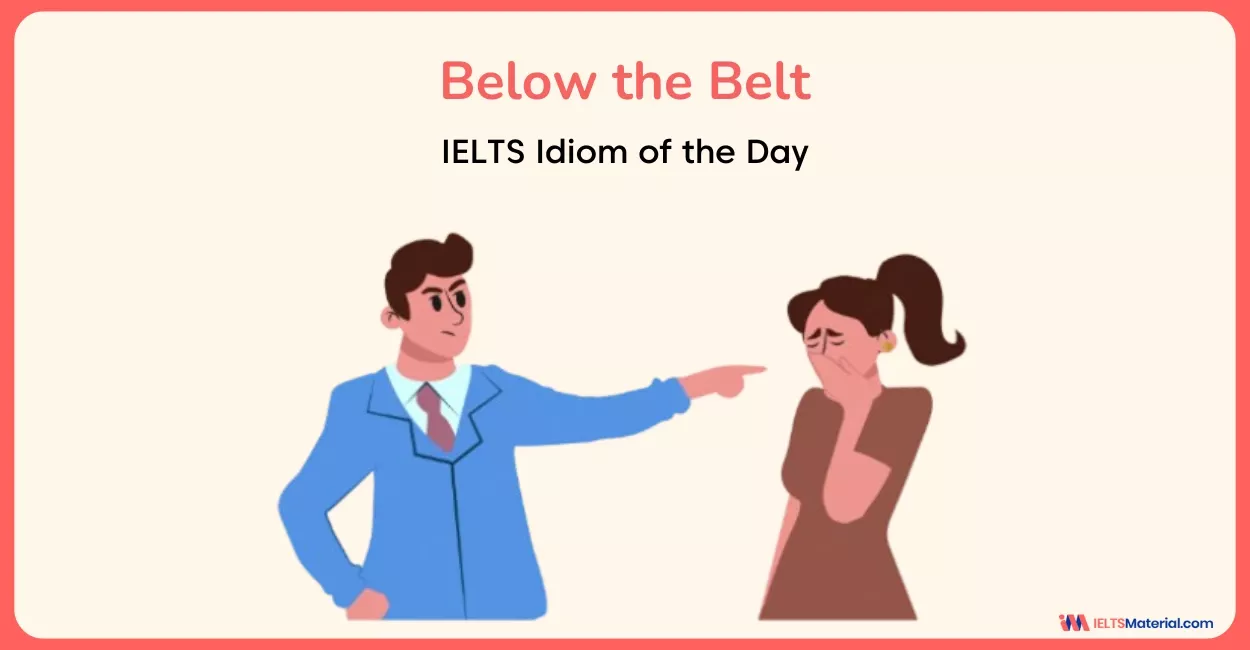
Table of Contents


Limited-Time Offer : Access a FREE 10-Day IELTS Study Plan!
Some actions don’t just hurt; they cross an invisible line of fairness. The idiom ‘below the belt’ is used precisely for such moments. Whether in arguments, competition, politics, or personal relationships, this expression highlights unfair, cruel, or unethical behaviour, especially when someone takes advantage of another person’s weakness.
This blog will discuss the meaning, history, usage, synonyms, IELTS-specific applications of the idiom ‘below the belt’ and exercises to help you use it naturally and appropriately and boost your IELTS vocabulary.
Below the Belt Idiom: Meaning
The idiom ‘below the belt’ refers to an action, comment, or tactic that is unfair, inappropriate, or deliberately hurtful, especially because it targets a sensitive area or weakness.
The phrase implies that there are unspoken rules of fairness, even during conflict. When someone goes ‘below the belt’, they violate these rules by using personal attacks, sensitive information, or unethical strategies to gain an advantage.
Origin of Below the Belt Idiom
The idiom ‘below the belt’ originated in 1865 from boxing, where Marquess of Queensberry rules are followed, which means that hitting the opponent is restricted below the waistline in the ring.
Later in the 19th century, people started using this expression more proactively. Over time, the term moved beyond sports and became a metaphor for moral boundaries in communication and behaviour.
Below the Belt Idiom Usage
Here are some examples demonstrating its application:
- “Adam, what you said was a bit below the belt.”
- People should think twice before saying anything. At times, what they say can hit someone below the belt.
- The outburst of the manager yesterday was completely below the belt.
- Nice saying, but it is a little too below the belt for me.
- We talked about it, and he knows that his remark was completely below the belt.
- He was feeling guilty that his comment might have been a bit below the belt.
- Ben’s joke about Ross’s problems was below the belt, which is why no one likes to talk to him.
- I do not like to argue below the belt. I feel things get personal when people do that.
- He wasn’t a very talented actor, but when the chips were down, he performed well.
- They are getting divorced while arguing about something they both went completely below the belt. It was quite shocking.
- The accusation made by Marie was below the belt.
- Bringing up her family problems during the debate was clearly below the belt.
- Criticising someone’s health condition is a below-the-belt tactic.
- The journalist’s personal attack on the candidate felt below the belt and unnecessary.
|
Scenario:
|
Below the Belt Idiom: Synonyms and Related Phrases
You can find a list of common idioms list for IELTS Speaking associated with the idiom 'below the belt' in the table presented below.
|
Idiom/Expression |
Meaning |
Example Sentence |
|---|---|---|
|
Unfair attack |
a morally unjustified criticism |
Personal insults are an unfair attack in debates. |
|
Cross the line |
go beyond acceptable behaviour |
His joke crossed the line completely. |
|
Play dirty |
use unethical methods |
The company played dirty to eliminate rivals. |
|
Hit where it hurts |
attack someone’s weakness |
He hit where it hurts by mocking her failure. |
|
Low blow |
an especially unfair action |
That comment about his past was a low blow. |
Below the Belt Idiom: Detailed Usage in IELTS Contexts
The idiom ‘below the belt’ is highly effective in IELTS Speaking, particularly when discussing ethics, conflict, or social behaviour, because it clearly signals moral judgement. So, let us check out some sample questions and answers where this idiom has been used in the right context.
IELTS Speaking Part 1
- Question: Do you think people should always be honest in arguments?
- Sample Answer: “In my opinion, honesty is important, but it should be respectful. Personal attacks that go below the belt usually damage relationships rather than solve problems.”
IELTS Speaking Part 3
- Question: Why do some people use unfair tactics in conflicts?
- Sample Answer: “Some individuals go below the belt because they lack strong arguments and rely on emotional attacks to gain control of the situation.”
Below the Belt Idiom: Practice Exercises
Now, it is time to test your understanding of the idiom ‘below the belt’ with the following exercises.
1 The politician’s remark about his opponent’s illness was below the belt.
2 The recipe tastes below the belt if you add too much salt.
3 Mocking her accent in a professional meeting was below the belt.
4 The movie’s ending was below the belt because it was sad.
1 His comment was unfair and targeted her personal life.
2 The attack crossed ethical boundaries during the discussion.
3 Using someone’s past mistakes to humiliate them is unfair.
4 The joke was hurtful and inappropriate in a formal setting.
Fair-weather Friend Idiom: Answer Key for Practice Exercises
|
Exercise A |
Exercise B |
|---|---|
|
1 Appropriate 2 Inappropriate (The recipe tastes bad if you add too much salt.) 3 Appropriate 4 Inappropriate (The movie’s ending was emotionally heavy/depressing.) |
1 His comment was below the belt because it targeted her personal life. 2 The attack went below the belt during the discussion. 3 Using someone’s past mistakes to humiliate them is below the belt. 4 The joke was below the belt in a formal setting. |
In conclusion, the idiom ‘below the belt’ powerfully expresses the idea of unfairness, ethical violation, and unnecessary cruelty. When used accurately, this idiom helps you communicate not just what happened, but why it was wrong. So, learn to use such idioms appropriately and how to use idioms in IELTS Speaking for a higher score.
Useful Links:
- Add Insult to Injury - Idiom of the Day for IELTS
- Bleeding Heart - Idiom of the Day for IELTS Speaking & Writing
- Get Out Of Hand - Idiom of the Day for IELTS Speaking & Writing
- Bite the Bullet – Idiom of the Day for IELTS Speaking & Writing
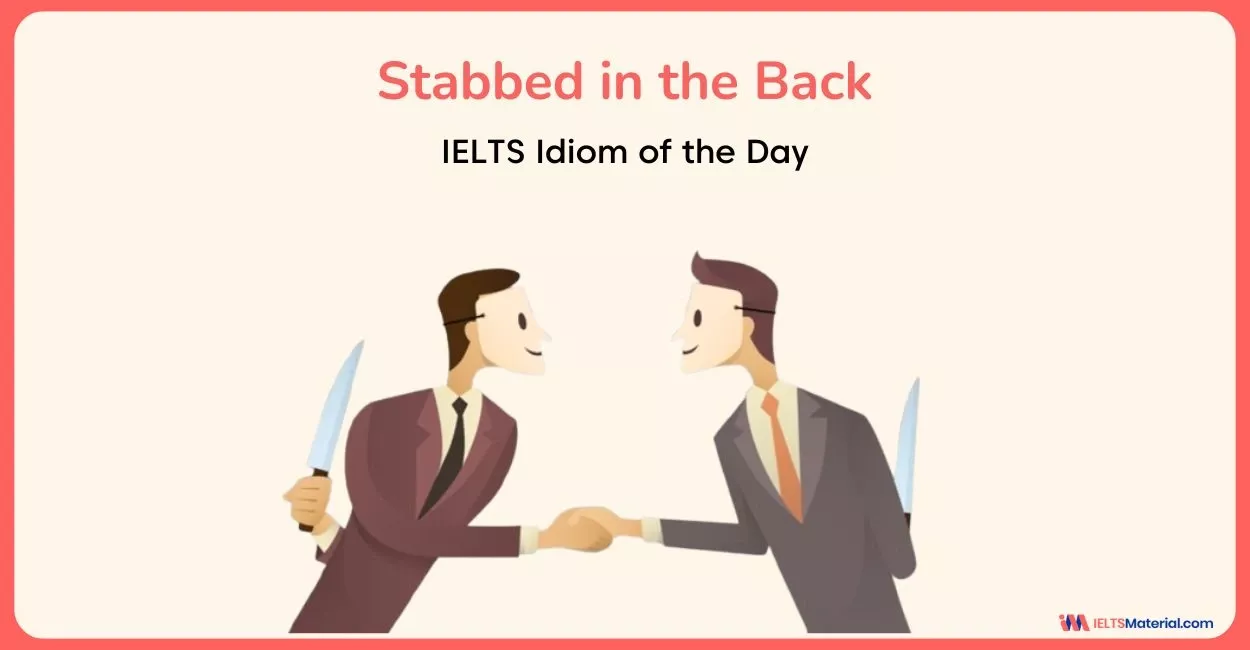
- Stabbed in the Back Idiom: Meaning, Origin, Usage & Exercises
- A Leopard Cannot Change His Spots – Idiom of the Day for IELTS
- Practical Tips on How to Improve Vocabulary for the IELTS Exam
Explore IELTS Resources

Start Preparing for IELTS: Get Your 10-Day Study Plan Today!

Check out other Idioms
Haniya Yashfeen


Recent Articles
Kasturika Samanta
Prity Mallick

Nehasri Ravishenbagam


Post your Comments