Stabbed in the Back Idiom: Meaning, Origin, Usage & Exercises
The idiom ‘stabbed in the back’ means ‘to betray a friend, or trusted person by acting disloyally’. Explore its usage & origin in this blog, with a synonym list and vocabulary-building tasks designed to help you use it effectively for a higher band score.
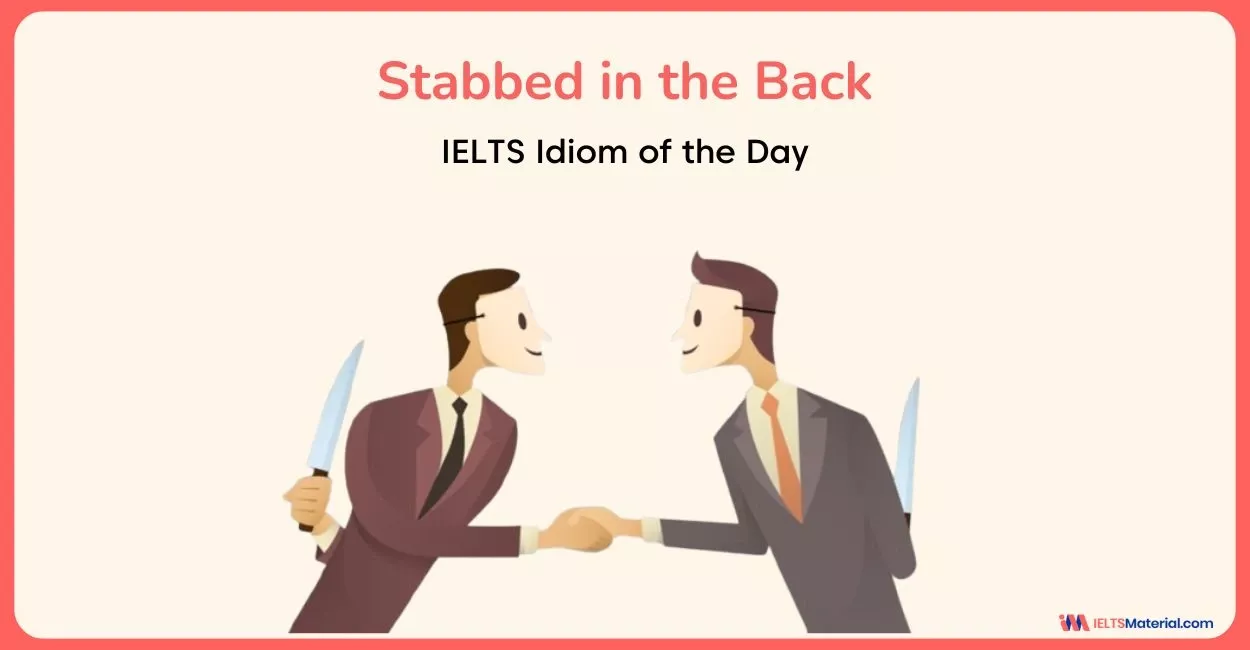
Table of Contents


Limited-Time Offer : Access a FREE 10-Day IELTS Study Plan!
Few idioms capture betrayal and emotional shock as vividly as ‘stabbed in the back’. It is one of the common idioms to boost your IELTS score – topic: deception that immediately suggests trust being broken in a sudden, painful way, often by someone unexpected.
In this blog, we will explore the meaning, origin, and usage of the idiom ‘stabbed in the back’ and provide examples from IELTS.
Stabbed in the Back Idiom: Meaning
The idiom ‘to be stabbed in the back’ means to be betrayed, deceived, or harmed by someone you trusted, especially when the act is secretive or unexpected.
Unlike open conflict, this idiom highlights hidden disloyalty. The betrayal usually comes from a friend, colleague, or ally, which makes the emotional impact stronger. The focus is not just on harm, but on the violation of trust.
Origin of Stabbed in the Back Idiom
The term ‘stabbed in the back’ originated in Germany just after World War I. The first reported use of it can be found in a report from England printed in ‘Neue Zürcher Zeitung’ on 1 December 1918.“As far as the German army is concerned, the general view is summarised in these words: It was a stab-in-the-back by the civilian population.”
The German army felt that they were betrayed by the politicians who signed the Treaty of Versailles. It was evident by this point that they were no match for the other side, and defeat was inevitable. However, the army did not believe this and constantly blamed the Jewish politicians for their loss. The story was perpetuated by Adolf Hitler when he was rising to power. He used this “stabbed in the back” story to gain followers. Even though an inquiry proved that the story was not true, it became a part of German history.
Stabbed in the Back Idiom Usage
Let us go through some examples to learn the appropriate usage of the idiom ‘stabbed in the back’. However, it is important to note that this idiom is emotionally strong, so it is best used sparingly and accurately, especially in formal writing.
- I did everything possible, but she left me because of that guy, who stabbed me in the back.
- Changing the presentation and removing my name was a real stab in the back.
- I believed that she was my only true friend. I can’t believe that she stabbed me in the back.
- You need to watch out for the new boss. I heard that he will stab you in the back without a second thought.
- She felt stabbed in the back when her colleague took credit for her work.
- He was stabbed in the back by a close friend during the election campaign.
- Discovering the leaked messages made him realise he had been stabbed in the back.
Book IELTS online classes if you’re looking for expert guidance on vocabulary building for IELTS!
Stabbed in the Back Idiom: Synonyms and Related Phrases
Given below are some phrases and common English words used in IELTS Speaking test related to the idiom, stabbed in the back.
|
Idiom/Expression |
Meaning |
Example Sentence |
|---|---|---|
|
Betray someone |
to be disloyal or dishonest |
He betrayed his partner for personal gain. |
|
Double-cross |
to deceive someone who trusts you |
She was double-crossed during the deal. |
|
Sell someone out |
to sacrifice loyalty for advantage |
He sold out his teammates to save himself. |
|
Backstab |
to harm someone secretly |
Office gossip often leads to backstabbing. |
|
Break someone’s trust |
to violate confidence |
Lying once can break someone’s trust forever. |
Boost your IELTS vocabulary and achieve success with our free online webinars.
Stabbed in the Back Idiom: Detailed Usage in IELTS Contexts
In everyday English as well as in IELTS Speaking, this idiom ‘stabbed in the back’ is extremely useful when discussing relationships, workplace politics, friendships, leadership, and ethics. Here are some sample responses to demonstrate how to employ the idiom for a more impressive answer.
IELTS Speaking Part 2
- Cue Card: Describe a time when you were disappointed by someone you trusted.
- Answer Excerpt: “I once felt stabbed in the back when a close friend revealed my personal plans to others. It was unexpected and deeply upsetting because I trusted that person completely.”
IELTS Speaking Part 3
- Question: Why do you think betrayals damage relationships so deeply?
- Sample Answer: “In my opinion, betrayals feel like being stabbed in the back because they destroy trust, which is the foundation of any strong relationship. Once trust is broken, rebuilding it becomes extremely difficult.”
Book a FREE demo to talk to our experts and boost your IELTS vocabulary now!
Stabbed in the Back Idiom: Practice Exercises
The exercises given below will help you better comprehend and use the idiom ‘stabbed in the back’, enabling appropriate usage in a variety of situations.
Exercise A: Rewrite each sentence using ‘stabbed in the back’ without changing the original meaning.
1 He was betrayed by his closest colleague during the project.
2 She trusted her friend, but he secretly worked against her.
3 The employee felt deeply hurt when his team turned against him.
4 Discovering the truth made her realize the betrayal she had faced.
Exercise B: Choose the possible synonyms for ‘stabbed in the back’ from the box below.
|
Double-cross |
Constancy |
Faithfulness |
Fidelity |
Turn traitor |
|
Backstab |
Loyalty |
Sell down the river |
Betray |
Trustworthy |
Stabbed in the Back Idiom: Answer Key for Practice Exercises
|
Exercise A |
Exercise B |
|---|---|
|
1 He was stabbed in the back by his closest colleague during the project. 2 She felt stabbed in the back when her friend secretly worked against her. 3 The employee felt stabbed in the back when his team turned against him. 4 Discovering the truth made her realize she had been stabbed in the back. |
|
To conclude, the idiom ‘stabbed in the back’ works best in Speaking Part 2 (personal experiences, relationships, workplace conflict) and Speaking Part 3 (trust, leadership, teamwork, ethics). However, avoid using it in the formal IELTS Writing Task 2 task, unless the tone is deliberately narrative or semi-formal. Remember, when used thoughtfully, it will allow you to express complex human experiences with clarity, impact, and linguistic confidence.
Useful Links:
- Pull the Wool Over Someone’s Eyes - Idiom of the Day for IELTS Speaking & Writing
- Accidentally on Purpose – Idiom of the Day for IELTS Speaking
- Wag the Dog Idiom: Meaning, Origin, Usage & Exercises
- A Little Bird Told Me Idiom: Meaning, Origin, Usage & Exercises
- 35 Useful Phrasal Verbs for IELTS Speaking (with Meaning & Examples)
- 'An Act of' Collocation for IELTS: A List to Boost Your Score
- Useful Resources & Websites for IELTS Vocabulary
Explore IELTS Resources

Start Preparing for IELTS: Get Your 10-Day Study Plan Today!

Check out other Idioms
Haniya Yashfeen
Haniya Yashfeen


Recent Articles
Kasturika Samanta

Prity Mallick

Nehasri Ravishenbagam


Post your Comments