Abhorrence – Word of the Day for IELTS Speaking & Writing
3 min read
Updated On
-
Copy link
Learn the meaning, usage, collocations, and IELTS examples of the formal noun “abhorrence.” Discover how to express deep moral disgust and strong disapproval in IELTS Speaking and Writing to enhance your lexical resource and boost your overall band score.
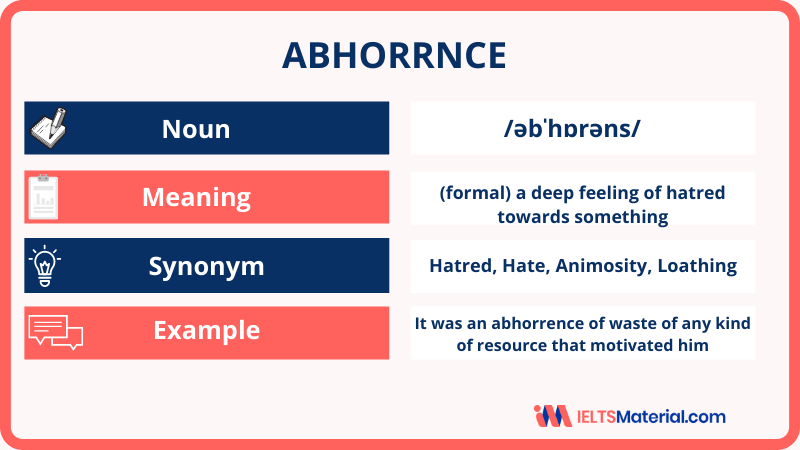
Table of Contents


Limited-Time Offer : Access a FREE 10-Day IELTS Study Plan!
Developing strong, precise vocabulary is essential for achieving a higher band score in the IELTS test, especially in Writing Task 2 and Speaking Part 3. Today’s word, “abhorrence,” is a powerful formal noun that helps you express deep disgust, hatred, or moral rejection. It is particularly effective when writing about ethical concerns, criminal behaviour, social injustice, or environmental issues. Using such high-level emotional-intensity vocabulary shows examiners your ability to discuss complex ideas using precise academic language.
Meaning of “Abhorrence”
Noun: A strong, intense feeling of hatred or disgust toward something.
“Abhorrence” expresses a deeper level of moral and emotional rejection than simple words like “hate.” It is a formal, academic term suitable for essays and discussions requiring serious tone and persuasive argumentation.
Origin of the Word
The word originates from the Latin abhorrēre, meaning “to shrink back from” or “to recoil.” Historically, it has been used in moral, religious, and legal contexts to show strong condemnation. Its formal tone makes it suitable for IELTS Writing Task 2 where academic vocabulary is expected.
Master high-band IELTS vocabulary for the IELTS exam, Book a Free Demo Class today!
How to Use “Abhorrence” in IELTS Speaking & Writing?
“Abhorrence” is extremely useful in essays that involve:
- Crime and punishment
- Environmental issues
- Social values and ethics
- Equality, discrimination, or injustice
- Violence or harmful cultural practices
- Political misconduct
- Human rights concerns
Using this word adds emotional precision, strengthens your argument, and elevates the register of your writing. In Speaking Part 3, it helps you respond to analytical questions in a more sophisticated way.
Examples of “Abhorrence” in Context
IELTS Speaking:
- “Many young people today express strong abhorrence towards animal cruelty.”
- “I feel deep abhorrence for corruption because it affects the entire society.”
- “The public often shows abhorrence at leaders who misuse their power.”
IELTS Writing:
- “There is widespread abhorrence of violent crimes, which has encouraged policymakers to introduce tougher laws.”
- “Environmentalists have long shown abhorrence for industries that exploit natural resources irresponsibly.”
- “Public abhorrence of unethical corporate behaviour has pushed companies to adopt transparent practices.”
Collocations with “Abhorrence”
- Feel abhorrence
- Express abhorrence
- Show abhorrence
- Deep/strong/utter abhorrence
- Abhorrence toward/of
These collocations can be used effectively in essays to portray strong emotional positions.
Grab the newly launched Vocabulary for IELTS to level up your preparation.
Synonyms
- Loathing, Hatred, Disgust, Detestation, Animosity
Antonyms
- Approval, Acceptance, Fondness, Admiration
IELTS Writing Task 2 Sample Sentence
“Growing public abhorrence of violent offences has pressured governments worldwide to reconsider the seriousness of their legal penalties.”
Sample IELTS Task 2 Paragraph Using “Abhorrence”
“There is a growing abhorrence among citizens toward repeated incidents of violent crime. This collective disapproval forces policymakers to evaluate whether stricter punishments, including capital punishment, are necessary to maintain long-term public safety. Without firm legal consequences, such crimes may escalate, reducing trust in the justice system.”
Grab the newly launched Vocabulary for IELTS to level up your preparation.
Practical Exercise
Complete the sentences with “abhorrence” or one of its synonyms:
- Citizens expressed strong __________ toward the recent acts of political corruption.
- Environmental groups show deep __________ for companies that pollute water bodies.
- The community reacted with universal __________ to the unethical practices revealed in the report.
- Many individuals feel utter __________ toward cruelty inflicted on innocent animals.
- His behaviour was met with public __________, leading to calls for reform.
Answer Key: abhorrence; abhorrence/disgust; detestation/abhorrence; abhorrence; hatred/abhorrence
IELTS Tip
Use “abhorrence” when you want to show strong moral or emotional disagreement with something. It is especially helpful for analytical essays in which you must discuss societal values or ethical dilemmas. Replacing simple words like “hate” or “dislike” with “abhorrence” demonstrates a higher lexical range, which is essential for Band 7 and above.
Visit IELTS eBooks store for top-rated books & elevate your IELTS preparation!
Using formal emotional vocabulary like “abhorrence” can significantly elevate your IELTS Speaking and Writing performance. It allows you to express strong opinions clearly, academically, and persuasively. Whether discussing social issues, ethical concerns, or criminal behaviour, incorporating precise vocabulary such as “abhorrence” shows examiners that you can handle complex topics with maturity and linguistic sophistication. Consistent practice with such words will strengthen your lexical resource and bring you closer to your target band score.
Also Check:
Explore IELTS Resources

Start Preparing for IELTS: Get Your 10-Day Study Plan Today!

Recent Articles
Kasturika Samanta
Kasturika Samanta
Kasturika Samanta


Post your Comments