Malicious - Word of the Day For IELTS Writing and Speaking
3 min read
Updated On
-
Copy link
Want to make your vocabulary stand out in your IELTS test? Learn what ‘malicious’ means, explore its origin and synonyms, and try fun practice exercises to master this powerful IELTS word of the day!
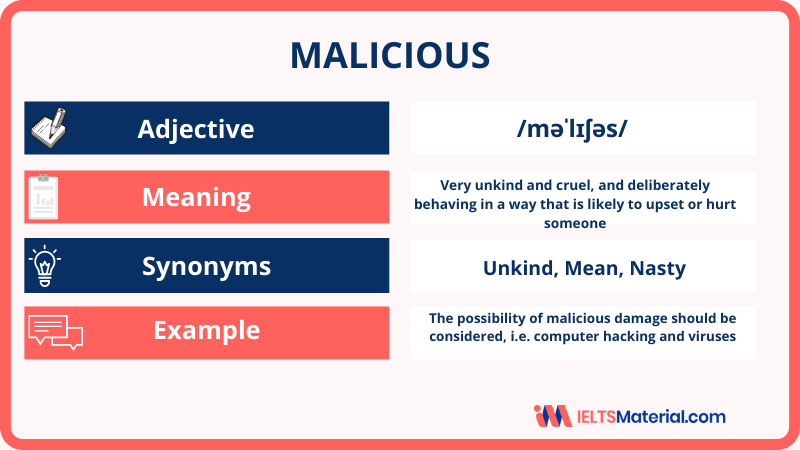
Table of Contents
- Meaning of “Malicious”
- Origin of the Word “Malicious”
- Using the Word “Malicious” in the IELTS Writing Task 2
- Using the Word “Malicious” in the IELTS Speaking
- Common Collocations with “Malicious”
- Sample Sentences
- Synonyms of the Word “Malicious”
- Antonyms of the Word “Malicious”
- Practice Exercise - Malicious
- Answer Key - Malicious


Limited-Time Offer : Access a FREE 10-Day IELTS Study Plan!
Words like ‘malicious’ are used in the IELTS exam to add variety and depth to answers and showcase lexical resources, which account for 25% of the total IELTS band score.
This word describes actions or intentions that are particularly harmful, violent, cruel, or meant to cause damage. ‘Malicious’ is useful in IELTS because many of the IELTS topics involve technology issues, crime, social media, and human behaviour.
Hence, this blog gives you the meaning, origin, sample sentences, practice exercises and much more related to this word, ‘malicious.’ Let us begin learning all about it now!
Meaning of “Malicious”
The word Malicious (adjective) means to have the intention or desire to harm someone. This is done with cruelty or ill will.
For Example:
- “The report confirmed that the cyberattack was a malicious attempt to steal personal data from people.”
- “Spreading false rumours about someone is a malicious act that can severely damage the concerned person’s reputation.”
This word is strong and formal, and makes it suitable for essays and discussions on crime, online safety, ethics, or violent behaviour.
Origin of the Word “Malicious”
The word “malicious” comes from the Latin root “malitia,” meaning “bad,” “ill will,” or “wickedness.” It later entered the Old French language as “malicios” before becoming “malicious” in Middle English.
Since its origin, this word has consistently described a harmful intent, cruelty, or behaviour meant to cause harm. Now, it remains as a widely used word in legal, technological, and everyday social contexts.
Using the Word “Malicious” in the IELTS Writing Task 2
In the IELTS Writing Task 2, “malicious” is extremely useful when you write essays about crime, cyber security, personal behaviour, ethics, social issues, or media problems. This adds strength and clarity to your arguments as you present your essay.
For example:
- “Governments must invest in a stronger cybersecurity system in order to protect citizens from malicious online activities.”
- “Malicious behaviour among youngsters often stems from a lack of proper emotional guidance from their elders.”
- “These days, the spread of malicious rumours on social media does have a long-term psychological effect.”
Using the word “malicious” appropriately shows your ability to use advanced vocabulary to clearly explain complex ideas, which is a key requirement for a Band 8 or higher.
Book a FREE trial to learn the tricks to maximise your word power for the IELTS exam!
Using the Word “Malicious” in the IELTS Speaking
You may use “malicious” naturally and fluently in the IELTS Speaking test, especially in Parts 2 and 3, where discussions become more logical and analytical. This shows you can organise ideas about harmful behaviour and intentions with clarity and precision.
Common Collocations with “Malicious”
- malicious intent
- malicious attack
- malicious rumour
- malicious behaviour
- malicious comment
- malicious software
- malicious act
- malicious malware
- malicious threat
Sample Sentences
- The investigation revealed an email that contained malicious software designed to steal financial information.
- Malicious comments on social media can majorly damage a person’s self-confidence.
- Our company took a legal action against the employee for her malicious attempt to leak confidential data.
Synonyms of the Word “Malicious”
- cruel
- spiteful
- hostile
- harmful
- wicked
- vindictive
- ill-intentioned
Antonyms of the Word “Malicious”
- kind
- harmless
- friendly
- benevolent
- forgiving
- good-natured
- well-intentioned
Practice Exercise - Malicious
Match the word below to complete these sentences.
(heartfelt, jubilant, cagey, heatproof, heinous, malicious)
- He gets very ……………… whenever I ask him about his job.
- People are still …………………………….. because they are miserable.
- She expressed her …………….. thanks to all those who had helped and supported her.
- Place in a …………….. dish and sprinkle the grated cheese over the top.
- The fans were in …………………. mood after the victory
- For agents, the new concern is that the ………………. activity may be directed at them
Answer Key - Malicious
- cagey
- malicious
- heartfelt
- heatproof
- jubilant
- heinous
Book a FREE Demo to talk to our experts and boost your IELTS vocabulary now!
When you incorporate words like ‘malicious’ into your vocabulary, you will be able to show the examiner your versatile nature in using words flexibly. Hence, by utilising ‘malicious’ appropriately in specific contexts, you can improve your communication skills and make your expressions more vivid and impactful, potentially increasing your IELTS band score!
Also Check:
Explore IELTS Resources

Start Preparing for IELTS: Get Your 10-Day Study Plan Today!

Recent Articles
Kasturika Samanta
Kasturika Samanta
Kasturika Samanta


Post your Comments