Cajole - Word of the Day for IELTS Speaking and Writing
The word ‘cajole’ means ‘to persuade gently through flattery, charm, or coaxing’. Discover its history, usage, meanings, synonyms, & antonyms, and engage in practical exercises using the word to help you grasp its context and application more effectively.
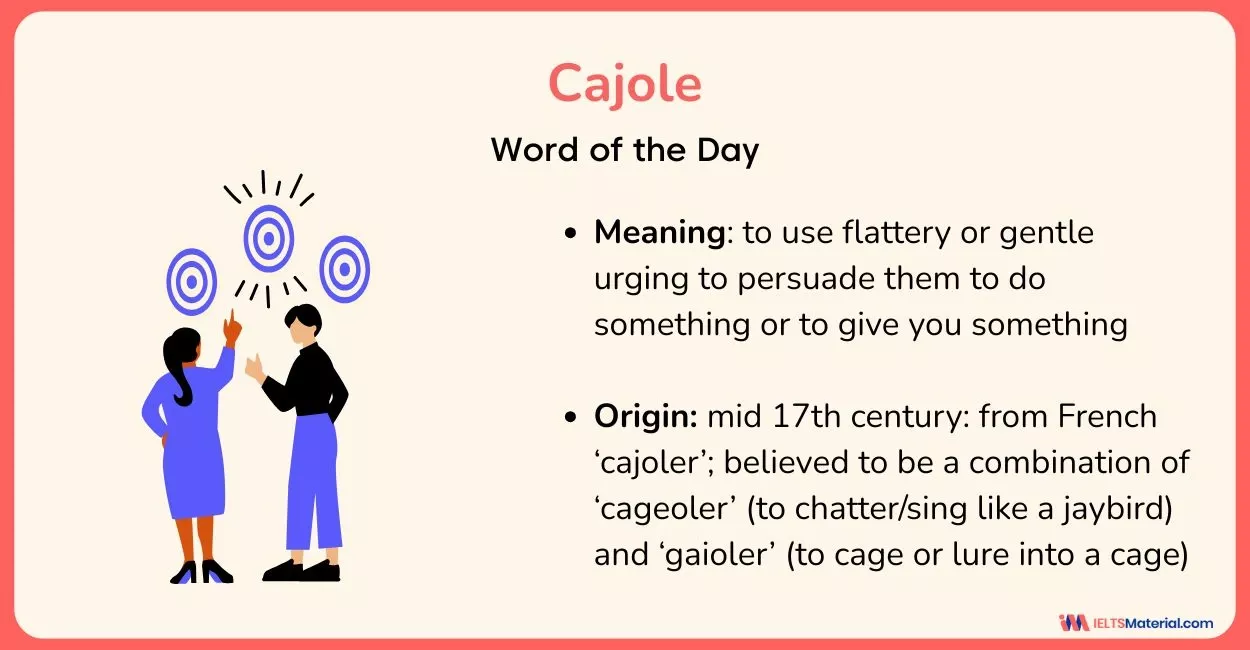
Table of Contents


Limited-Time Offer : Access a FREE 10-Day IELTS Study Plan!
Some situations require forceful arguments, while others demand subtle persuasion, and the word ‘cajole’ perfectly captures the latter. This word describes the skill of influencing someone through friendliness, encouragement, or gentle pressure rather than authority.
In this blog, we will examine the meaning, origin, history, synonyms, and antonyms of the word 'cajole,' as well as its proper usage within the context of the IELTS exam. We will solidify our understanding through practical exercises.
Meaning of Cajole
- Pronunciation: /kə-ˈjōl/ (sounds like kuh-JOHL)
The meaning of the word ‘cajole’ is ‘to persuade someone to do something by talking to them in a friendly way’. It usually implies persuasion that is friendly or persistent rather than aggressive.
It often carries a slightly informal or conversational tone, though it remains suitable for IELTS contexts.
History and Origin of Cajole
‘Cajole’ comes from the French word “cajoler,” meaning ‘to flatter or soothe’. It entered English in the early 17th century and was often associated with coaxing someone through charm or reassurance.
Over time, it retained its sense of gentle manipulation rather than forceful persuasion. Knowing the origin of the word helps learners understand why the word implies warmth rather than pressure.
Usage & Examples of Cajole
Let's explore a variety of example sentences that effectively demonstrate the use of the verb 'cajole.'
- She cajoled me into doing my laundry today.
- Rohit really knows how to cajole people into listening to him.
- The anglers staying in had to cajole the outsiders into staying away from the riverside.
- Every time, my brother cajoles the waiter into giving us some extra food.
- As Rohan was tired, he gently cajoled Roy to make the supper.
- She managed to cajole her younger brother into completing his homework on time.
- Parents often cajole children into developing healthy habits.
- Employers may cajole staff rather than issue strict orders.
- Advertisements attempt to cajole consumers into buying products.
- Diplomats sometimes cajole rival nations instead of confronting them directly.
Using ‘Cajole’ as Different Parts of Speech
Although 'cajole' is a verb, it can also function as a noun and an adjective. Below are some sentences using the word in its different forms.
|
Word Form |
Example Sentences |
|---|---|
|
Noun (Cajoler/ Cajolement) |
|
|
Adjective (Cajoling/ Cajolingly) |
|
Book a FREE IELTS online class to learn how to maximize your word power for IELTS!
IELTS Usage of ‘Cajole’
In IELTS, ‘cajole’ is particularly valuable because it allows you to discuss human behaviour, communication, and relationships with nuance and precision. So, let us go through some IELTS Writing and Speaking answers to help you understand how to use the word appropriately.
IELTS Writing Task 2
- Question: Some people believe that governments should encourage healthy lifestyles rather than enforce strict rules. Do you agree or disagree?
- Answer Excerpt: Governments should focus on cajoling citizens into adopting healthy lifestyles rather than imposing strict regulations. Friendly campaigns and educational programs can influence behaviour without creating resistance.
IELTS Speaking Part 2
- Cue Card Topic: Describe a time when you persuaded someone to do something.
- Answer Excerpt: “I once had to cajole my friend into attending a professional workshop with me. He was reluctant at first, but I explained the long-term benefits in a friendly and encouraging way. Eventually, he agreed and found the experience very useful.”
Book a FREE demo to talk to our experts and boost your IELTS vocabulary now!
Synonyms and Antonyms of Cajole
You will find some close synonyms and antonyms for IELTS Writing and Speaking of the word ‘cajole’, each explained with a sample sentence, in the table below.
|
Word Type |
Word |
Meaning |
Example Sentence |
|---|---|---|---|
|
Synonym |
Coax |
to persuade someone gradually or gently. |
The teacher coaxed the shy student into participating in class. |
|
Persuade |
to make someone do or believe something. |
He persuaded his parents to let him study abroad. |
|
|
Entice |
to attract someone by offering pleasure or advantage. |
The discount was used to entice customers into the store. |
|
|
Wheedle |
to influence by soft words or flattery. |
She wheedled extra time to submit her assignment. |
|
|
Antonym |
Compel |
to force someone to do something. |
Employees were compelled to follow the new rules. |
|
Demand |
to ask for something forcefully. |
The manager demanded an immediate explanation. |
|
|
Coerce |
to persuade using force or threats. |
People should not be coerced into making decisions. |
Participate in FREE online webinars to improve your IELTS vocabulary for success!
Exercise to Master the Meaning of Cajole
Now that you have explored the meaning, origin, synonyms, and antonyms of the word ‘cajole,’ it is time to complete the following exercise to strengthen your understanding of the word.
Exercise: Choose the correct option.
1 Identify the sentence where ‘cajole’ is used incorrectly.
A She cajoled him into revealing the secret with gentle humor.
B The government cajoled citizens through mandatory fines.
C He tried to cajole his colleague with repeated assurances.
D The host cajoled the guests into staying longer.
2 Why might a speaker deliberately choose ‘cajole’ instead of ‘persuade’?
A To imply authority
B To indicate legal pressure
C To show urgency
D To suggest manipulation or charm
3 Which phrase forms the most natural collocation with ‘cajole’?
A cajole with flattery
B cajole by decree
C cajole under oath
D cajole by enforcement
4 What does the use of ‘cajole’ most strongly imply about the person being persuaded?
A They are legally obligated to comply
B They were already eager to agree
C They were initially hesitant or resistant
D They were unaware of the request
5 In which context would ‘cajole’ be least appropriate?
A A parent convincing a child to eat vegetables
B A diplomat easing tensions during negotiations
C A police officer issuing a legal warning
D A manager softly encouraging overtime
Answer Key
|
1 |
2 |
3 |
4 |
5 |
|
B |
D |
A |
C |
C |
To conclude, by understanding the meaning, origin, collocations, and exam-specific applications of ‘cajole’, you can express complex social interactions more naturally. Moreover, when used correctly, it enhances both clarity and sophistication, key qualities for achieving a higher IELTS band score.
Useful Links:
Explore IELTS Resources

Start Preparing for IELTS: Get Your 10-Day Study Plan Today!

Check out other Word of the Day Articles
Kasturika Samanta
Nehasri Ravishenbagam
Kasturika Samanta
Haniya Yashfeen

Recent Articles
Kasturika Samanta
Kasturika Samanta
Kasturika Samanta


Post your Comments