Clandestine: Word Meaning, Examples, Origin & Usage in IELTS
The word ‘clandestine’ means ‘done secretly or kept secret'. Explore the word's usage, history, synonyms, and antonyms, followed by practice exercises in this blog that will help you improve your overall vocabulary to achieve a band score of 8 and above.
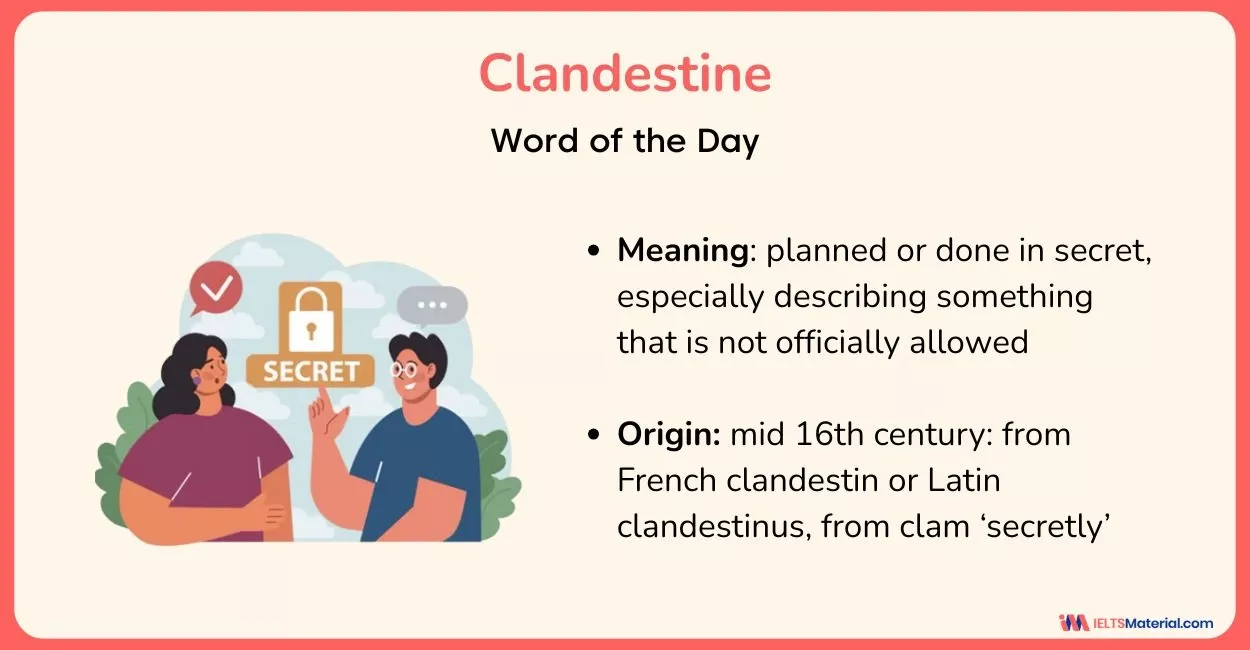
Table of Contents


Limited-Time Offer : Access a FREE 10-Day IELTS Study Plan!
Some words immediately suggest mystery, secrecy, and concealed intentions. The word of the day, ‘clandestine’, is a powerful and common English word used in IELTS Speaking Test, and used to describe actions carried out quietly to avoid detection.
As a result, this blog post will examine the definition, history, and proper usage of the word ‘clandestine’, particularly in relation to the IELTS exam. It will conclude by providing a number of useful exercises to help you better understand the concept.
Meaning of Clandestine
- Pronunciation: /klænˈdɛstɪn/ (sounds like klan·deh·stn)
While the Oxford Dictionary states that ‘clandestine’ means ‘done secretly, especially when illegal or not allowed’, the Cambridge Dictionary refers to it as ‘planned or done in secret, often to avoid being noticed’.
The word often carries a serious or dramatic tone and is commonly found in formal or academic contexts.
History and Origin of ‘Clandestine’
The word ‘clandestine’ originated from the Latin word ‘Clandestinus,’ which comes from the word ‘Clam’ meaning ‘secretly.’ Clandestine is used or applied to actions that involve maintaining secrecy for an illicit purpose.
Over time, it became associated with covert operations, secret meetings, and hidden relationships.
Usage & Examples of Clandestine
Given below are some examples of how the word ‘clandestine’ can be used in a sentence.
- She was offered a hefty sum of money as the job seemed to be clandestine in nature.
- The gang met at a secluded and clandestine spot to plan the robbery.
- Many people live in a clandestine manner across the borders without any national documents.
- Raj went on a clandestine trip to do things that he was not allowed to do.
- The teacher warned the students that their clandestine actions would land them in trouble.
- The group organised a clandestine meeting to avoid attention.
- Clandestine activities often undermine public trust in institutions.
- The novel describes a clandestine relationship during wartime.
- Governments sometimes carry out clandestine operations for national security.
Using ‘Clandestine’ as Different Parts of Speech
Despite being an adjective, ‘clandestine’ can also be a noun or an adverb. Here are a few sentences that use the word in various ways.
|
Word Form |
Example Sentences |
|---|---|
|
Noun (Clandestineness/ Clandestinity) |
|
|
Adverb (Clandestinely) |
|
Book free IELTS online classes to maximize your vocabulary for the IELTS exam!
IELTS Usage of ‘Clandestine’
In IELTS, the word ‘clandestine’ is especially useful when discussing politics, crime, relationships, or social behaviour where secrecy plays a role. Using this word appropriately demonstrates strong lexical resource and topic awareness. When used naturally, ‘clandestine’ can significantly enhance IELTS Writing and Speaking responses, especially at Band 7 and above.
IELTS Speaking Part 2
- Cue Card: Describe a situation when people had to act secretly.
- Answer Excerpt: “I would like to describe a clandestine project organised by students at my university. We were raising funds for a cause that had not yet received official approval. Because of this, we worked quietly and communicated carefully.”
IELTS Writing Task 2
- Topic: Some people believe governments should allow secret operations for national safety, while others think all actions should be transparent. Discuss both views and give your opinion.
- Answer Excerpt: Supporters argue that clandestine operations are sometimes necessary to protect national security. Without secrecy, sensitive information could fall into the wrong hands.
Book a FREE demo to talk to our experts and boost your IELTS vocabulary now!
Synonyms and Antonyms of Clandestine
The table below lists close synonyms and antonyms for the IELTS Writing and Speaking word ‘clandestine’, with sample sentences.
|
Type of Word |
Word |
Meaning |
Example Sentence |
|---|---|---|---|
|
Synonyms |
Secret |
Kept hidden from others |
They held a secret discussion after the meeting. |
|
Covert |
hidden or secret |
The journalist uncovered a covert operation. |
|
|
Surreptitious |
done secretly and dishonestly |
He took a surreptitious glance at his phone. |
|
|
Undercover |
done while pretending to be someone else |
The officer worked undercover to gather evidence. |
|
|
Antonyms |
Open |
not hidden or secret |
The discussion was open to the public. |
|
Public |
known or visible to everyone |
The decision was announced in a public statement. |
|
|
Transparent |
easy to understand or see through |
Transparent policies increase public trust. |
Join us in our free webinars to learn tricks to improve IELTS vocabulary! Join Now!
Exercise to Master the Meaning of ‘Clandestine’
Now, let us complete the exercise that has been designed to strengthen your understanding of the meaning of the word ‘clandestine.’
Exercise A: Choose the correct option.
1 Which factor is essential for an activity to be described as ‘clandestine’?
A It is illegal
B It occurs at night
C It is deliberately concealed
D It involves multiple participants
2 Which sentence uses ‘clandestine’ incorrectly?
A The journalist uncovered a clandestine funding network.
B They held a clandestine meeting away from public scrutiny.
C The festival became clandestine after attracting large crowds.
D The group maintained clandestine communication channels.
3 Which situation would be least appropriate to describe as ‘clandestine’?
A Secret talks between rival governments
B A hidden research lab operating without approval
C A surprise birthday party planned by friends
D An underground resistance movement
4 Why might a historian choose ‘clandestine’ instead of ‘secret’?
A To simplify language
B To imply deliberate, sustained concealment
C To suggest something fictional
D To avoid political implications
5 Which noun forms the strongest academic collocation with ‘clandestine’?
A surveillance
B routine
C laughter
D sandwich
Answer Keys
|
1 |
2 |
3 |
4 |
5 |
|
C |
C |
C |
B |
A |
To conclude, IELTS examiners reward candidates who can express complex ideas clearly and accurately. The word ‘clandestine’ allows learners to discuss secrecy without relying on long explanations. So, add it to your IELTS Vocabulary words list for Band 8 or 9 and make sure to use it in appropriate contexts for a high-scoring response in IELTS.
Useful Links:
- Conspicuous: Word Meaning, Examples, Origin & Usage in IELTS
- Protectorate: Word Meaning, Examples, Origin & Usage in IELTS
- Wingspan: Word Meaning, Examples, Origin & Usage in IELTS
- Ambivalent - Word of the Day for IELTS Speaking and Writing
- IELTS Band 9 Vocab Secrets Cambridge (Ebook)
- Mind Maps to Improve Your IELTS Vocabulary
Explore IELTS Resources

Start Preparing for IELTS: Get Your 10-Day Study Plan Today!

Check out other Word of the Day Articles
Kasturika Samanta

Nehasri Ravishenbagam
Kasturika Samanta
Haniya Yashfeen

Recent Articles
Kasturika Samanta
Kasturika Samanta
Kasturika Samanta


Post your Comments