Word of the day - Croon
4 min read
Updated On
-
Copy link
Explore the IELTS Word of the Day “Croon,” including its meaning, history, and practical examples as a noun and verb. This vocabulary guide helps IELTS learners improve their lexical resource and use expressive words in Speaking and Writing tasks.
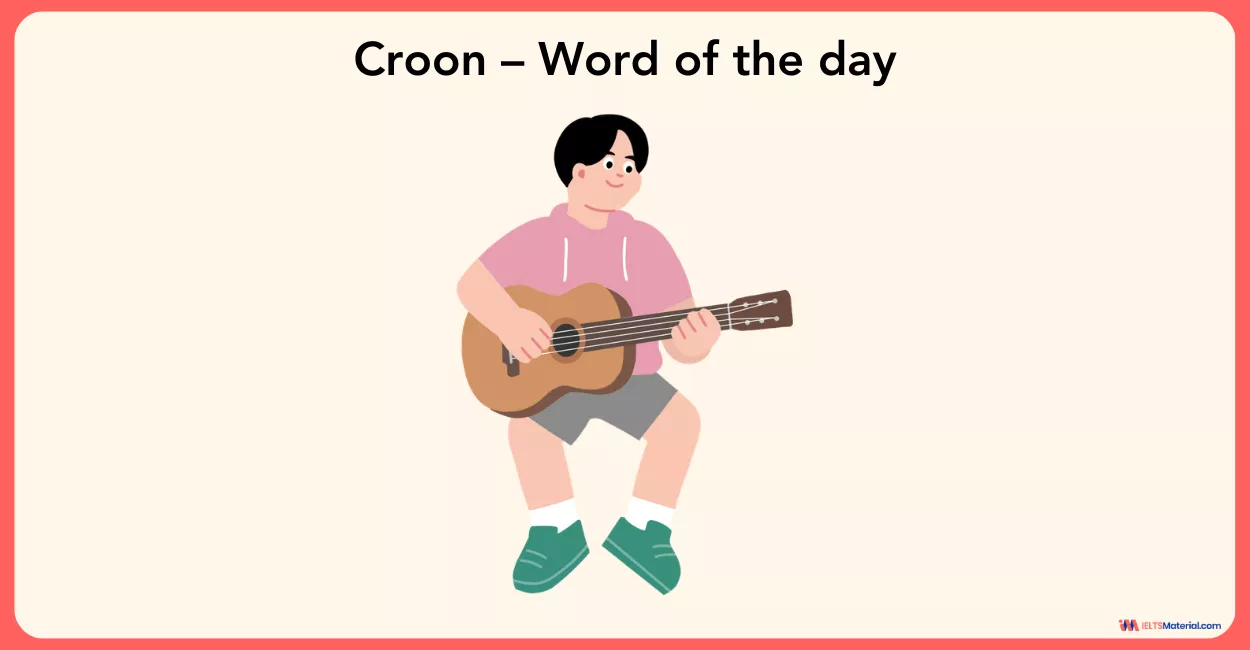
Table of Contents


Limited-Time Offer : Access a FREE 10-Day IELTS Study Plan!
Building a strong vocabulary is an essential part of achieving a high band score in the IELTS exam. Whether you are preparing for IELTS Speaking, Writing, Reading, or Listening, learning new words and understanding how to use them naturally can significantly improve your language skills. One useful and expressive word to learn today is “croon.” This word is often used in literature, music, and everyday conversations to describe a soft and gentle voice, especially when someone is singing or humming.
Understanding words like croon helps IELTS candidates describe sounds, emotions, and situations more vividly in Speaking Part 2 cue cards or Writing Task 2 essays. Let us explore the meaning, history, and usage of this word in detail.
Meaning
Croon can function as both a noun and a verb, and it usually relates to a soft, gentle sound.
As a Noun: A croon refers to a soft, low, and gentle voice or tone. It is often associated with quiet singing, humming, or soothing sounds that create a calm atmosphere.
As a Verb: To croon means to hum or sing in a soft and sentimental voice. People often croon when they are expressing affection, sadness, nostalgia, or comfort.
In simple terms, crooning usually involves a quiet and emotional style of singing or speaking, rather than a loud or powerful voice.
Want to boost your IELTS score? Enroll in our expert-led IELTS online classes today!
History and Origin
The origin of the word croon has been widely debated by language historians. Many believe that the term has roots in both Dutch and Irish linguistic traditions.
One possible origin comes from the Middle Dutch word “kronen,” which meant to groan or lament. This suggests that the word was originally associated with soft expressions of sorrow or emotional sound.
Another theory traces the word to the Old Irish term “crónán,” which referred to a low humming or murmuring sound. Over time, the meaning gradually evolved in the English language to describe soft singing or humming in a sentimental manner.
Usage in Sentences
To use the word croon effectively in English, it is important to see how it works in different sentence structures. Below are examples of how the word can be used as a verb, adjective-style description, and noun.
Verb Examples – Croon
When used as a verb, croon describes the action of singing or humming softly.
- The cat was crooning like a newborn baby, producing a gentle and comforting sound.
- She was crooning softly near the body of her husband, expressing her grief through quiet murmurs.
- Lisa was heard crooning along with the singer, enjoying the melody in a calm and relaxed manner.
In these sentences, the word croon describes a soft, emotional sound produced by a person or even an animal.
Join us in our free webinars to learn tricks to improve IELTS vocabulary! Join Now!
Descriptive Examples – Crooning
Sometimes the word appears in descriptive phrases such as “crooning voice,” “crooning sound,” or “crooning breeze.” These expressions are often used in literature to create a poetic effect.
- She woke up to the sound of the crooning cuckoo early in the morning.
- She walked through the forest listening to the crooning leaves as the wind passed gently through the trees.
- She stood on the terrace enjoying the crooning breeze that brought a sense of peace and relaxation.
These sentences illustrate how the word crooning can describe soft and soothing sounds in nature.
Noun Examples – Croon
When used as a noun, croon refers to the soft voice itself.
- The singer’s voice shifted suddenly between a powerful note and a gentle croon.
- The croon of the blind woman still echoed in his ears long after she had finished singing.
- His emotional croon during the singing competition impressed the judges and even won him a prize.
Here, the word refers directly to the soft vocal sound produced by someone singing or humming.
Book free IELTS online classes to maximize your vocabulary for the IELTS exam!
Why This Word is Useful for IELTS
The word croon can be very helpful for IELTS candidates because it allows them to describe sounds and emotions more vividly. Instead of simply saying “someone sang softly,” a student can say “someone crooned softly,” which sounds more natural and expressive.
For example:
IELTS Speaking Example:
“I remember my grandmother used to croon old songs while cooking in the kitchen, and the gentle sound always made the house feel warm and peaceful.”
IELTS Writing Example:
“In many cultures, mothers often croon lullabies to their babies because the soft rhythm helps children fall asleep.”
Using such vocabulary can improve lexical resource, which is one of the key scoring criteria in IELTS.
Tips to Remember the Word
Here are a few simple tips to remember and use croon effectively:
- Associate the word with soft singing or humming.
- Think of lullabies or emotional songs when you hear the word.
- Practice using it in Speaking Part 2 descriptions or storytelling answers.
For instance, if you are describing a memorable sound, a singer, or a childhood memory, the word croon can be a very natural choice.
Book a FREE demo to talk to our experts and boost your IELTS vocabulary now!
Overall, the word croon is a beautiful and expressive term that describes soft singing or humming filled with emotion. With its interesting historical roots and poetic usage, it adds depth to both spoken and written English.
For IELTS learners, mastering words like croon can help improve descriptive ability, vocabulary range, and overall fluency. Try using this word in your daily conversations, writing practice, or speaking exercises to become more comfortable with it. Remember, building vocabulary step by step is one of the most effective ways to achieve a higher band score in IELTS.
Useful Links:
Explore IELTS Resources

Start Preparing for IELTS: Get Your 10-Day Study Plan Today!

Recent Articles
Kasturika Samanta
Kasturika Samanta
Kasturika Samanta


Post your Comments