Decathect – Word of the Day
Learn the meaning, origin, examples, and IELTS usage of “Decathect.” Master this word to boost your vocabulary, enhance descriptive language, improve precision, and increase your Lexical Resource score in Speaking and Writing.
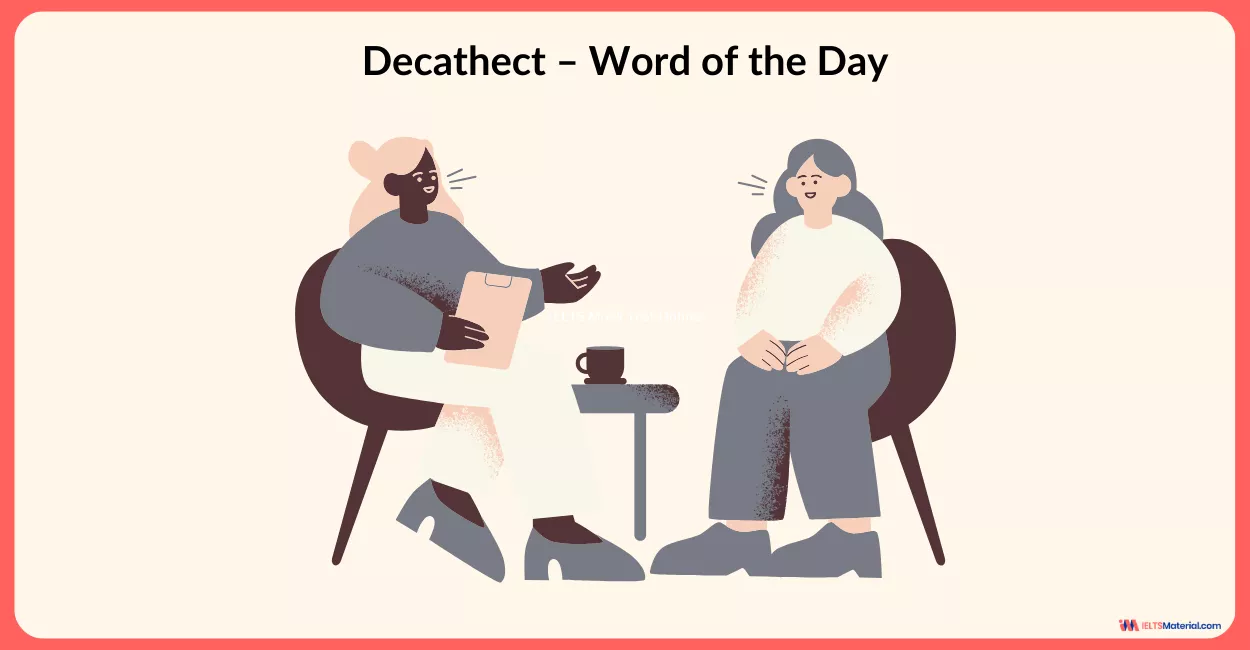
Table of Contents


Limited-Time Offer : Access a FREE 10-Day IELTS Study Plan!
Decathect (verb) means to emotionally detach oneself from a person, object, belief, or situation to which one was previously strongly attached. This emotional withdrawal often occurs as a protective response when an individual anticipates loss, pain, rejection, or disappointment. In essence, to decathect is to reduce or remove emotional investment in order to cope with an emotionally difficult reality.
People may decathect consciously or unconsciously. For instance, someone facing the imminent loss of a loved one may begin to distance themselves emotionally to lessen the intensity of future grief. Similarly, an individual in a harmful relationship might decathect to regain emotional stability and self-respect.
In everyday terms, decathecting can be understood as “letting go emotionally” before circumstances force that separation.
Want to boost your IELTS score? Enroll in our expert-led IELTS online classes today!
Origin and History
The term decathect originates from a blend of classical linguistic roots. The Latin prefix de- conveys the idea of removal, undoing, or reversal. The Greek root kathexis, derived from kathekhein meaning “to hold” or “to occupy,” refers to the mental or emotional energy invested in a person, object, or idea.
The concept gained prominence through the work of Sigmund Freud, the founder of psychoanalysis, in the early 20th century—particularly during the 1930s. Freud used the term cathexis to describe how individuals attach emotional energy to people, desires, or memories. Decathexis, or decathecting, referred to the withdrawal of this emotional energy.
Freud believed that psychological well-being often depended on how effectively individuals could reallocate emotional energy. When attachment became painful or unhealthy, decathecting allowed the mind to disengage and redirect that energy elsewhere.
Join us in our free webinars to learn tricks to improve IELTS vocabulary! Join Now!
Psychological Perspective
From a psychological standpoint, decathecting is often viewed as a coping mechanism. It commonly appears in situations involving grief, trauma, emotional exhaustion, or prolonged stress. Rather than indicating a lack of care, decathecting may signal emotional self-protection.
Common situations where people decathect include:
- Coping with terminal illness or the expected death of a loved one
- Ending a romantic relationship after repeated disappointment
- Distancing oneself from toxic friendships or family dynamics
- Preparing for major life transitions such as relocation, retirement, or job loss
However, while decathecting can be helpful, it is not always beneficial if done excessively or prematurely. Emotional withdrawal without proper processing can lead to numbness, avoidance of intimacy, or difficulty forming future attachments. For this reason, therapists often encourage individuals to recognize why they are decathecting and whether it is serving their emotional health.
Examples in Sentences
- He began to decathect from his mother emotionally as a way of preparing himself for the pain of her impending death.
- After years of emotional neglect, she realized she had slowly decathected from the relationship without even noticing.
- Leena started to decathect from her friends when she felt their constant criticism and negativity were harming her mental well-being.
- Many employees unconsciously decathect from their workplace once they sense instability or the possibility of layoffs.
- The therapist explained that decathecting too early can sometimes intensify grief rather than ease it.
Book free IELTS online classes to maximize your vocabulary for the IELTS exam!
Usage and Form
- Decathect is primarily used in psychology, counseling, academic writing, and reflective prose.
- It is uncommon in casual conversation but highly effective for describing complex emotional processes.
- The noun form decathexis refers to the act or process of emotional withdrawal.
- The adjective form decathected describes a state of emotional disengagement.
Because of its technical nature, the word often appears in discussions about emotional health, grief management, attachment theory, and trauma recovery.
Why This Word Is Important?
The value of the word decathect lies in its ability to capture a deeply human experience that is otherwise difficult to articulate. Many people experience emotional distancing without fully understanding why. Having a word for this process helps normalize it and encourages emotional awareness.
Recognizing when you are decathecting can lead to healthier coping strategies. It allows individuals to reflect on whether their emotional withdrawal is necessary for healing or whether it is driven by fear, avoidance, or unresolved pain. Moreover, understanding this concept fosters empathy—helping us realize that emotional distance in others may stem from vulnerability rather than indifference.
Book a FREE demo to talk to our experts and boost your IELTS vocabulary now!
To decathect is to withdraw emotional energy from a person or situation, often as a way to cope with anticipated or ongoing emotional distress. Rooted in Freudian psychology, the term remains relevant today as it sheds light on how humans manage attachment, loss, and emotional survival. Used thoughtfully, it provides powerful insight into the complex ways people protect their hearts while navigating life’s challenges.
Useful Links:
Explore IELTS Resources

Start Preparing for IELTS: Get Your 10-Day Study Plan Today!

Recent Articles
Kasturika Samanta
Kasturika Samanta
Kasturika Samanta


Post your Comments