Hapless – Word of the Day for IELTS Speaking & Writing
This guide explains the adjective “hapless” with its meaning, history, practical examples, and IELTS-friendly usage tips to help you improve your Lexical Resource score and sound more natural in the exam.
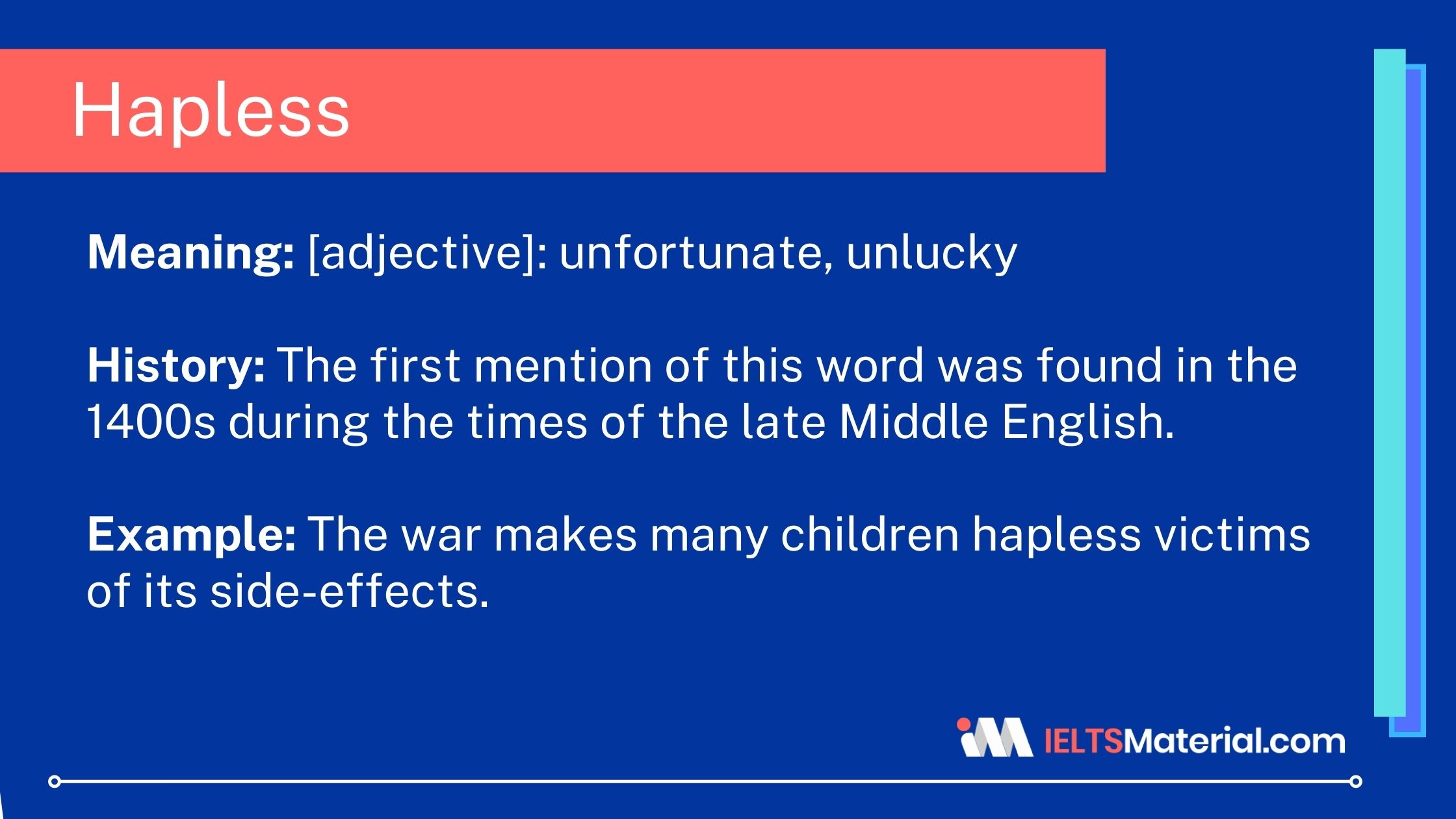
Table of Contents


Limited-Time Offer : Access a FREE 10-Day IELTS Study Plan!
Using precise and expressive adjectives in IELTS Speaking and Writing can significantly enhance your Lexical Resource score and make your descriptions more vivid. The adjective “hapless” is especially useful when describing people or situations affected by bad luck or unfortunate circumstances beyond their control. This blog explains its meaning, origin, examples, and practical tips for using it naturally in IELTS.
Meaning of “Hapless”
Definition: [adjective]: Unfortunate, unlucky, or marked by bad luck.
Explanation: When you describe someone or something as hapless, you mean they are suffering from bad luck or unfortunate circumstances, often beyond their control. The word is commonly used to show sympathy or highlight difficult situations.
Origin / History
The word hapless dates back to the late Middle English period (1400s). It is formed from two English elements:
- hap meaning luck or fortune
- -less meaning without
Together, hapless literally means without luck. Over time, it came to describe people or situations affected by misfortune.
Join us in our free webinars to learn tricks to improve IELTS vocabulary! Join Now!
Usage Examples of “Hapless”
- The war turned many children into hapless victims of violence.
- The entire coastal village became a hapless victim of the hurricane.
- Due to bad weather, hapless passengers were stranded at the airport for three days.
- Snowstorms trapped several hapless hikers in the mountains.
- The hapless man was wrongly accused and punished for a crime he did not commit.
- During the economic crisis, many hapless business owners lost everything.
- The movie tells the story of two hapless lovers separated by social barriers.
- The newspaper reported on hapless children forced to beg on the streets.
- Losing his job and family made him feel completely hapless and defeated.
- The hapless mouse could not escape from the trap.
Using “Hapless” in IELTS Speaking
You can naturally use hapless in the IELTS Speaking Part 2 and Part 3 when describing people, social issues, or unfortunate events.
Sample phrases:
- “Many hapless families suffer during natural disasters.”
- “I felt sorry for the hapless workers who lost their jobs suddenly.”
- “The documentary focused on hapless victims of poverty.”
Pro Tip: Use hapless to show empathy and describe social problems, disasters, or personal struggles. This demonstrates strong vocabulary control and emotional awareness.
Book free IELTS online classes to maximize your vocabulary for the IELTS exam!
Sample IELTS Speaking Answer Using “Hapless”
Cue Card: Describe a difficult situation faced by someone you know.
“I once knew a shop owner who became hapless after a sudden economic downturn. His business collapsed due to rising costs and low sales. Despite working hard, he couldn’t recover financially. Watching his struggle made me realize how unpredictable life can be and how important support systems are.”
Tips to Use “Hapless” Effectively
- Common collocations: hapless victim, hapless situation, hapless people
- Use it to describe people, groups, or situations, not objects
- Avoid overuse; apply it when discussing serious or emotional contexts
Exercise: Choose the Correct Meaning
-
The flood left many hapless families without shelter.
a) Lucky
b) Unfortunate
c) Wealthy -
The hapless employee lost his job despite working hard.
a) Successful
b) Unlucky
c) Skilled -
The story highlights the struggles of hapless children in war zones.
a) Protected
b) Fortunate
c) Unfortunate
Answer Key: 1 – b, 2 – b, 3 – c
Book a FREE demo to talk to our experts and boost your IELTS vocabulary now!
Mastering descriptive adjectives like hapless can significantly improve your Lexical Resource score in IELTS Speaking and Writing. When used accurately, it helps convey emotion, empathy, and clarity—qualities examiners value highly.
Mastering descriptive adjectives like obnoxious can significantly enhance your Lexical Resource score in IELTS Speaking and Writing. Using this word correctly helps you convey strong opinions about people, behaviors, or situations clearly and naturally. Regular practice with examples and exercises ensures confident usage in the exam.
Useful Links:
Explore IELTS Resources

Start Preparing for IELTS: Get Your 10-Day Study Plan Today!

Recent Articles
Kasturika Samanta
Kasturika Samanta
Kasturika Samanta


Post your Comments