28 Answer: I
Question type: Matching Sentence Endings
Answer location: Paragraph 1
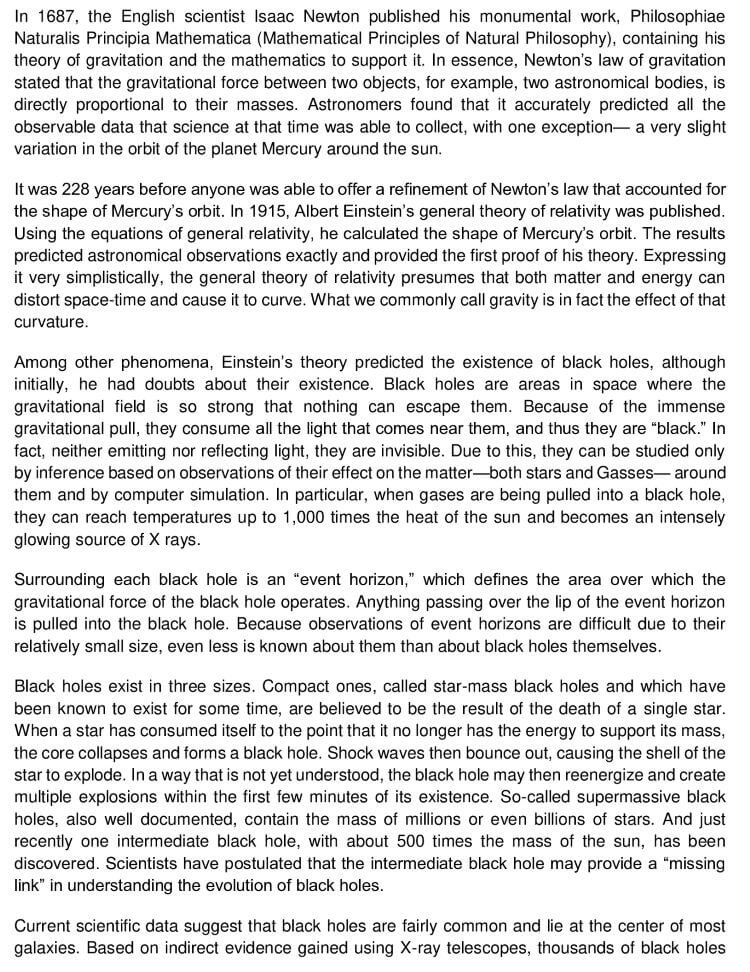
Answer explanation: We find a reference for Newton’s law of gravitation in the first paragraph, which states that according to Newton’s law of gravitation, the gravitational force between two objects, for example, two astronomical bodies, is directly proportional to their masses. Astronomers found that it accurately predicted all the observable data that science at that time was able to collect, with one exception— a very slight variation in the orbit of the planet Mercury around the sun. These lines indicate that although Newton’s law of gravitation accurately predicted all the data that time science was able to collect, the law was unable to explain Mercury’s path around the sun. Thus, the answer is I.
29 Answer: B
Question type: Matching Sentence Endings
Answer location: Paragraph 3
Answer explanation: The initial lines of paragraph 3 states that among the other phenomena, Einstein’s theory predicted the existence of black holes, although he initially had doubts about their existence. These lines suggest that there were several phenomena of Einstein’s theory and the existence of black holes was one of them for which he had doubts initially. Thus, it’s clear that Einstein’s theory of relativity suggested the presence of black holes in outer space, so, the answer is B.
30 Answer: F.
Question type: Matching Sentence Endings
Answer location: Paragraph 3, line 2
Answer explanation: The 2nd line of paragraph 3 states that black holes are areas in space where the gravitational field is so strong that nothing can escape them. These lines clearly suggest that black holes are areas that have an inescapable gravitational pull. Thus, the answer is F.
31 Answer: A
Question type: Matching Sentence Endings
Answer location: Paragraph 3,line 5
Answer explanation: The 5th line of the 3rd paragraph states that Due to this, they (black holes) can be studied only by inference based on observations of their effect on the matter—both stars and Gasses— around them and by computer simulation. These lines suggest that black holes can be studied by inference on the basis of observations of their effect on the matter. Thus, it is evident that scientists study black holes by observing the matter around them. Therefore, the answer is A.
32 Answer: L
Question type: Matching Sentence Endings
Answer location: Paragraph 3, last line
Answer explanation: The last line of 3rd paragraph states that when gases are being pulled into a black hole, they can reach temperatures up to 1,000 times the heat of the sun and become an intensely glowing source of X rays. We can deduce from these lines that gases that are pulled back into the black hole become extremely hot, i.e they reach temperatures up to 1,000 times the heat of the sun. Thus, the answer is L.
33 Answer: D
Question type: Matching Sentence Endings
Answer location: Paragraph 4, last line
Answer explanation: Paragraph 4 explains the Event horizon which is defined as the area over which the gravitational force of the black hole operates. The last line in this paragraph states that the observations of event horizons are difficult due to their relatively small size, even less is known about them than about black holes themselves. These lines indicate that event horizon are difficult to study. Thus, the answer is D.
34 Answer: C
Question type: Matching Sentence Endings
Answer location: Paragraph 5
Answer explanation: The initial lines of paragraph 5 illustrates that the Black holes exist in three sizes. Compact ones, called star-mass black holes and which have been known to exist for some time, are believed to be the result
of the death of a single star. We can understand from these lines that there are 3 sizes of black holes, of which the compact ones called stars make black holes occur when a single star collapses. Thus, the answer is C.
35 Answer: B
Question type: Multiple Choice Question
Answer location: Paragraph 6
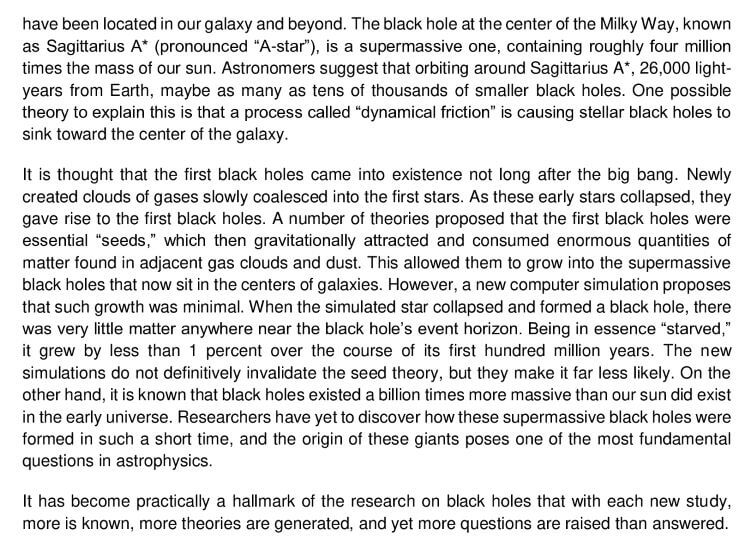
Answer explanation: The first line of the 6th paragraph states that current scientific data suggest that black holes are fairly common and lie at the center of most galaxies. These lines indicate that black holes can be commonly found in most galaxies. Thus, the answer is B.
36 Answer: A
Question type: Multiple Choice Question
Answer location: Paragraph 6, line 3
Answer explanation: The 3rd line of paragraph A reveals that the black hole at the center of the Milky Way, known as Sagittarius A* (pronounced “A-star”), is a supermassive one, containing roughly four million times the mass of our sun. Astronomers suggest that orbiting around Sagittarius A*, 26,000 light-years from Earth, maybe as many as tens of thousands of smaller black holes. We can understand that Sagittarius A* is the black hole at the center of the milky way, which contains roughly 4 million times the mass of the sun. The astronomers suggest that Sagittarius A* is located 26,000 light-years away from the Earth. Thus, the answer is B.
37 Answer: Not Given
Question type: True/False/Not Given
Answer location: Paragraph 7
Answer explanation: The introductory lines of the 6th paragraph states that it is thought that the first black holes came into existence not long after the big bang. These lines illustrate that the initial black holes came not long after the big bang. However, it’s not mentioned when the big band exactly occurred. Thus, the answer is Not Given.
38 Answer: True
Question type: True/False/ Not Given
Answer location: Paragraph 7,line 3
Answer explanation: The 3rd line of paragraph 7 states that a number of theories proposed that the first black holes were essential “seeds,” which then gravitationally attracted and consumed enormous quantities of matter found in adjacent gas clouds and dust. This allowed them to grow into the supermassive black holes that now sit in the centers of galaxies. We can deduce from these lines that several theories proposed the first black holes as seeds, which were then pulled by gravitation and consumed enormous quantities of matter, enabling them to grow into supermassive black holes that now sit in the galaxy’s center. Thus, the statement agrees with the information, so, the answer is True.
39 Answer: False
Question type: True/False/ Not Given
Answer location: Paragraph 7, line 7
Answer explanation: Paragraph 7 illustrates the fact that according to the seed theory, the first black holes eventually became supermassive black holes. However, the 7th line of the paragraph reveals that the computer simulation proposed such growth as minimal because when the stimulated star collapsed and formed a black hole, there was very little matter near the black hole’s event horizon. The 10th states that the new simulations do not definitively invalidate the seed theory, but they make it far less likely. These lines suggest that the seed theory was not proven to be accurate by computer simulation. As a result, the answer is False.
40 Answer: False
Question type: True/False/ Not Given
Answer location: Paragraph 7,line 11
Answer explanation: The eleventh line of paragraph 7 illustrates that it is known that black holes existed a billion times more massive than our sun did exist in the early universe. These lines indicate that the existence of black holes was a billion times larger than the sun existed in the early universe. Thus, the statement contradicts the information in the passage, so, the answer is False.










Post your Comments