Engender - Word of the Day for IELTS Writing and Speaking
4 min read
Updated On
-
Copy link
This article explains all about the word “engender” which means to cause or provoke a feeling towards something. Learn its origin, usage, in IELTS writing and speaking, and much more now!
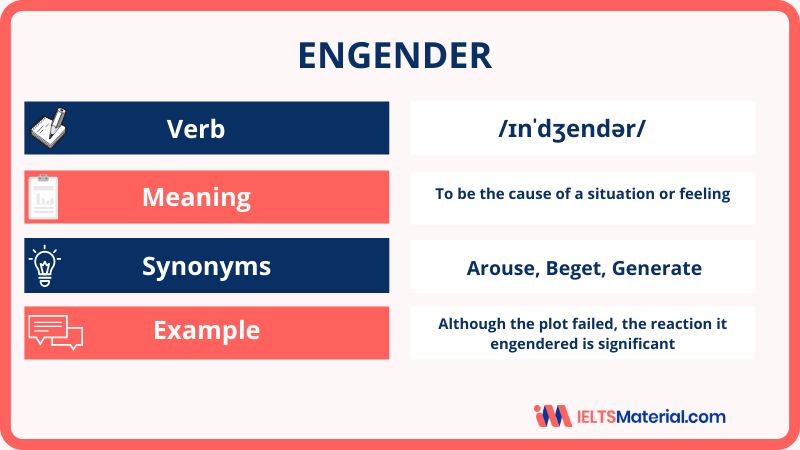
Table of Contents


Limited-Time Offer : Access a FREE 10-Day IELTS Study Plan!
In the IELTS Speaking and Writing modules, using a wide variety of academic words would help you express ideas clearly and make you sound professional. One such useful word for your IELTS exam is “Engender,” which means to give or cause a rise of a feeling or give a rise to an idea.
This is one of the perfect words to use whenever you get to talk about workplace settings, political topics, and social situations. In this blog, let's explore the word "Engender" and prepare you for a higher IELTS band score in your final test.
Meaning of “Engender”
The word, Engender (verb) means to give, produce, or cause a rise to a feeling, condition, or situation.
For Example:
- “His latest book on racism has engendered a lot of controversy”
- “Clear and Proper communication engenders trust within a team in every office.”
The word is commonly used in academic writing, IELTS essays, research papers, and even in professional discussions.
Origin of the Word “Engender”
This word “engender” comes from the Latin verb “ingenerare,” which means “to produce” or “to bring into being.” This is formed from “in-“ (in) and “generare” (to create or make).
The term then evolved through Old French as “engendrer” right before it entered Middle English in the 14th century. Throughout history, its meaning has remained consistent,; which is the idea of causing something to exist or happen.
Using the Word “Engender” in IELTS Writing Task 2
In the IELTS Writing Task 2, “engender” is very effective for explaining causes and consequences between ideas. This word helps your writing sound more academic and professional, especially when discussing topics such as technology, education, healthcare, the environment, or social changes.
For example:
“Excessive screen time can engender many health problems among young individuals.”
“When people invest in public transport, it may engender long-term economic benefits for cities.”
Using the word “engender” shows that you can express your ideas more clearly and professionally. Try to avoid overusing basic verbs like “cause” or “lead to”, wherein replacing them with “engender” boosts your lexical resource band score.
Using the Word “Engender” in IELTS Speaking
In the IELTS Speaking test, especially in Part 3, “engender” helps you express your views in a more thoughtful and expressive way. This shows the examiner that you can use a higher level of vocabulary naturally when discussing society, issues, or future developments.
For Example:
- “Stricter rules can sometimes engender fear rather than respect towards the government.”
- “Modern technology often engenders both excitement and concern among the commoners.”
Using these kinds of words will make your answer stand out from the crowd and help you improve your lexical resource score. But make sure to use it naturally and do not forcibly stuff it in a sentence.
- In IELTS Speaking Part 1 (Introduction), when you are asked to talk about habits or situations that create certain feelings.
- In IELTS Speaking Part 2 (Cue Card): When you are describing an experience that produced a reaction or change.
- In IELTS Speaking Part 3 (Follow-Up), you will be discussing broader issues and the effects they produce.
Hence, using the word “engender” in the IELTS Speaking test appropriately makes your speaking sound more mature and fluent.
Book a FREE demo to get in touch with our experts to boost your IELTS vocabulary now!
Common Collocations Related to the Word “Engender”
- engender trust
- engender fear
- engender change
- engender conflict
- engender support
- engender interest
- engender debate
These kinds of collocation combinations are frequently used in academic writing.
Sample Sentences Based on the Word “Engender”
- Our government’s new policy has definitely engendered widespread public support.
- Poor working conditions often engender frustration among employees.
- Cultural exchange programs these days can engender greater understanding between countries.
- The rapid urban development has engendered many new environmental challenges.
- Fair treatment in a workplace engenders loyalty from the employees.
Synonyms of “Engender”
- Cause
- Produce
- Provoke
- Generate
- Trigger
- Bring about
- Spark
- Give rise to
Antonyms of “Engender”
- Prevent
- Discourage
- Suppress
- Stop
- Halt
Enroll into our Free IELTS Webinar and learn more about techniques to improve your vocabulary!
Practice Exercise Based on “Engender”
Exercise 1
Try answering the following questions using the word “engender.” You can speak the answers out loud or write them down.
Question 1: Do you think strict rules in schools always create discipline among their students?
Question 2: Do you think social media engenders more positive or negative effects in society?
Question 3: Do you believe certain government policies can engender long-term changes in people’s behaviour?
Exercise 2
Match the word below to complete these sentences.
Fabricated, perfection, engender, glossy, gluttony, settlement
-
They have facts, figures, glossy brochures, ……………. lawyers and beatific smiles.
-
It was a very entertaining, albeit …………………. film
-
She has committed several sins, greed and ……………… being high on the list
-
The veggies were cooked to …………….., with no distracting crunchiness to contend with, and the flavors blended together gloriously.
-
The treaty guaranteed the peaceful ……………….. of disputes between the two countries.
-
This new reality helped …………………….. a more sensitive ecclesial approach to the plight of Catholics in broken marriages.
Answer Key - Engender
Exercise 1
Sample Answer 1: Strict rules can at times engender discipline, but they can also create fear or resistance among students in schools.
Sample Answer 2: Social media can engender both the positive and negative effects as it depends on how it is being used.
Sample Answer 3: Of course, effective government policies can engender a significant long-term change in the common people’s attitudes and daily habits.
Exercise 2
- glossy
- fabricated
- gluttony
- perfection
- settlement
- engender
Also Check:
Explore IELTS Resources

Start Preparing for IELTS: Get Your 10-Day Study Plan Today!

Recent Articles
Kasturika Samanta
Kasturika Samanta
Kasturika Samanta


Post your Comments