Ludicrous - Word of the Day For IELTS Writing and Speaking
4 min read
Updated On
-
Copy link
The IELTS word 'ludicrous’ refers to a silly or unbelievable act or idea that happens. Find out its meaning, origin, and much more with exercises to help you use it accurately in your final test!
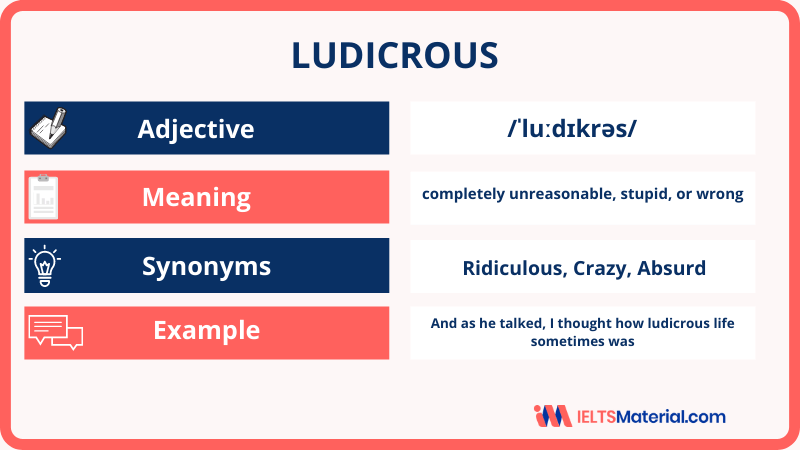
Table of Contents
- Meaning of “Ludicrous”
- Origin of the Word “Ludicrous”
- Synonyms of “Ludicrous”
- Antonyms of “Ludicrous”
- Using the Word “Ludicrous” in IELTS Writing Task 2
- Using the Word “Ludicrous” in IELTS Speaking
- Common Collocations with “Ludicrous”
- Common Mistakes When Using the Word “Ludicrous”
- Practice Exercise - Ludicrous
- Answer Key - Ludicrous


Limited-Time Offer : Access a FREE 10-Day IELTS Study Plan!
In IELTS Academic English, certain words help you to express strong opinions with proper clarity and precision. This word, “ludicrous”, is one of them. “Ludicrous” as a striking adjective is used when you are ready to describe ideas, actions, or views that are so silly or illogical in every way.
In the context of the IELTS exam, you often need to put forth arguments, challenge assumptions, and even highlight flaws in reasoning. Hence, “ludicrous” is a powerful word that gives a way to present your stance effectively.
The word adds emphasis without sounding informal, and that is what makes it ideal for both IELTS essays and opinion-based IELTS speaking questions. So why wait? Let’s begin with learning all about “Ludicrous” in this blog now!
Meaning of “Ludicrous”
The word Ludicrous (adjective) means that something that is absurd, unreasonable, or so ridiculous that it provokes laughter or even disbelief.
For example:
- “The idea that students must be studying for ten hours a day without any break is completely ludicrous.”
- “Some people who claim that smartphones have no impact on modern communication are simply ludicrous.”
The word “ludicrous” is powerful since it expresses strong criticism, and it makes it ideal for argumentative essays and opinion-based answers in the IELTS exam.
Origin of the Word “Ludicrous”
This word “ludicrous” has its origin from the Latin word “ludicrus,” which means, “pertaining to play” or “be sportive.” It is also related to ludere, which means “to play.”
Over the period, the meaning of the word evolved from something playful or amusing to something so foolish or unreasonable that it became laughable. By the 17th century, the word “ludicrous” directly entered the English language with the same meaning that we still use today.
It has a connection to the word “play”, and that explains why the word often carries a sense of exaggerated foolishness or comedic absurdity, which is perfect for describing ideas that make no logical sense.
Learn a list of unique words like this to excel in your IELTS exam! Book a Free Demo!
Synonyms of “Ludicrous”
- absurd
- ridiculous
- laughable
- illogical
- unreasonable
- nonsensical
- outrageous
Antonyms of “Ludicrous”
- reasonable
- sensible
- rational
- logical
- credible
- serious
- practical
Using the Word “Ludicrous” in IELTS Writing Task 2
In the IELTS Writing Task 2, “ludicrous” is especially effective when you want to strongly disagree with an idea or pinpoint that a suggestion is unreasonable. Instead of just using common words like “silly,” “nonsense,” or “not logical,” you can use“ludicrous” to add academic precision and a sophisticated tone to your writing.
Using the Word “Ludicrous” in IELTS Speaking
In the IELTS Speaking test, mainly in Part 3, “ludicrous” can make you express strong opinions naturally and fluently. It is particularly useful when you are reacting to an unrealistic assumption, extreme behaviour, or an illogical trend.
Common Collocations with “Ludicrous”
- ludicrous idea
- ludicrous view
- ludicrous assumption
- ludicrous behaviour
- ludicrous amount
- ludicrous situation
- completely ludicrous
- utterly ludicrous
- Utmost ludicrous
Common Mistakes When Using the Word “Ludicrous”
-
Using this word for minor or normal situations.
Incorrect Usage: The traffic in our city was ludicrous today.
Correct Usage: The thought that we can solve traffic problems by banning all cars and bikes is ludicrous.
This word should be used only for extremely unreasonable ideas and not normal ones.
-
Using it in casual or friendly criticism
Incorrect Usage: His choice of outfit was ludicrous.
This will sound rude or offensive to the listener if used informally about them.
-
Using it to just describe objects instead of ideas
Incorrect Usage: This mobile phone is ludicrous.
Correct Usage: The price of this mobile phone is ludicrous.
-
Misspelling or mispronouncing the word
Common mistakes: “ludacris,” “ludicrus,” and “ludricous”
Correct spelling: ludicrous
-
Using it too often in an essay or speaking answer
It is a strong word, and hence you must use it especially for emphasis.
Get your hands on this IELTS Vocabulary Ebook to expand your word list for your IELTS test!
Practice Exercise - Ludicrous
Match the word below to complete these sentences.
(fabricated, perfection, ludicrous, glossy, gluttony, settlement)
- The court granted him the …………………. sum of £100 in damages
- As a repentant ………………, I pledge to swear off this hallucinogen
- Only three of the 20 homes in his street had escaped the burglars and the ……………..
- Most were reluctant, defensive, or simply ……………….. to blow their own trumpet.
- She flicked him a ……………… smile, then strode briskly on.
- As long as any advert does not bring the profession into …………….. nor is in bad taste then it is permissible
Answer Key - Ludicrous
- ludicrous
- sinner
- wrecker
- hesitant
- haughty
- disrepute
The word “Ludicrous” holds a good amount of emotion, which is strong enough to use in sentences for both the IELTS Speaking and Writing tests. As you make sentences with this word, you can express your exact views, and with the right strategy, this would enhance your vocabulary skills, helping you be more persuasive, fluent, and confident. Begin using this word on a daily basis, and you will for sure be able to achieve a band score of 8+ in your final test!
Also Check:
Explore IELTS Resources

Start Preparing for IELTS: Get Your 10-Day Study Plan Today!

Recent Articles
Kasturika Samanta
Kasturika Samanta
Kasturika Samanta


Post your Comments