Abominate: Word Meaning, Examples, Origin & Usage in IELTS
The word ‘abominate’ means ‘to feel deep hate or horror for something/somebody'. Discover its usage, history, synonyms & antonyms, and practice using it with the given exercise to expand your lexical resources & impress the IELTS examiner for a top score.
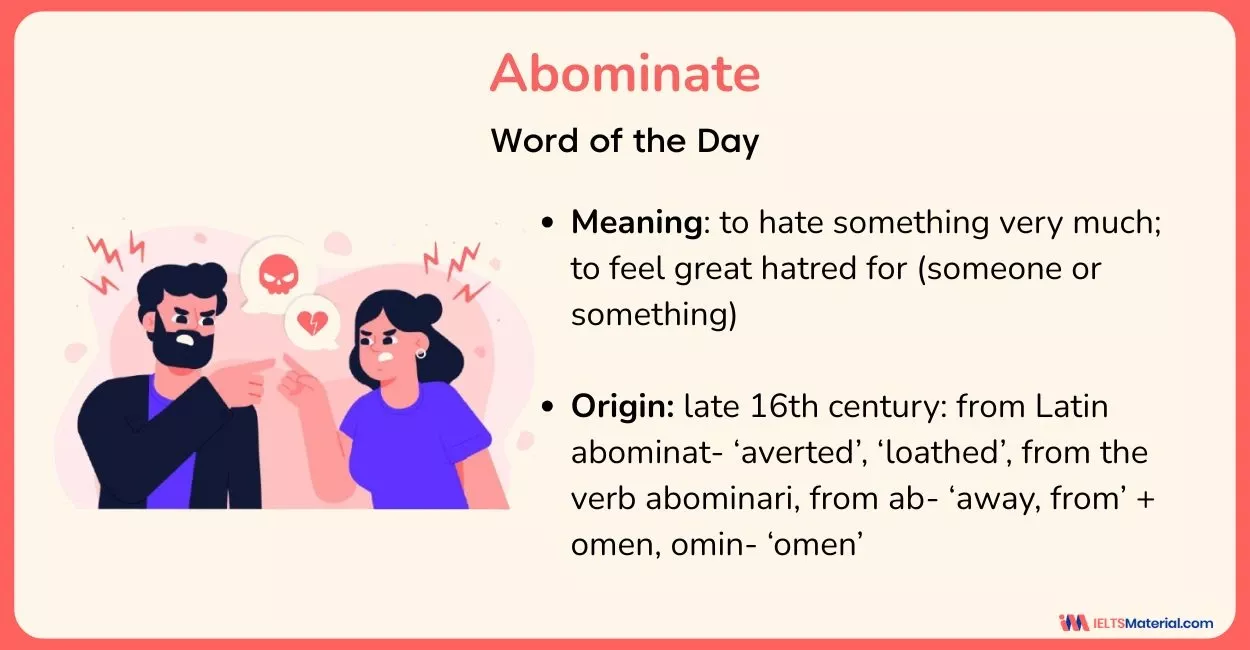
Table of Contents


Limited-Time Offer : Access a FREE 10-Day IELTS Study Plan!
Repeating words like ‘hate’ or ‘dislike’ in IELTS can reduce your lexical resource score. So, it is best to add words like ‘abominate’ to your IELTS Vocabulary words list for Band 8 or 9. The word captures a level of dislike that goes far beyond simple disagreement.
In this blog post, we will examine the meaning, origin, history, synonyms, and antonyms of the word, as well as its proper usage of the term ‘abominate’ within the context of IELTS, reinforcing our understanding through practical exercises.
Meaning of Abominate
- Pronunciation: /əˈbɒmɪneɪt/ (sounds like uh·baw·muh·nayt )
According to the Cambridge Dictionary, the word ‘abominate’ means ‘to feel strong dislike or hatred toward something’. In other words, to abominate something means to strongly hate it, often because it is considered morally wrong or unacceptable.
The word is typically used in formal, academic, or ethical discussions, making it suitable for IELTS Speaking and Writing.
History and Origin of ‘Abominate’
The word comes from the Latin “abominari,” meaning ‘to regard as an evil omen’ or ‘to shun’. It’s also derived from the verb abominari from ‘ab’ which refers ‘to away or from’ + ‘omen’ or ‘omin’.
It entered English in the late Middle Ages and was frequently used in religious and ethical contexts. Over time, it came to describe intense personal or societal hatred toward certain actions or ideas.
Book free IELTS online classes to maximize your vocabulary for the IELTS exam!
Usage & Examples of Abominate
Let us look at some example sentences where the word ‘abominate’ has been used in its verb form.
- Tim abominates the very idea of society.
- She abominates Madonna.
- As a teacher, I abominate cheating.
- I abominate disrespectful behaviour.
- My mother abominates pop music, but she doesn’t mind if I play it at a low volume.
- Many citizens abominate corruption in government.
- She openly abominates cruelty toward animals.
- Society should abominate practices that violate human rights.
- The author abominates violence as a solution to conflict.
Using ‘Abominate’ as Different Parts of Speech
Although ‘abominate’ is a verb, it can also be used in noun, adjective, and adverb forms. So, given below are some sentences using the word in different forms.
|
Word Form |
Example Sentences |
|---|---|
|
Noun (Abomination) |
|
|
Adjective (Abominable) |
|
|
Adverb (Abominably) |
|
IELTS Usage of ‘Abominate’
In IELTS, the word ‘abominate’ is valuable because it allows candidates to express strong opinions clearly and forcefully without sounding informal or exaggerated. Below are IELTS-style questions with clear, well-developed answers.
IELTS Speaking Part 1
- Question: Do you think personal values should influence decisions?
- Sample Answer: “In my opinion, personal values play an important role in decision-making. People often abominate actions that conflict with their moral beliefs. As a result, values strongly guide behaviour in daily life.”
IELTS Writing Task 2
- Topic: Some people believe immoral behaviour should be strictly punished, while others think education is a better solution. Discuss both views and give your opinion.
- Answer Excerpt: “Many people abominate immoral behaviour because it threatens social stability. Strict punishment may deter offenders in the short term. However, education can address the root causes and encourage ethical thinking in the long run.”
Book a FREE demo to talk to our experts and boost your IELTS vocabulary now!
Synonyms and Antonyms of ‘Abominate’
The table below provides a list of synonyms and antonyms of ‘abominate’, complete with their meanings and example sentences.
|
Type |
Word |
Meaning |
Example Sentence |
|---|---|---|---|
|
Synonym |
Detest |
to dislike intensely |
She detests dishonesty in any form. |
|
Loathe |
to hate someone or something |
Many people loathe unfair treatment at work. |
|
|
Despise |
to feel contempt or deep dislike |
He despises corruption in public life. |
|
|
Abhor |
to regard with extreme disgust |
The community abhors acts of violence. |
|
|
Antonym |
Admire |
to respect or approve of someone |
She admires leaders who act ethically. |
|
Appreciate |
to recognise the value of something |
People should appreciate cultural diversity. |
|
|
Cherish |
to hold something dear |
He cherishes freedom of expression. |
Join us in our free webinars to learn tricks to improve IELTS vocabulary! Join Now!
Exercise to Master the Meaning of ‘Abominate’
We will now work through the following exercise to improve your understanding of the word ‘abominate’.
Exercise A: Choose the correct option.
1 What level of emotion does ‘abominate’ most accurately convey?
A Mild disapproval
B Rational disagreement
C Temporary annoyance
D Intense moral hatred
2 “She abominated corruption in all its forms.” - What can be inferred about her attitude?
A She tolerated corruption if necessary
B She opposed corruption on practical grounds only
C She felt deep moral revulsion toward corruption
D She avoided discussing corruption publicly
3 In which context would ‘abominate’ be MOST appropriate?
A Casual conversation about food preferences
B Formal writing condemning human rights abuses
C Friendly debate over sports teams
D Light-hearted social media commentary
4 Which sentence uses ‘abominate’ incorrectly?
A He abominated the cruelty inflicted on civilians.
B Many citizens abominate acts of terrorism.
C She abominated waking up early on Mondays.
D The author abominated censorship in any form.
5 Which sentence maintains correct verb–object logic with ‘abominate’?
A He abominated that the rules were strict.
B She abominated the practice of forced labour.
C They abominated to witness injustice.
D We abominated when the policy changed.
Answer Keys
|
1 |
2 |
3 |
4 |
5 |
|
D |
C |
B |
C |
B |
To sum it up, ‘abominate’ allows learners to replace basic phrases like ‘hate very much’ with a single, accurate verb. When used appropriately, this word demonstrates strong control over tone and meaning. As a result, ‘abominate’ can significantly enhance your IELTS vocabulary as well as your performance in both speaking and writing, particularly at Band 7 and above.
Useful Links:
- Abhorrence – Word of the Day for IELTS Speaking & Writing
- Abrogate: Meaning, Definition & Synonyms
- Avarice: Word Meaning, Examples, Origin & Usage in IELTS
- Common Idioms to Boost your IELTS Score - Topic: Anger and Irritation
- Increase your Speaking & Writing Score with Synonyms and Antonyms
- Useful Resources & Websites for IELTS Vocabulary
Explore IELTS Resources

Start Preparing for IELTS: Get Your 10-Day Study Plan Today!

Check out other Word of the Day Articles
Kasturika Samanta
Nehasri Ravishenbagam
Kasturika Samanta

Recent Articles
Kasturika Samanta
Kasturika Samanta
Kasturika Samanta


Post your Comments