Describe a Poisonous Plant - IELTS Cue Card
4 min read
Updated On
-
Copy link
Prepare for IELTS Speaking with the cue card “Describe a Poisonous Plant.” Access sample answers, useful vocabulary, and expert tips to explain characteristics, effects, and precautions fluently while improving coherence and band score.
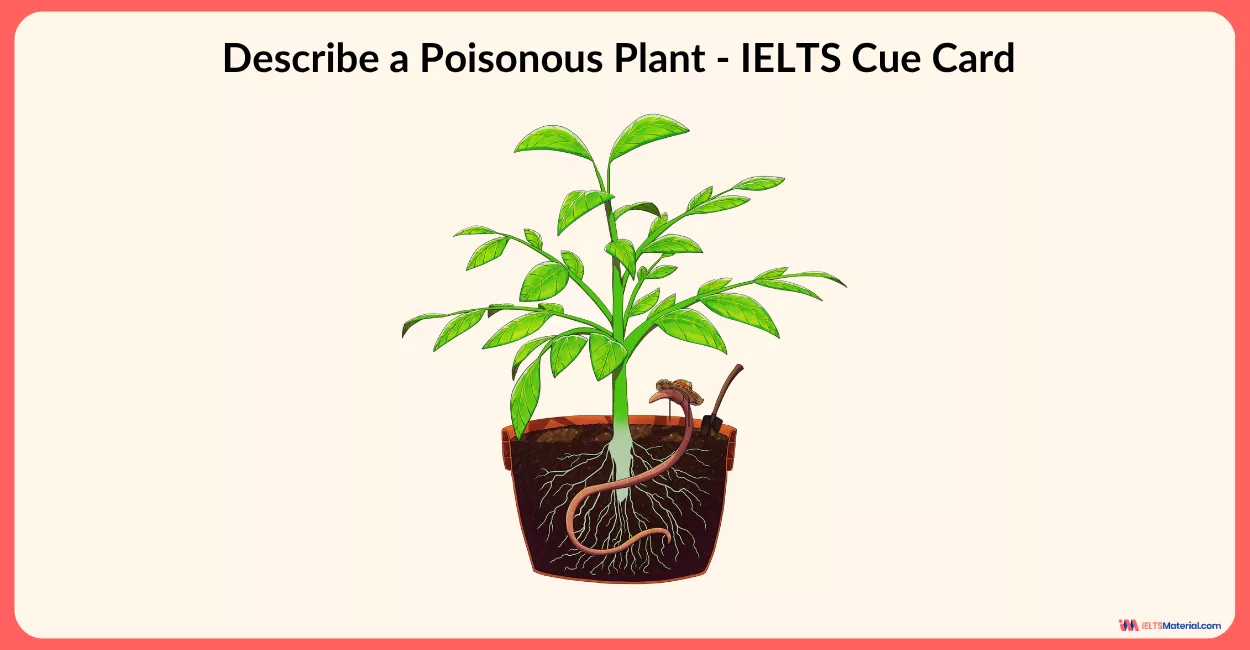
Table of Contents


Limited-Time Offer : Access a FREE 10-Day IELTS Study Plan!
The IELTS Speaking Part 2 cue card “Describe a Poisonous Plant” asks you to talk about a plant that is harmful or toxic in some way. This topic assesses your ability to describe natural objects, explain their properties, and share personal experiences or knowledge. To answer effectively, you should focus on describing the plant’s appearance, where it is found, its toxic effects, and any experiences or warnings associated with it, while using clear vocabulary, linking words, and coherent sentences to demonstrate fluency and confidence.
Learn useful idioms to answer IELTS Cue Cards with the guide below!
For more Cue Cards, take a look at IELTS Speaking Part 2 | Topics, Questions and Samples Answers.
Describe a Poisonous Plant - IELTS Cue Card
You should say:
- What is it?
- Why is it poisonous?
- Where is it found?
Describe a Poisonous Plant - Sample Answer 1
The domain of plants in the plant kingdom is stupefying, and they would surprise anyone with little interest in this subject. Among them, many are carnivorous. Some cure diseases, while others can be deadly if consumed inappropriately. From their ability to grow in extreme places to their ability to adapt to a new environment, they often shock even veteran botanists. Recently, I was appalled when I found out that tomato plants are poisonous.
They are commonly found in most regions of Asia and the rest of the world. I accidentally learned about the toxic tomato plant when I read a journal called “Journal of Plant Physiology”. Usually, a tomato is a fruit, but it is a vegetable for culinary purposes. It is an indispensable ingredient in preparing a salad, and every household knows this fruit.
However, if ingested, tomato leaves and stems contain toxic solanine, causing digestive upset and nervous excitement. If someone rubs the tomato leaf in their fingers, it gives a bitter odour due to the poisonous substance. Even the raw or green tomato has a little toxicity, which is not deadly. Ripe tomatoes do not comprise any detectable tomatine.
Join us in our free webinars to learn tricks to drive away your IELTS exam blues! Explore Now!
Describe a Poisonous Plant - Sample Answer 2
One poisonous plant that I am familiar with is the Deadly Nightshade, also known as Atropa belladonna. It is a small shrub with shiny green leaves and purple bell-shaped flowers, and it produces black berries that look attractive but are extremely toxic.
This plant is poisonous because it contains a chemical called atropine, which affects the nervous system. Consuming even a few berries can lead to severe symptoms like dizziness, hallucinations, vomiting, or in extreme cases, death. Handling the plant without care can also cause skin irritation.
Deadly Nightshade is commonly found in parts of Europe, North America, and some regions of Asia. It usually grows in shaded woodlands, along roadsides, and in uncultivated areas. People need to be cautious, especially if they have children or pets, as the berries can look appealing but are highly dangerous.
Enroll in our IELTS Online Classes to boost your IELTS Speaking Skills!
Describe a Poisonous Plant - Sample Answer 3
Another poisonous plant I know is Oleander, which is a popular ornamental shrub with vibrant pink or white flowers. While it is widely used in gardens for decoration, all parts of the plant, including the leaves, flowers, and stems, are highly toxic.
Oleander is poisonous because it contains cardiac glycosides, which can affect the heart and lead to irregular heartbeat, nausea, or even fatal poisoning if ingested. Even inhaling smoke from burning Oleander can be harmful.
This plant is commonly found in warm climates, such as in Southern Europe, the Mediterranean region, and parts of India. It is often seen in parks, gardens, and along roadsides. Despite its beauty, people should handle it with care and keep it away from children and animals to avoid accidental poisoning.
Level up your speaking skills with our 4.5+ Rated Speaking Ebook! Buy Now!
Describe a Poisonous Plant - Vocabulary
- Stupefying
Meaning – astonishing and shocking.
Example – My elder brother has stupefying financial incompetence and needs to save money.
- Culinary
Meaning – of or for cooking.
Example – Almost everyone in my family praises my mother for her exceptional culinary skills.
- Indispensable
Meaning – absolutely necessary.
Example – The intern made himself indispensable to his boss.
- Appalled
Meaning – greatly dismayed or horrified.
Example – I was appalled by the effort of last year’s winning team in the marathon.
- Veteran
Meaning – a person who has had long experience in a particular field.
Example – Adam had immense knowledge of the wars as he was a veteran of the two world wars.
Grab our Comprehensive IELTS Speaking Band 8 Preparation Course before it’s Out of Stock! Don’t Miss Out!
Describing a poisonous plant allows you to demonstrate your ability to talk about natural objects, explain their characteristics, and share knowledge or personal experiences. By clearly describing the plant’s appearance, location, toxic effects, and precautions, you can showcase a wide range of vocabulary, logical organization, and fluency. Practising this topic also prepares you for Part 3 follow-up questions about plants, nature, or safety, helping you perform confidently in the IELTS Speaking test.

Start Preparing for IELTS: Get Your 10-Day Study Plan Today!

Recent Articles

Haniya Yashfeen

Kasturika Samanta

Nehasri Ravishenbagam


Post your Comments