Woes - Word of the Day for IELTS Speaking and Writing
The word 'Woes' means to go through a trouble or an issue with something. Here, you will find out the word’s origin, examples of its usage in the IELTS Speaking and Writing practice tests, etc., to master the perfect usage of this word!
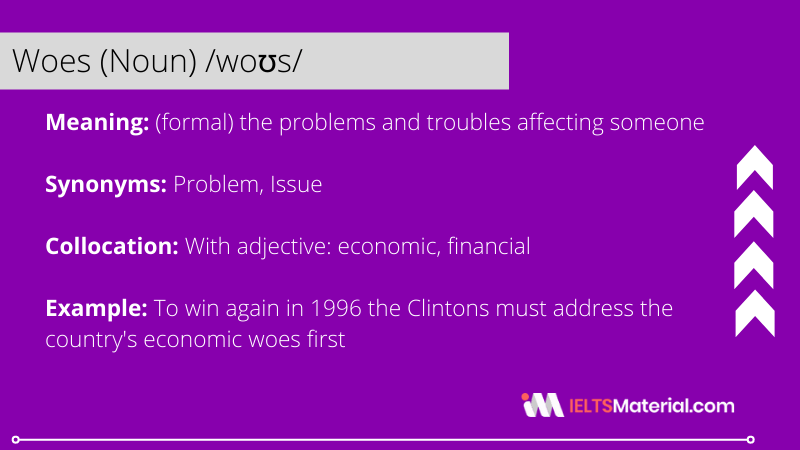
Table of Contents


Limited-Time Offer : Access a FREE 10-Day IELTS Study Plan!
Using suitable words in the perfect contexts as you speak English in an everyday setting will enhance the way you convey a message! One such commonly used word is ‘Woes’, which is especially used by people in both casual and professional discussions, and that is what makes it perfect for the IELTS exam.
Here, we will learn the meaning, origin, and usage of the word, along with examples of how to use it to your advantage when preparing for the IELTS Speaking and Writing tests!
Meaning of “Woes”
“Woes” is the plural form of “woe,” which means to experience a deep sorrow, trouble, or problem. While the words “problem” or “issue” sound neutral, the word “woes” carries a more emotional and serious tone. This is often used to describe long-standing or severe issues such as economic woes, health woes, or even environmental woes.
For example: “The country’s economic woes have worsened due to global instability.”
Origin of the Word “Woe / Woes”
The word “woe” originates from the Old English term “wā,” which expressed deep grief, sadness, or distress. Over these centuries, as the English language transformed, the word “woe” retained its emotional essence, becoming a poetic yet the most commonly used word in modern English.
Today, “woes” is a word that appears frequently in literature, news reports, and academic writing in order to describe multiple problems faced by people or societies.
Using the Word “Woes” in the IELTS Writing Task 2
In the IELTS Writing Task 2, “woes” is a useful word for essays that discuss global or social challenges. This adds richness to your vocabulary knowledge and helps you avoid repeating the usual word called “problems.” You can use this word to describe ongoing, serious, or wide-ranging issues.
For example, you may write:
- “Many developing nations are lately burdened by economic woes caused by unemployment and the rapidly rising living costs.”
- “Environmental woes such as pollution and climate change require an urgent global action.”
Using the word “woes” properly in the perfect context shows the examiner that you can express complex ideas with an emotional touch and academic tone.
Using the Word “Woes” in the IELTS Speaking
In the IELTS Speaking test, especially in Part 2 and Part 3, “woes” is a word that helps you describe difficulties in a professional and natural way. It works well when you discuss personal struggles, social challenges, or problems faced by communities.
For example:
- “One of the major woes in my country is traffic congestion, which affects most of the people’s daily routines.”
- “Many young people these days face mental health woes due to academic pressure and social expectations.”
Since the word “woes” sounds expressive yet formal, it makes your answers sound thoughtful and mature when used properly.
Synonyms of the Word “Woes”
- Troubles
- Struggles
- hardships
- difficulties
- distress
- dilemmas
- burdens
Antonyms of the Word “Woes”
- Relief
- comfort
- ease
- improvements
- solutions
- well-being
Sample Sentences Based on the Word “Woes”
- The company’s financial woes began right after the economic slowdown.
- To win again in the year 1997 the Clintons must address the country’s economic woes first.
- Farmers are facing severe agricultural woes because of the unpredictable weather patterns.
- Most people experience emotional woes during major life changes.
- Our government is trying to resolve the country’s long-standing social woes.
- The threat of at least one multi-million-dollar fine facing Koons and Sonnabend compounds their financial woes at this moment.
- Her health woes worsened because she delayed seeking treatment.
- His arrival and the Raiders’ existing financial woes have had an impact on various areas of the organisation.
- He said first he had to deal with the provincial government’s financial woes and an economic downturn.
Practice Exercise - Woes
Try to use the word “woes” in your speech.
Question 1: Are people concerned about environmental problems in your country?
Sample Answer:
Well, it’s hard to say for sure. I think some people are concerned but probably not enough of them. There are people who take environmental woes seriously enough to actually recycle their rubbish appropriately but I don’t think there are enough people who concern themselves with resource depletion which I consider to be a pressing issue. So many people are using energy and buying products without any thought to the impact of their actions. We all know that the world’s resources are being used at an alarming rate but no one seems to actually feel it’s their responsibility to change the way they live. So, I guess, although there are some people who are concerned, it’s not enough and more people in my country need to change the way they live.
Question 2: Do you believe climate change is a serious problem?
Sample Answer:
Yes, I do. The woes of climate change have been growing over the past few decades and we are now witnessing serious changes in global weather patterns. While some countries are suffering from heat waves, other countries are suffering from terrible snow storms. But that isn’t the worst of the problem. The changes in the climate are also causing extreme weather such as typhoons, earthquakes and tsunamis, which are devastating many countries. On top of that, there are also concerns about rising sea levels, which although not a problem now, will be a serious concern to any low-lying country in the future. So, I feel that climate change is something which needs to be taken very seriously.
To conclude, ‘Woes’ is an emotionally rich and expressive word that fits naturally into narratives about issues, trouble, or even sadness. Hence, you can master this word, along with its synonyms, antonyms, and usage contexts, to make it one of the common English words used in IELTS Speaking test and writing test to strengthen your vocabulary range and confidence!
Useful Links:
- Cumbersome: Word Meaning, Examples, Origin & Usage in IELTS
- Garrulous: Word Meaning, Examples, Origin & Usage in IELTS
- Word of the Day Rhapsodic - Meaning, Usage & IELTS Examples
Explore IELTS Resources

Start Preparing for IELTS: Get Your 10-Day Study Plan Today!

Recent Articles
Kasturika Samanta
Kasturika Samanta
Kasturika Samanta


Post your Comments