Admonish: Word Meaning, Examples, Origin & Usage in IELTS
5 min read
Updated On
-
Copy link
The word ‘admonish’ means ‘express disapproval or concern about an action'. Explore the word's usage, history, synonyms, and antonyms, followed by exercises in this blog that will help you improve your overall vocabulary to achieve a band score of 8+.
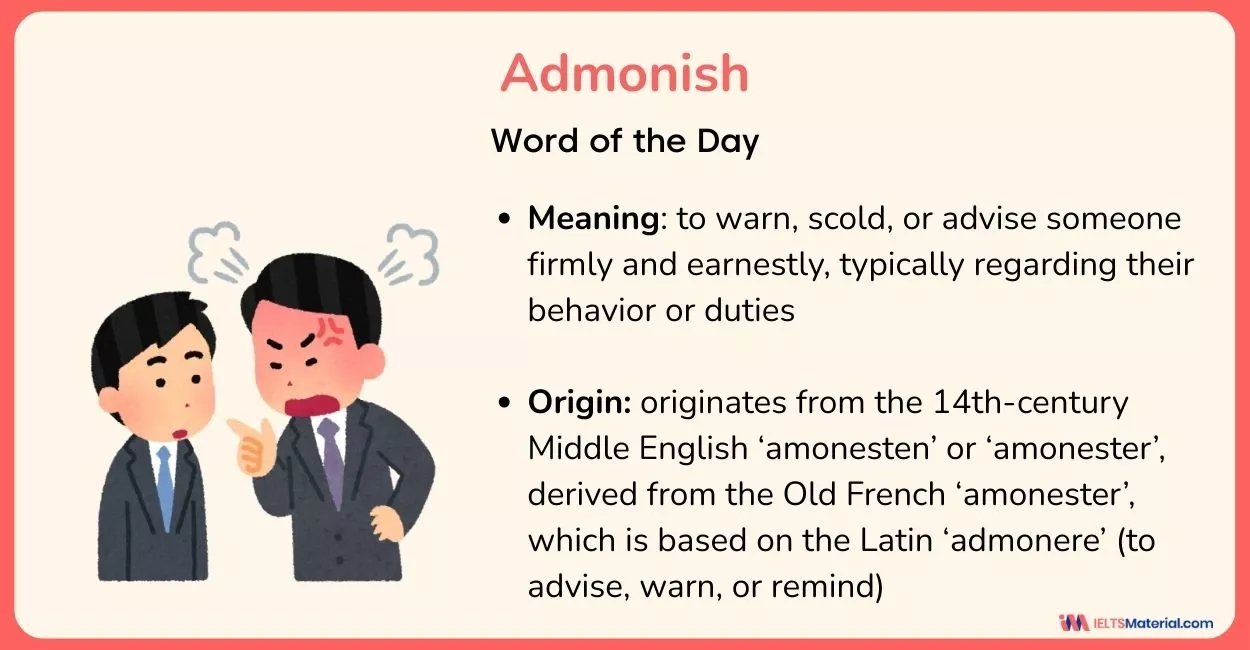
Table of Contents


Limited-Time Offer : Access a FREE 10-Day IELTS Study Plan!
Today’s word of the day, ‘admonish’ reflects more than just actions; it reflects actions and attitudes. In other words, it conveys the idea of correcting or warning someone in a firm yet constructive manner. Therefore, adding it to your IELTS vocabulary helps when discussing education, parenting, leadership, and social behaviour, where guidance and discipline are important.
This blog post will, therefore, check the definition, historical context, and proper usage of the word 'admonish’, one of the IELTS Academic high-frequency vocabulary words, particularly in the IELTS exam. You will also find a variety of useful exercises at the end to help you grasp the concept.
Meaning of Admonish
- Pronunciation: /ædˈmɑ.nɪʃ / (sounds like uhd·maw·nish)
According to the Oxford Dictionary, it means ‘to warn or reprimand someone firmly’, and the Cambridge Dictionary states its meaning as ‘to tell someone that they have done something wrong in a serious but kind way’.
To use ‘admonish’ accurately, it is important to understand that it involves advice or criticism intended to improve behaviour. The tone is usually serious but not necessarily harsh, making it suitable for formal and academic contexts.
History and Origin of ‘Admonish’
The word ‘admonish’ comes from the Latin “admonere,” meaning ‘to remind or warn’. It combines “ad-” (to) and “monere” (to warn), representing a firm, earnest warning or reprimand, rather than severe punishment.
It entered English in the late Middle Ages and was often used in religious and educational contexts. Over time, it came to describe any situation where someone offers firm advice or correction.
Usage & Examples of Admonish
Given below are some examples of how the word ‘admonish’ can be used in a sentence.
- The kids were admonished by their parents for playing pranks on the neighbour.
- The Ministry admonished Mr. John for taking a bribe.
- The management told Lisa not to admonish any employee in public.
- Teachers often admonish students for not completing assignments.
- Parents should admonish children gently rather than harshly.
- Leaders may admonish employees to maintain discipline.
- Society should admonish behaviours that harm others.
Using ‘Admonish’ as Different Parts of Speech
Despite being a verb, ‘admonish’ can also be a noun or an adjective. Here are a few sentences that use the word in various ways.
|
Word Form |
Example Sentences |
|---|---|
|
Noun (Admonition) |
|
|
Adjective (Admonitory) |
|
Book free IELTS online classes to maximize your vocabulary for the IELTS exam!
IELTS Usage of ‘Admonish’
IELTS examiners reward candidates who use precise and appropriate vocabulary. ‘Admonish’ replaces basic phrases like ‘tell someone off’ or ‘scold’, making responses more formal and academic. When used correctly, this word demonstrates a strong lexical resource and control of tone.
IELTS Speaking Part 3
- Question: Should children be disciplined strictly?
- Sample Answer: “Children should be guided with balance rather than strict punishment. Parents can admonish them when necessary, but the approach should remain supportive. This helps children learn responsibility without fear.”
IELTS Writing Task 2
- Topic: Some people believe strict discipline is necessary for success, while others think encouragement is more effective. Discuss both views and give your opinion.
- Answer Excerpt: Supporters of discipline argue that individuals must be admonished when they make mistakes. This approach can help maintain standards and accountability. However, excessive criticism may reduce motivation and confidence.
Book a FREE demo to talk to our experts and boost your IELTS vocabulary now!
Synonyms and Antonyms of Admonish
The table below lists close synonyms and antonyms for the IELTS Writing and Speaking word ‘admonish’, with sample sentences.
|
Word Type |
Word |
Meaning |
Example Sentence |
|---|---|---|---|
|
Synonym |
Reprimand |
to express disapproval of someone’s behaviour |
The teacher reprimanded the student for being late. |
|
Warn |
to tell someone about a possible danger or problem |
Parents should warn children about online risks. |
|
|
Advise |
to give suggestions about what should be done |
The doctor advised him to change his lifestyle. |
|
|
Counsel |
to give advice especially professionally |
She counselled students on academic choices. |
|
|
Antonym |
Praise |
to express approval |
The teacher praised the student’s effort. |
|
Encourage |
to give support or confidence |
Parents should encourage creativity in children. |
|
|
Commend |
to formally praise |
The manager commended her for excellent work. |
Join us in our free webinars to learn tricks to improve IELTS vocabulary! Join Now!
Exercises to Master the Meaning of ‘Admonish’
Now, let us complete the exercise that has been designed to strengthen your understanding of the meaning of the word ‘admonish’.
Exercise A: Choose the correct option.
1 “She gently admonished him for interrupting others during the meeting.” - What can be inferred?
A She was extremely angry
B She offered mild correction with concern
C She ignored the behaviour
D She imposed a formal penalty
2 Which sentence uses ‘admonish’ incorrectly?
A The manager admonished the team for missing deadlines.
B The law admonished citizens to follow regulations.
C She admonished her child for speaking rudely.
D The coach admonished players for lack of discipline.
3 Which phrase forms the most appropriate collocation of ‘admonish’?
A admonish severely with punishment
B admonish legally through arrest
C admonish gently for misconduct
D admonish mechanically with rules
4 Which subject is least likely to be described using ‘admonish’?
A A teacher addressing a student
B A parent correcting a child
C A machine issuing instructions
D A mentor guiding a trainee
5 Which sentence shows correct grammatical use of ‘admonish’?
A He admonished that the policy was unfair.
B We admonished when he arrived late.
C They admonished for the mistake.
D She admonished him to improve his conduct.
Answer Keys
|
1 |
2 |
3 |
4 |
5 |
|
B |
B |
C |
C |
D |
To sum up, use ‘admonish’ in contexts involving guidance or correction, not casual conversation. It is especially valuable in discussions about education, behaviour, and leadership, helping candidates achieve Band 7+ performance. So, add it to your advanced vocabulary word list for IELTS and make sure to use it in appropriate contexts for a high-scoring response in IELTS.
Useful Links:
Explore IELTS Resources

Start Preparing for IELTS: Get Your 10-Day Study Plan Today!

Check out other Word of the Day Articles
Kasturika Samanta
Nehasri Ravishenbagam
Haniya Yashfeen

Recent Articles
Kasturika Samanta
Kasturika Samanta
Kasturika Samanta


Post your Comments