Enchantment: Word Meaning, Examples, Origin & Usage in IELTS
The word ‘enchantment’ means ‘a feeling of great pleasure and attraction, especially because something is beautiful’. Discover its usage, origin, synonyms & antonyms, and practice the provided exercise here to boost your vocabulary for an 8+ IELTS score.
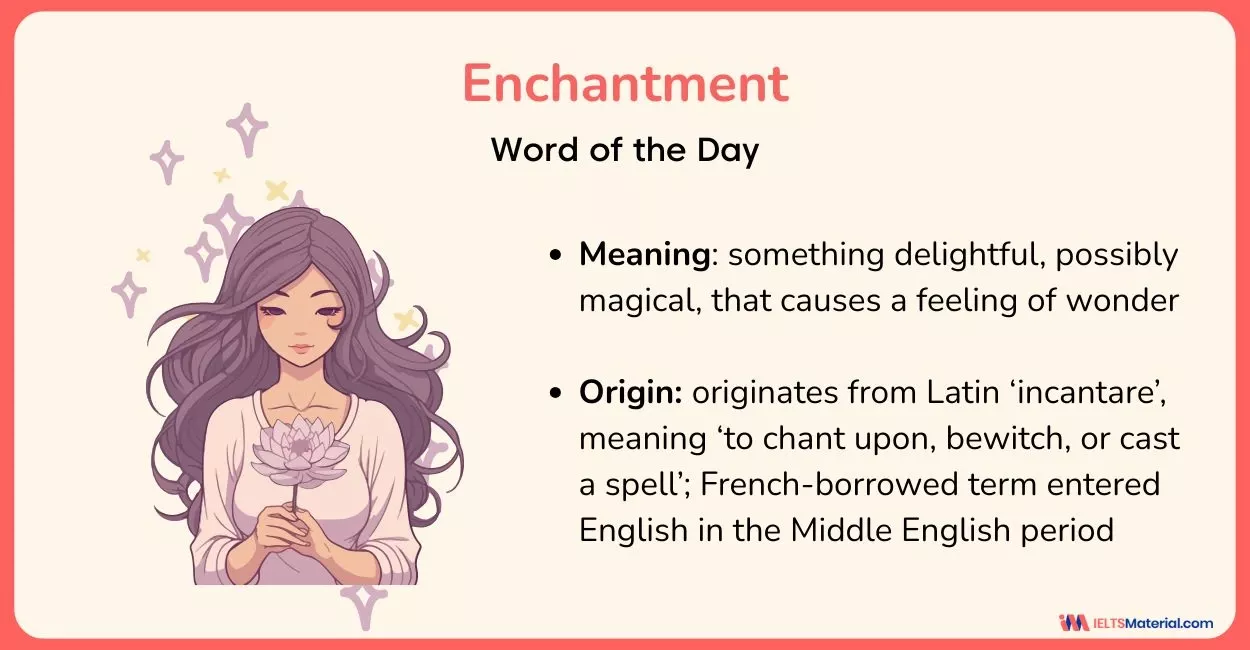
Table of Contents


Limited-Time Offer : Access a FREE 10-Day IELTS Study Plan!
The word ‘enchantment’ carries a rare blend of magic, mystery, and emotional depth. It is one of those words that instantly transforms ordinary language into vivid imagery. As a result, having a strong grasp of this particular word will significantly improve your IELTS vocabulary, ultimately leading to a more persuasive and effective communication style.
In this blog post, we will explore the meaning, origin, history, synonyms and antonyms of the word and proper usage of the term ‘enchantment’ within the context of IELTS, solidifying our understanding through practical exercises.
Meaning of Enchantment
- Pronunciation: /ɪnˈtʃɑːntmənt/ (sounds like uhn·chaant·muhnt)
The word ‘enchantment’ means ‘a feeling of great pleasure or delight; the state of being fascinated or charmed’.
History and Origin of ‘Enchantment’
‘Enchantment’ originates from the Old French word ‘enchanter’, meaning ‘to cast a spell’. This came from the Latin root ‘incantare’, where ‘in-’ means ‘upon’ and ‘cantare’ means ‘to sing.’
Historically, the word referred to magical chants used by sorcerers. Over time, its meaning expanded to include emotional and aesthetic charm, something so beautiful that it feels magical.
Book free IELTS online classes to maximize your vocabulary for the IELTS exam!
Usage & Examples of Enchantment
Let us look at some example sentences where the word ‘enchantment’ has been used in its noun form.
- Meera’s dance performance was a magical enchantment. Just like the movie Black Swan but even more captivating!
- He wrote so beautifully about the dangers as well as the enchantments of paragliding.
- Tim couldn’t get rid of the enchantment of Yukti.
- Mayank is in a state of enchantment.
- Annie’s enchantment faded when she found that the house needed even more repair.
- This place has lost its enchantment for me.
- The enchanted silence of the library created an atmosphere of complete concentration.
- Children listened in enchantment as their grandmother narrated ancient folktales.
- The city was filled with a festive enchantment during the winter celebrations.
Using ‘Enchantment’ as Different Parts of Speech
Although ‘enchantment’ is a noun, it can also be used in adjective and verb forms. So, given below are some sentences using the word in different forms.
|
Word Form |
Example Sentences |
|---|---|
|
Verb (Enchant) |
|
|
Adjective (Enchanted) |
|
IELTS Usage of ‘Enchantment’
The word ‘enchantment’ can elevate your IELTS Writing and Speaking answers, especially when describing a breathtaking landscape, an unforgettable moment, or a captivating story. Given below are examples of the usage of the word in IELTS Speaking and Writing Task 2.
IELTS Speaking Part 3
- Question: Do people today still appreciate experiences that feel exciting?
- Sample Answer: “Yes, I believe so. Despite technology taking over much of our time, people still seek moments of enchantment - whether in nature, travel, or art. Such experiences bring emotional relief and help people reconnect with themselves. In a way, enchantment has become a rare but needed escape from daily stress.”
IELTS Writing Task 2
- Topic: Some people believe that modern cities should preserve natural landscapes. To what extent do you agree or disagree?
- Answer Excerpt: I completely agree that modern cities should protect natural landscapes. These spaces offer a sense of enchantment that cannot be replicated by urban structures. Natural environments reduce stress, improve mental health, and promote community well-being.
Book a FREE demo to talk to our experts and boost your IELTS vocabulary now!
Synonyms and Antonyms of ‘Enchantment’
The table below provides a list of synonyms and antonyms of ‘enchantment’, complete with their meanings and example sentences.
|
Type |
Word |
Meaning |
Example Sentence |
|---|---|---|---|
|
Synony |
Charm |
the power of pleasing or attracting |
The village had a rustic charm that enchanted every traveller. |
|
Magic |
a mysterious or extraordinary quality |
The concert had a magic that left the audience speechless. |
|
|
Allure |
a mysterious, attractive quality |
The allure of the forest grew stronger as the mist settled in. |
|
|
Fascination |
strong interest or attraction |
His fascination with astronomy began in childhood. |
|
|
Antonym |
Boredom |
a state of feeling uninterested |
The long, repetitive lecture filled the room with boredom. |
|
Disenchantment |
loss of admiration or disappointment |
There was a sense of disenchantment among workers after the policy change. |
|
|
Repulsion |
a strong feeling of disgust |
The dirty surroundings caused instant repulsion among tourists. |
Join us in our free webinars to learn tricks to improve IELTS vocabulary! Join Now!
Exercise to Master the Meaning of ‘Enchantment’
To enhance your understanding of the word 'enchantment', we will now work through the exercise below.
Exercise: Choose the correct option.
1 Which situation best represents ‘enchantment’ in its abstract, non-magical sense?
A A spell cast in a fairy tale
B A person's intense admiration for a breathtaking performance
C A scientist conducting a physics experiment
D A teacher explaining a mathematical formula
2 If a character feels ‘enchantment’ upon entering a library, what can be inferred about their emotional state?
A They feel overwhelmed with anxiety
B They are irritated by the silence
C They are deeply captivated and charmed
D They wish to leave immediately
3 Enchantment is to wonder as:
A Inspiration is to creativity
B Disappointment is to delight
C Fear is to calm
D Anger is to harmony
4 Which statement incorrectly interprets the meaning of ‘enchantment’?
A It always refers to literal magic and cannot be used metaphorically.
B It can describe deep emotional captivation.
C It can refer to a sense of magical charm.
D It can be used to describe the irresistible beauty of a place or experience.
5 In which academic context would ‘enchantment’ most appropriately describe a phenomenon?
A A chemistry experiment producing inaccurate results
B An engineering manual describing machine parts
C A statistical analysis of inflation trends
D A psychological study on emotional responses to natural beauty
Answer Keys
|
1 |
2 |
3 |
4 |
5 |
|
B |
C |
A (Enchantment evokes wonder just as inspiration evokes creativity.) |
A |
D |
To conclude, using ‘enchantment’ demonstrates range, precision, and emotional nuance, all of which contribute to a higher lexical resource score. It helps describe experiences, places, and emotions vividly, perfect for IELTS Speaking Part 2 and writing descriptions in Task 2. The word also fits naturally into academic and semi-formal contexts, making it a powerful addition to your IELTS vocabulary.
Useful Links:
Explore IELTS Resources

Start Preparing for IELTS: Get Your 10-Day Study Plan Today!

Check out other Word of the Day Articles
Kasturika Samanta
Nehasri Ravishenbagam
Kasturika Samanta
Haniya Yashfeen

Recent Articles
Kasturika Samanta
Kasturika Samanta
Kasturika Samanta


Post your Comments