Condemn: Word Meaning, Examples, Origin & Usage in IELTS
5 min read
Updated On
-
Copy link
The word ‘condemn’ means ‘to criticize something or someone strongly, usually for moral reasons’. Explore the history, usage, synonyms, and antonyms of the word, and practice the provided exercises to improve your IELTS vocabulary for a Band 7 and above.
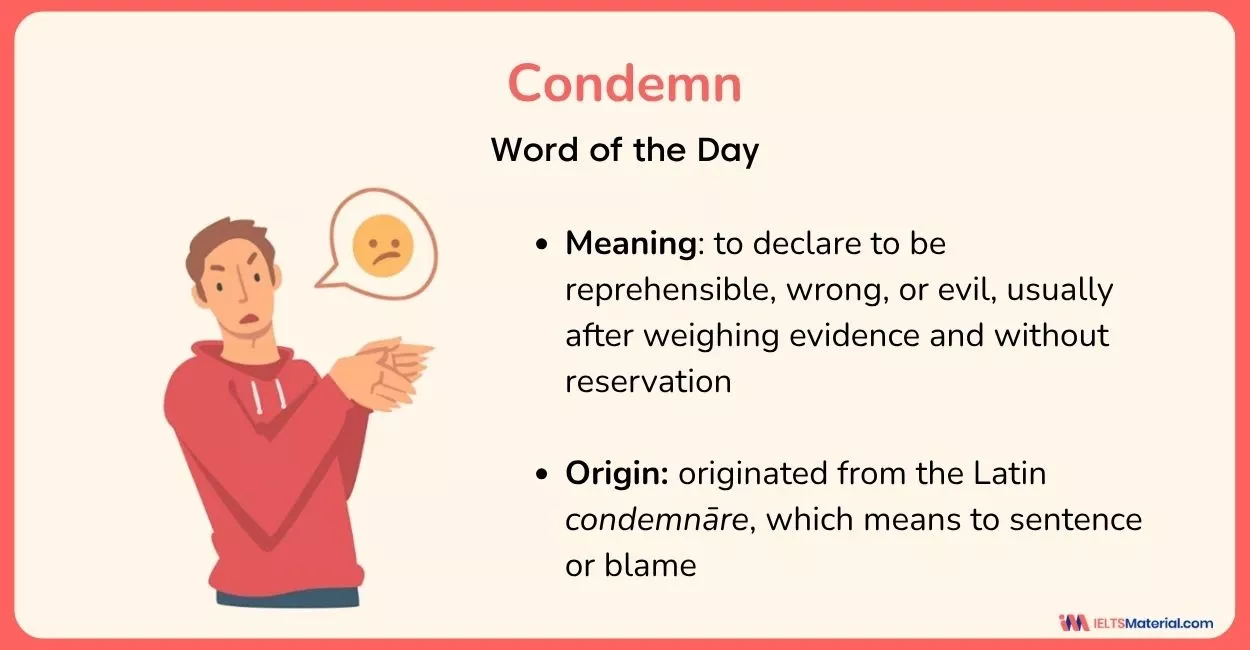
Table of Contents


Limited-Time Offer : Access a FREE 10-Day IELTS Study Plan!
You might have come across the word ‘condemn’ on social media or in online discussions when people speak against crimes or criticize something. Using such powerful words while writing essays, participating in debates, or preparing for IELTS can significantly raise the sophistication of your language. However, knowing its correct usage is important.
In this blog post, we will examine the meaning, origin, history, synonyms, and antonyms of the word, as well as its proper usage of the term ‘condemn’ within the context of IELTS, reinforcing our understanding through practical exercises.
Meaning of Condemn
- Pronunciation: /kən’dem/ (sounds like kuhn·dem)
The word ‘condemn’ means ‘to express strong disapproval of something, especially on moral or legal grounds’.
Understanding the meaning of the word is essential because the word is emotionally strong and contextually significant. It is widely used in discussions related to ethics, governance, social issues, and public responsibility.
History and Origin of ‘Condemn’
The word ‘condemn’ has long-standing roots in legal and moral discourse. It originates from the Latin verb ‘condemnāre’, meaning ‘to sentence, blame, or disapprove strongly’. It entered Old French as ‘condemner’, and later Middle English around the 14th century.
Because of these roots, ‘condemn’ retains a strong judicial sense, often connected to moral wrongdoing, punishment, or societal judgment.
Usage & Examples of Condemn
Let us look at some example sentences where the word ‘condemn’ has been used in its different contexts.
- Tom has condemned me all day for not telling him the truth.
- A large number of people condemned the government for spending money on building more houses instead of investing in preserving the polluted local environment.
- Governments worldwide condemn acts of terrorism due to their devastating impact on society.
- Environmentalists condemn industries that exploit natural resources irresponsibly.
- The public was quick to condemn the politician after the corruption scandal emerged.
Book IELTS online classes to maximize your word power for the IELTS exam!
IELTS Usage of ‘Condemn’
The word ‘condemn’ is excellent for IELTS Writing Task 2, especially in essays about crime, ethics, governance, and social responsibility. It is also powerful in the IELTS Speaking responses, where you must share about something you dislike or express opinions on serious issues.
IELTS Speaking Part 3
- Question: Should governments take steps against the use of fossil fuels more strongly?
- Sample Answer: Absolutely, governments should take a firm stance and condemn the excessive use of fossil fuels because of their severe environmental impact. It will encourage industries to shift towards cleaner alternatives and also send a clear message that sustainability is a national priority. Such measures may gradually influence public behaviour as well.
IELTS Writing Task 2
- Topic: Some people argue that nations should condemn violent video games for promoting aggression among young people. Do you agree?
- Answer Excerpt: Exposure to repeated violence may desensitize children, which is a serious psychological concern. However, condemning them outright is not a practical solution.
Book a FREE demo to talk to our experts and boost your IELTS vocabulary now!
Synonyms of Condemn
You should learn some close synonyms for IELTS Writing and Speaking of the word ‘condemn’. The following table explains them with dictionary meanings and unique example sentences.
|
Synonym |
Meaning |
Example Sentence |
|---|---|---|
|
Denounce |
to publicly declare something wrong or evil |
The activist denounced the company for its unethical labour practices. |
|
Criticize |
to express disapproval by pointing out faults |
The committee criticized the report for lacking reliable data. |
|
Censure |
to formally reprimand someone for unacceptable behaviour |
The board censured the official for misusing public funds. |
|
Rebuke |
to express sharp disapproval or criticism |
His manager rebuked him for ignoring safety guidelines. |
|
Blame |
to assign responsibility for a wrong or harmful act |
Many people blamed the administration for the poor planning. |
Use our free webinars to learn tricks to improve IELTS vocabulary! Join Now!
Antonyms of Condemn
Antonyms of ‘condemn’ help show how the meaning shifts from disapproval to acceptance, approval, or support. These are useful in argumentative writing where contrast is required.
|
Antonym |
Meaning |
Example Sentence |
|---|---|---|
|
Praise |
to express warm approval or admiration |
Teachers praised the students for their remarkable teamwork. |
|
Approve |
to agree to or accept something officially |
The council approved the new environmental policy unanimously. |
|
Support |
to give assistance or encouragement |
Many residents supported the proposal to expand green spaces. |
|
Endorse |
to publicly declare one’s approval |
The celebrity endorsed the charity’s new awareness campaign. |
|
Commend |
to speak favourably about someone’s achievements |
The director commended the team for their innovative ideas. |
Exercises to Master the Meaning of ‘Condemn’
Since you have gone through the meaning, origin, and usage of ‘condemn’, it is the right time to test your understanding of the word by taking the following exercises.
Exercise A: Rewrite the Sentence Using ‘Condemn’.
1 Many international leaders strongly criticised the violent actions of the rebel group.
2 The organisation publicly stated that the corruption scandal was unacceptable.
3 The villagers expressed complete disapproval of the factory for polluting the river.
4 The judge declared that the accused man deserved punishment for his inhumane actions.
Exercise B: Choose the correct option.
1 Which sentence best reflects the legal meaning of ‘condemn’?
A The audience condemned the actor for forgetting his lines.
B The government condemned the building, declaring it unsafe for living.
C The students condemned the cafeteria food for being bland.
D The artist condemned his old painting and refused to display it.
2 What does the word ‘condemn’ most likely imply in the following sentence: “Human rights groups condemned the new policy immediately.”?
A They publicly expressed strong disapproval of the policy.
B They quietly accepted the policy.
C They agreed to review the policy later.
D They supported the policy but requested minor edits.
Answer Keys
|
Exercise A |
Exercise B |
|---|---|
|
1 Many international leaders condemned the violent actions of the rebel group. 2 The organisation publicly condemned the corruption scandal as unacceptable. 3 The villagers condemned the factory for polluting the river. 4 The judge condemned the accused man for his inhumane actions. |
1 B 2 A |
In conclusion, the word ‘condemn’ is strong, formal, and impactful, and allows you to articulate criticism precisely and confidently in academic settings. So, using this word correctly will make your writing and speaking more authoritative as well as improve your IELTS vocabulary score.
Useful Links:
Explore IELTS Resources

Start Preparing for IELTS: Get Your 10-Day Study Plan Today!

Check out other Word of the Day Articles
Kasturika Samanta

Nehasri Ravishenbagam
Kasturika Samanta
Haniya Yashfeen

Recent Articles
Kasturika Samanta
Kasturika Samanta
Kasturika Samanta


Post your Comments