Calisthenics - IELTS Reading Answers
15 min read
Updated On
-
Copy link
Boost your IELTS reading band score to 8 and above by using the ‘Calisthenics’ IELTS reading passage and its answer key. Also, use the answer explanation and tips in the blog to tackle various IELTS reading questions and improve your reading strategy.
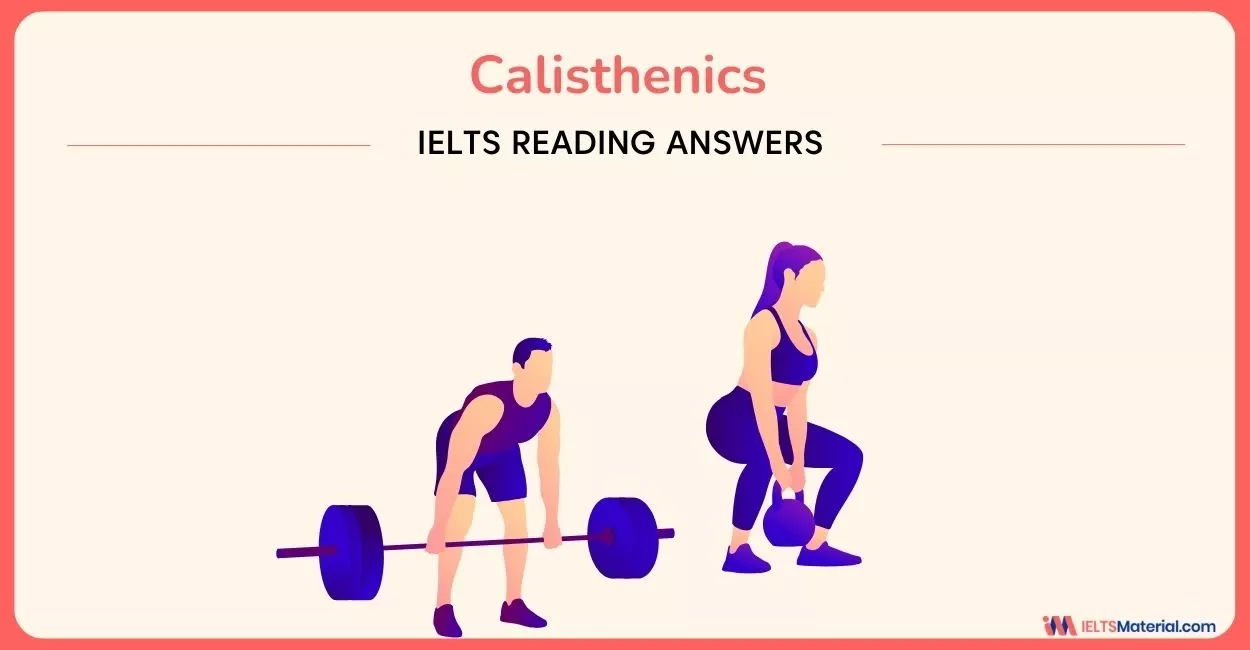
Table of Contents


Limited-Time Offer : Access a FREE 10-Day IELTS Study Plan!
Single-passage practice acts as a confidence-building step. Completing one passage like ‘Calisthenics IELTS Reading Answers’ accurately reassures you that your strategies are working. This gradual progression makes the transition to full tests smoother and less intimidating.
So, take the test, Calisthenics, below, and try more IELTS reading practice tests. We have provided explanations, locations, and tips for the answers to help you handle the three different types of reading questions here.
Passage for Calisthenics IELTS Reading Answers
Go through the passage for ‘Calisthenics’ Reading Answers given below, and be prepared to solve similar IELTS Reading topics for General and Academic for the reading section.
You should spend about 20 minutes on Questions 28-40, which are based on the Reading Passage below.
Calisthenics
A From the very first caveman to scale a tree or hang from a cliff face, to the mighty armies of the Greco-Roman empires and the gymnasiums of modern American high schools, calisthenics has endured and thrived because of its simplicity and utility. Unlike strength training which involves weights, machines or resistance bands, calisthenics uses only the body’s own weight for physical development.
B Calisthenics enters the historical record at around 480 B.C., with Herodotus’ account of the Battle of Thermopolylae. Herodotus reported that, prior to the battle, the god-king Xerxes sent a scout party to spy on his Spartan enemies. The scouts informed Xerxes that the Spartans, under the leadership of King Leonidas, were practising some kind of bizarre, synchronised movements akin to a tribal dance. Xerxes was greatly amused. His own army was comprised of over 120,000 men, while the Spartans had just 300. Leonidas was informed that he must retreat or face annihilation. The Spartans did not retreat, however, and in the ensuing battle, they managed to hold Xerxes’ enormous army at bay for some time until reinforcements arrived. It turns out their tribal dance was not a superstitious ritual but a form of calisthenics by which they were building awe-inspiring physical strength and endurance.
C The Greeks took calisthenics seriously not only as a form of military discipline and strength but also as an artistic expression of movement and an aesthetically ideal physique. Indeed, the term calisthenics itself is derived from the Greek words for beauty and strength. We know from historical records and images from pottery, mosaics and sculptures of the period that the ancient Olympians took calisthenics training seriously. They were greatly admired – and still are, today – for their combination of athleticism and physical beauty. You may have heard a friend whimsically sigh and mention that someone ‘has the body of a Greek god’. This expression has travelled through centuries and continents and the source of this envy and admiration is the calisthenics method.
D Calisthenics experienced its second golden age in the 1800s. This century saw the birth of gymnastics, an organised sport that uses a range of bars, rings, vaulting horses and balancing beams to display physical prowess. This period is also when the phenomena of strongmen developed. These were people of astounding physical strength and development who forged nomadic careers by demonstrating outlandish feats of strength to stunned populations. Most of these men trained using hand balancing and horizontal bars, as modern weight machines had not yet been invented.
E In the 1950s, Angelo Siciliano – who went by the stage name Charles Atlas – was crowned “The World’s Most Perfectly Developed Man”. Atlas’s own approach stemmed from traditional calisthenics and through a series of mail-order comic books he taught these methods to hundreds of thousands of children and young adults through the 1960s and 1970s. But Atlas was the last of a dying breed. The tides were turning, fitness methods were drifting away from calisthenics, and no widely-regarded proponent of the method would ever succeed him.
F In the 1960s and 1970s, calisthenics and the goal of functional strength combined with physical beauty was replaced by an emphasis on huge muscles at any cost. This became the sport of bodybuilding. Although body building’s pioneers were drawn from the calisthenics tradition, the sole goal soon became an increase in muscle size. Bodybuilding icons, people such as Arnold Schwarzenegger and Sergio Oliva, were called mass monsters because of their imposing physiques. Physical development of this nature was only attainable through the use of anabolic steroids, synthetic hormones which boosted muscle development while harming overall health. These bodybuilders also relied on free weights and machines, which allowed them to target and bloat the size of individual muscles rather than develop a naturally proportioned body. Calisthenics, with its emphasis on physical beauty and a balance in proportions, had little to offer the mass monsters.
G In this “bigger is better” climate, calisthenics was relegated to groups perceived to be vulnerable, such as women, people recuperating from injuries and school students. Although some of the strongest and most physically developed human beings ever to have lived acquired their abilities through the use of sophisticated calisthenics, a great deal of this knowledge was discarded and the method was reduced to nothing more than an easily accessible and readily available activity. Those who mastered the rudimentary skills of calisthenics could expect to graduate to weight training rather than advanced calisthenics.
H In recent years, however, fitness trends have been shifting back toward the use of calisthenics. Bodybuilding approaches that promote excessive muscle development frequently lead to joint pain, injuries, unbalanced physiques and weak cardiovascular health. As a result, many of the newest and most popular gyms and programmes emphasize calisthenics-based methods instead. Modern practices often combine elements from a number of related traditions such as yoga, Pilates, kettle-ball training, gymnastics and traditional Greco-Roman calisthenics. Many people are keen to recover the original Greek vision of physical beauty and strength and harmony of the mind-body connection.
Questions for Calisthenics Reading Answers
The IELTS General Reading passage, Calisthenics Reading Answers, consists of 13 questions, which showcase three different IELTS Reading question types. They are:
- IELTS Reading Multiple-Choice Question (Q. 28)
- IELTS Reading Matching Information (Q. 29-35)
- IELTS Reading Summary Completion (Q. 36-40)
Questions 28
Which of the following statements is true according to the passage?
Write A, B, C or D in the box 28 on your answer sheet.
28 Calisthenics is:
A the world’s oldest form of sports training
B a strength training
C a battle technique
D being emphasized by many popular gyms
Questions 29-35
The text has eight paragraphs, A–H. Which paragraph contains the following information?
Write the correct letter, A–H, in boxes, 29–35 on your answer sheet
29 The origin of the word ‘calisthenics’.
30 The last popular supporter of calisthenics.
31 The first use of calisthenics as a training method.
32 A multidisciplinary approach to all-round health and strength.
33 Reasons for the survival of calisthenics throughout the ages.
34 The use of a medical substance to increase muscle mass and strength.
35 A reference to travelling showmen who displayed their strength for audiences.
Questions 36-40
Complete the summary below.
Choose NO MORE THAN TWO WORDS from the text for each answer.
Write your answers in boxes 36–40 on your answer sheet.
During the sixties and seventies, attaining huge muscles became more important than (36) ……………… or having an attractive-looking body. The first people to take up this new sport of bodybuilding had a background in calisthenics but the most famous practitioners became known as (37) ……………… on account of the impressive size of their muscles. Drugs and mechanical devices were used to develop individual muscles to a monstrous size. Calisthenics then became the domain of ‘weaker’ people: females, children and those recovering from (38) ……………… . Much of the advanced knowledge about calisthenics was lost and the method was subsequently downgraded to the status of a simple, user-friendly activity. Once a person became skilled at this, he would progress to (39) ……………… . Currently, a revival of calisthenics is underway as extreme muscle building can harm the body leaving it sore, out of balance, and in poor (40) ……………… .
Looking for comprehensive preparation material for IELTS General Reading?
Check out - IELTS 2026 Reading (General) Actual Tests with Answers!
Answers and Explanations of Calisthenics IELTS Reading Passage
Check out the 'Calisthenics' answer key with explanations and locations to assess your improvement and achieve a high IELTS band score.
28 Answer: D
Question type: Multiple choice Questions
Answer location: Paragraph A, line 1- line 3 & Paragraph H , line 4 – line 5
Answer explanation: The introductory line from Paragraph A that says that “From the very first caveman … and the gymnasiums of modern American high schools, calisthenics has endured and thrived because of its simplicity and utility.” and the mentioned lines from Paragraph H that states “As a result, many of the newest and most popular gyms and programmes emphasize calisthenics-based methods instead.” points to the fact that Calisthenics is emphasized by many gyms. Moreover, it is the oldest form of resistance training and not sports training and is different from strength training or battle techniques. Hence the answer is D.
29 Answer: C
Question type: Matching Information
Answer location: Paragraph C, line 3 – line 4
Answer explanation: The following lines from Paragraph C says that “Indeed, the term calisthenics itself is derived from the Greek words for beauty and strength.” This shows that the details of the origin of the word ‘calisthenics’ is found in Paragraph C. Hence the answer is C.
30 Answer: E
Question type: Matching Information
Answer location: Paragraph , line 2 – line 5
Answer explanation: The following line from Paragraph E says that “Atlas’s own approach stemmed from traditional calisthenics …. But Atlas was the last of a dying breed.” These lines indicate that Angelo Siciliano, alias Charles Atlas, was the last of the group of people who supported the practice of calisthenics. Hence the answer is E.
31 Answer: B
Question type: Matching Information
Answer location: Paragraph B, line 1 – line 2
Answer explanation: The stated lines from Paragraph B says that “Calisthenics enters the historical record at around 480 B.C., with Herodotus’ account of the Battle of Thermopolylae’. Then, the rest of the paragraph relates how calisthenics was used as a training method in the battle. Hence the answer is B.
32 Answer: H
Question type: Matching Information
Answer location: Paragraph H, line 5 – line 7
Answer explanation: The mentioned line from Paragraph H says that “Modern practices often combine elements from a number of related traditions such as yoga, Pilates, kettle-ball training, gymnastics and traditional Greco-Roman calisthenics.” In other words, now, people are more interested in a multidisciplinary approach to all-round health and strength combining yoga, Pilates, kettle-ball training, gymnastics and calisthenics. Hence the answer is H.
33 Answer: A
Question type: Matching Information
Answer location: Paragraph A, line 1 – line 3
Answer explanation: The specified lines from Paragraph A says that “From the very first caveman to scale a tree or hang from a cliff face, to the mighty armies of the Greco-Roman empires and the gymnasiums of modern American high schools, calisthenics has endured and thrived because of its simplicity and utility.” So, the simplicity and utility of calisthenics are the reasons for its survival throughout the ages. Hence the answer is A.
34 Answer: F
Question type: Matching Information
Answer location: Paragraph F, line 7 – line 9
Answer explanation: The mentioned lines from Paragraph F states that “Physical development of this nature was only attainable through the use of anabolic steroids, synthetic hormones which boosted muscle development while harming overall health.” It means that people used medical substances like anabolic steroids, synthetic hormones to increase muscle mass and strength. Hence the answer is F.
35 Answer: D
Question type: Matching Information
Answer location: Paragraph D, line 4 – line 6
Answer explanation: The quoted lines from Paragraph D says that “These were people of astounding physical strength and development who forged nomadic careers by demonstrating outlandish feats of strength to stunned populations.” In other words, there were many travelling showmen (nomadic) who displayed (demonstrated) their feats of strength to stun their audiences. Hence the answer is D.
36 Answer: functional strength
Question type: Summary Completion
Answer location: Paragraph F, line 1 – line 2
Answer explanation: The mentioned lines from Paragraph F says that “In the 1960s and 1970s, calisthenics and the goal of functional strength combined with physical beauty was replaced by an emphasis on huge muscles at any cost.” It means that during the sixties and seventies, more emphasis was put on huge muscles, which became more important than the goal of functional strength or having an attractive-looking body (physical beauty). Hence the answer is functional strength.
37 Answer: mass monsters
Question type: Summary Completion
Answer location: Paragraph F, line 3 – line 6
Answer explanation: The given lines from Paragraph F says that “Although body building’s pioneers were drawn from the calisthenics tradition, the sole goal soon became an increase in muscle size. Bodybuilding icons, people such as Arnold Schwarzenegger and Sergio Oliva, were called mass monsters because of their imposing physiques.” It refers to the fact that the first people to take up this new sport of bodybuilding (bodybuilding pioneers) had a background in calisthenics (drawn from the calisthenics tradition) but the most famous practitioners (icons) became known as mass monsters. Hence the answer is mass monsters.
38 Answer: injuries
Question type: Summary Completion
Answer location: Paragraph G, line 1 – line 2
Answer explanation: The introductory lines from Paragraph G says that “In this “bigger is better” climate, calisthenics was relegated to groups perceived to be vulnerable, such as women, people recuperating from injuries and school students.” As it is quite clear from this sentence that calisthenics then became the domain of ‘weaker’ people: females (women), children (school students) and those recovering (recuperating) from injuries, the answer is injuries.
39 Answer: weight training
Question type: Summary Completion
Answer location: Paragraph G, line 6 – line 7
Answer explanation: The stated lines from Paragraph G says that “Those who mastered the rudimentary skills of calisthenics could expect to graduate to weight training rather than advanced calisthenics.” It means that once a person became skilled (mastered) at the basic skills of calisthenics, he would progress to weight training rather than moving to its advanced levels. Hence the answer is weight training.
40 Answer: cardiovascular health
Question type: Summary Completion
Answer location: Paragraph H, line 1 – line 3
Answer explanation: In the introductory lines of Paragraph H, it is given that “In recent years, however, fitness trends have been shifting back toward the use of calisthenics. Bodybuilding approaches that promote excessive muscle development frequently lead to joint pain, injuries, unbalanced physiques and weak cardiovascular health.” It means that calisthenics is being revived as extreme muscle building can harm the body leading to soreness (joint pain), out of balance (unbalanced physiques), and poor cardiovascular health. Hence the answer is cardiovascular health.
Book a FREE Demo to learn proven reading techniques and tips from experts!
How to Solve the Question Types in the Calisthenics Reading Passage?
Here are some IELTS exam preparation tips for band score of 8+ to help you prepare for the Calisthenics Reading Answers and improve your reading skills.
Multiple Choice Question
- Focus on the keyword that defines the topic: The stem says “Calisthenics is:”, so your task is to identify how the passage describes or defines calisthenics today or overall. Ignore personal assumptions about exercise or fitness, and rely only on textual evidence. This ensures your choice is based on the writer’s claim, not general knowledge.
- Compare each option carefully; don’t scan for only one: Check all options. The passage may mention some ideas historically (e.g., battle training) but not define calisthenics overall.
- Locate where the passage describes modern relevance: Words like “modern gyms,” “current trends,” or “popular programmes” often indicate present-day definitions. If the passage states that many gyms emphasise calisthenics-based methods, that directly matches option D. IELTS often tests current status rather than historical references.
- Eliminate partially true distractors: If calisthenics were used in battle or strength training historically, those options may sound correct, but are not the main definition asked in Question 28. Always select the statement that fully matches the passage’s main claim.
Matching Information
- Identify the precise information required: Each question has a very specific focus. For example, Q29 is about the origin of the word, Q31 is about its first use as a training method, and Q34 is about a medical substance to increase muscle mass. These are factual details, so scan for precise references, not general discussion.
- Predict likely vocabulary or synonyms: For example, the origin of the word is derived from, comes from, Greek roots, travelling showmen refers to nomadic performers, strongmen exhibitions, and medical substance is steroids and synthetic hormones. Predicting paraphrases helps you recognise the correct paragraph quickly.
- Scan topic sentences first: Paragraph openings often introduce key information. If a paragraph begins by describing historical terminology or language roots, it likely matches Question 29 (origin of the word ‘calisthenics’). This saves time before reading full paragraphs.
- Match unique clues exactly: Some questions contain very distinctive details. For example, Question 35 mentions “travelling showmen who displayed their strength”, which is a vivid image and easy to locate. Specific imagery is easier to match than abstract concepts.
- Distinguish between historical vs modern references: Question 31 asks for “first use as a training method,” which suggests early history. Question 32 refers to “multidisciplinary approach”, which sounds modern. Time reference helps you identify the correct section quickly.
- Use elimination when multiple paragraphs discuss similar themes: Several paragraphs may discuss strength or fitness, but only one explains why calisthenics survived through the ages (Question 33). Choose the paragraph that explains reasons, not just description.
- Remember information may appear mid-paragraph: Do not assume the answer is in the first line. For example, details about steroids (Question 34) may appear in the middle of a discussion on bodybuilding. Scan the whole paragraph if necessary.
Summary Completion
- Read the summary to understand the timeline: The summary moves from 1960s–70s bodybuilding trends, decline of calisthenics, who practised it, skill progression to modern revival. Understanding this sequence helps you locate information in order.
- Pay close attention to the word limit: The instruction says “Choose NO MORE THAN TWO WORDS.” Writing three words or changing wording (e.g., adding articles) will make the answer incorrect. Always copy the phrase exactly as it appears.
- Predict grammar before searching: Grammar prediction helps you recognise the correct phrase instantly. Look at sentence structure:
- Q36 “more important than ___” → noun phrase
- Q38 “recovering from ___” → plural noun
- Q40 “poor ___” → health-related noun phrase
- Locate the paragraph using strong keywords: For example, Q37 refers to “huge muscles” and bodybuilding, so scan the muscle development section, and as Q39 refers to skill progression, look for words like ‘master’, ‘graduate’, and ‘progress’. Find the paragraph first, then identify the exact words.
- Match paraphrased meaning with original wording: The summary may say “attaining huge muscles became more important than…” but the passage may use different wording like goal replaced by emphasis on muscle size. Understand meaning first, then copy the original words.
- Copy only what fits grammatically: If the text says “weak cardiovascular health,” and the sentence says “poor ….,” only write cardiovascular health. Never include extra descriptive words unless required.
- Check spelling and word count at the end: Technical terms (e.g., health-related phrases or training types) must be spelled correctly. Even one spelling error results in a wrong answer. Always recheck answers before moving on.
In conclusion, it is essential to practice single passages like Calisthenics IELTS Reading Answers from IELTS Reading recent actual tests and real Reading practice tests. You can use them to improve your reading speed, quickly pinpoint your areas of weakness, and successfully answer various comprehension test questions. You can, therefore, get closer to reaching your intended outcomes by practicing these tests regularly.
Useful Links:
- Employment in Japan - IELTS Reading Answers
- Evening Courses - IELTS Reading Answers
- Mass Appeal of the Manta Rays – IELTS Reading Answers
- Emergency Procedures & Community Education - IELTS Reading Answers
- Trends in Indian Fashion and Textiles Industries - IELTS Reading Answers
- How to Finish 3 IELTS Reading Comprehension in Less Than 60 Mins?
Practice IELTS Reading based on question types

Start Preparing for IELTS: Get Your 10-Day Study Plan Today!

Explore other Reading Actual Tests

Kasturika Samanta
Prity Mallick

Kasturika Samanta
Kasturika Samanta

Recent Articles
Nehasri Ravishenbagam
Haniya Yashfeen

Haniya Yashfeen

Haniya Yashfeen


Post your Comments