Describe a Puzzle That You Solved - IELTS Cue Card
7 min read
Updated On
-
Copy link
This blog provides 3 Band 9 sample answers for the IELTS Speaking cue card “Describe a Puzzle That You Solved,” along with vocabulary and Part 3 questions to help you confidently prepare, improve fluency, and boost your IELTS Speaking score.
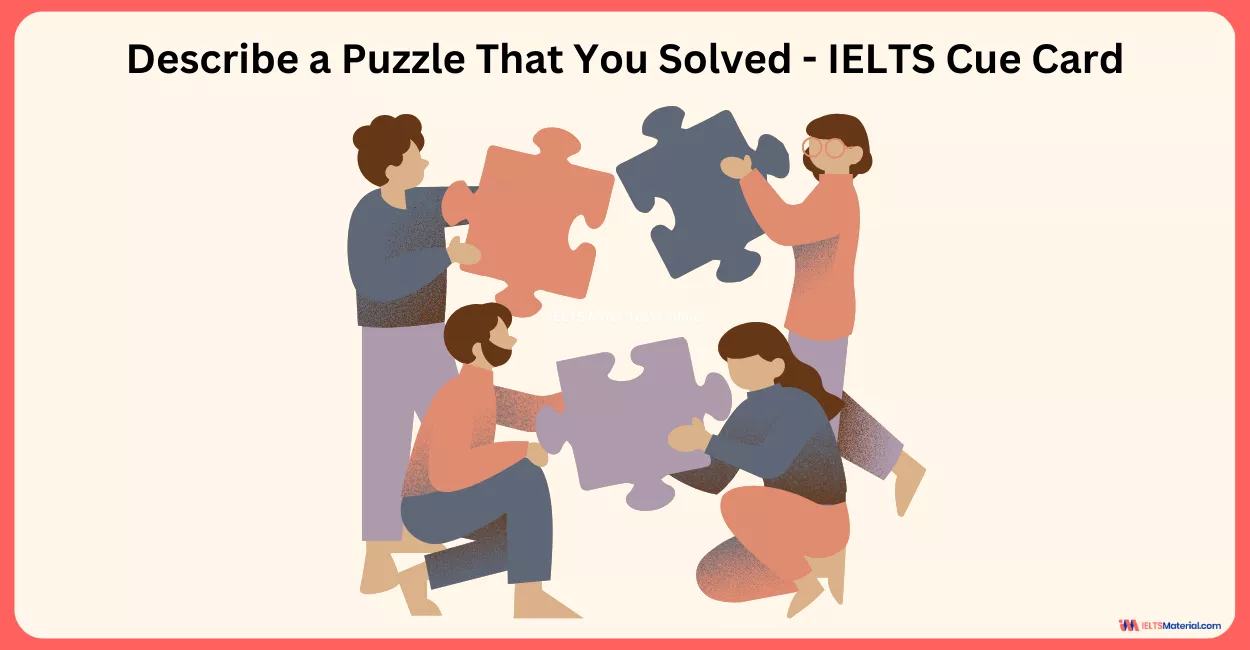
Table of Contents
- Describe a Puzzle That You Solved (jigsaw, crossword, etc)
- Describe a Puzzle That You Solved - Sample Answer 1
- Describe a Puzzle That You Solved - Sample Answer 2
- Describe a Puzzle That You Solved - Sample Answer 3
- Describe a Puzzle That You Solved - IELTS Vocabulary
- Speaking Part 3 – Follow up Questions
- Speaking Part 3 – Follow up Vocabulary


Limited-Time Offer : Access a FREE 10-Day IELTS Study Plan!
“Describe a Puzzle That You Solved” is a popular IELTS Speaking cue card that assesses fluency, coherence, and vocabulary. In this blog, you will find 3 band-based sample answers, useful vocabulary, and related Part 3 questions to help you deliver a confident and well-prepared response.
Learn IELTS Cue Card tips and practice more topics with the guide below!
For more Cue Cards, take a look at IELTS Speaking Part 2 | Topics, Questions and Samples Answers.
Describe a Puzzle That You Solved (jigsaw, crossword, etc)
You should say:
- What puzzle was it?
- How long does it take to complete it?
- Whether it was difficult or easy?
- How you feel about it
Describe a Puzzle That You Solved - Sample Answer 1
Puzzles are a part of almost everyone’s childhood. These brain-teasers are a riveting and refreshing way of diverting our minds. A similar experience of solving a puzzle that I would like to talk about is the Rubik’s Cube. The Rubik’s Cube is probably the most recognized puzzle around the world. It is difficult to find an individual who hasn’t tried their hand at solving a Rubik’s Cube. This particular puzzle comes in the form of a plastic cube that is overlaid with multicolored squares on every side. The objective is to twist and turn the cube and cumulate all the same coloured squares on each side or face.
The most intriguing characteristic of this puzzle is that it can be solved in a matter of seconds if the player can figure out all the moves accurately. On the other hand, this exact feature has a tantalizing effect on players, because, in a rush to solve the puzzle as quickly as possible, players often twist and turn the cube in the wrong direction, making it even more perplexing.
I remember distinctly when my mother brought me a Rubik’s Cube as a birthday present. Initially, I had no clue how to go about solving this puzzle on my own. I would spend hours twisting and turning the cube, making the colors even more jumbled than they were before. Eventually, I managed to solve the puzzle after several days and was ecstatic at the fact and showed my parents the solved Rubik’s Cube.
The Rubik’s Cube has always been a puzzling and entertaining experience for me ever since I was a child. Even to this day, I still have not figured out a definite pattern to solve this particular puzzle.
Join us in our free webinars to learn tricks to drive away your IELTS exam blues! Explore Now!
Describe a Puzzle That You Solved - Sample Answer 2
One puzzle I clearly remember solving was a 1,000-piece jigsaw puzzle that showed a scenic mountain landscape. I worked on it during a weekend at home, and it took me around three days to complete, spending a few hours each day.
At the beginning, it was quite challenging, especially sorting the pieces by colour and edges. The sky section was particularly tricky because many pieces looked almost identical. However, once I organised the pieces properly, the process became much easier and more enjoyable.
I felt extremely satisfied and relaxed after completing the puzzle. It gave me a sense of achievement and helped me unwind after a busy week. Overall, it was a rewarding experience, and I would definitely like to solve similar puzzles again.
Enroll in our IELTS Online Classes to boost your IELTS Speaking Skills!
Describe a Puzzle That You Solved - Sample Answer 3
Another puzzle I solved recently was a daily crossword puzzle from a newspaper. I usually attempt it in the morning, and on this occasion, it took me about 20 to 25 minutes to finish.
I would say it was moderately difficult because some clues required strong vocabulary and general knowledge. A few answers were confusing at first, but crossing letters helped me figure them out gradually. This problem-solving aspect made the puzzle more engaging.
I felt mentally stimulated and proud once I completed it. Solving the crossword improved my concentration and vocabulary, and it has now become a regular habit that I genuinely enjoy.
Grab our Comprehensive IELTS Speaking Band 8 Preparation Course before it’s Out of Stock! Don’t Miss Out!
Describe a Puzzle That You Solved - IELTS Vocabulary
Here are some IELTS Speaking vocabulary words used in the sample answers for the topic: Describe a Puzzle That You Solved (jigsaw, crossword, etc)- IELTS Cue Card.
- Riveting
Meaning: completely engrossing; compelling.
Eg: The new magic show had a riveting effect on everyone present in the auditorium.
- Cumulate
Meaning: gather together and combine.
Eg: The detective wanted to cumulate all the evidence before the trial.
- Tantalizing
Meaning: tormenting or teasing with the sight or promise of something unattainable.
Eg: Fame has a tantalizing effect on the minds of many people.
- Perplexing
Meaning: completely baffling; very puzzling.
Eg: The Bermuda Triangle is one of the most perplexing mysteries of the world.
- Ecstatic
Meaning: feeling or expressing overwhelming happiness or joyful excitement.
Eg: The college volleyball team was ecstatic about their tournament victory.
Check out our IELTS Speaking Practice Tests to improve your performance & boost your band score!
Speaking Part 3 – Follow up Questions
IELTS Speaking Part 3 focuses on abstract and opinion-based questions. Your answers should be longer and show critical thinking. The sample Band 9 responses below demonstrate how to extend answers with examples and reasoning.
-
What do people do online in their free time?
The current era is known for its technological advancements. Presently, the most common form of leisure is surfing the Internet. People nowadays tend to spend a majority of their free time on social media platforms. Online video-sharing platforms like Youtube are also extremely popular as a form of entertainment during spare time.
-
What impact does the internet have on schools?
Just like any other phenomenon, the Internet has both positive and negative effects on schools and schoolchildren. Today, a stupendous amount of study resources are available to both students and teachers through online platforms. Such a development can remarkably improve the quality of education dispensed at the school level. On the other hand, the convenience of the Internet can have a detrimental effect on both teachers and students. The easy availability of information can lead to a certain degree of complacency in the process of learning.
-
Do you think many people waste their time online?
Yes, I believe that spending too much time online has become a distressing issue over the last few years. Today, people tend to spend hours on the Internet browsing and scrolling through social media platforms like Facebook and Instagram. Such practices deteriorate the mental and physical health of the general masses. The average person has significantly less time on their hands because of the amount of time they waste online.
-
What can people do with the Internet in the future? And how?
The Internet can be a dynamic and powerful tool if used correctly. There are dedicated online platforms available for nearly every aspect of human life. One of the most striking characteristics of the Internet is the ability to make a livelihood online. I believe that people will be able to earn a living online. Such an endeavor can be undertaken when people showcase their skills and talents through online platforms like Youtube and Twitch.
-
In what ways can people get information nowadays?
The most prevalent approach to acquiring information in the present day scenario is browsing the Internet. Since the Internet is accessible through personal computers and smartphones, any kind of information is available at a person’s fingertips. Google, which is the most powerful web browser available, is commonly used for research and queries of all sorts. This particular browser can give an individual more than millions of results for the type of information they are looking for.
Speaking Part 3 – Follow up Vocabulary
Using precise IELTS Vocabulary can help you strengthen your answers in Part 3. Here are some useful phrases from the sample responses with meanings and examples:
- Surfing
Meaning: move from page to page or site to site on (the World Wide Web).
Eg: A better internet connection makes surfing much easier.
- Stupendous
Meaning: extremely impressive.
Eg: The company rewarded the employees with bonuses due to their stupendous performance.
- Detrimental
Meaning: tending to cause harm.
Eg: The Chernobyl Nuclear Disaster in Ukraine had a detrimental effect on all the neighboring countries.
- Complacency
Meaning: a feeling of smug or uncritical satisfaction with oneself or one’s achievements.
Eg: Kevin was fired from the team due to his complacency during work.
- Dynamic
Meaning: characterized by constant change, activity, or progress
Eg: The economy is a dynamic aspect of a nation that requires time and effort to understand.
In conclusion, this blog provides 3 sample answers, key vocabulary, and Part 3 practice questions for the cue card “Describe a Puzzle That You Solved”, giving you everything you need to confidently prepare and improve your IELTS Speaking score.
Useful Links:
- How to Prepare a Cue Card for IELTS Speaking
- What to Do if You Forget What to Say During IELTS Speaking Test?
- Latest IELTS Speaking Vocabulary to Boost Your Score
- How to Express Your Mixed Feelings in IELTS Writing & Speaking?
- 10 Useful Structures to Express Contrasting Ideas in IELTS Speaking & Writing Task 2
- 75+ Common English Words Used in IELTS Speaking Test
- 5 Silly Things You Say To Decrease Your IELTS Speaking Band Score

Start Preparing for IELTS: Get Your 10-Day Study Plan Today!

Recent Articles

Haniya Yashfeen
Kasturika Samanta

Nehasri Ravishenbagam


Post your Comments