The Rise of Adjuncts - IELTS Reading Answers
Boost your IELTS reading band score to 8 and above by using the ‘The Rise of Adjuncts’ IELTS reading passage and its answer key with location. Also, learn to tackle different IELTS reading questions using the tips here and refine your reading strategy.
Table of Contents


Limited-Time Offer : Access a FREE 10-Day IELTS Study Plan!
Engaging with complete tests can often lead to mental fatigue; however, focusing on individual passages like ‘The Rise of Adjuncts IELTS Reading Answers’ can alleviate stress and enhance concentration. By tackling one passage at a time, you can take your time to fully comprehend the material and identify patterns within the text. This method helps to condition the brain without causing overload, contributing to a more manageable and lasting study routine.
Take the passage, ‘The Rise of Adjuncts’ below, and try more IELTS Reading practice tests. We have provided explanations, locations for the answers, and tips to help you handle the three different types of reading questions here.
Passage for The Rise of Adjuncts IELTS Reading Answers
Now go through the passage for ‘The Rise of Adjuncts’ IELTS Reading Answers given below, and be prepared to solve similar IELTS Reading topics for General and Academic for the reading section.
You should spend about 20 minutes on Questions 20-26, which are based on the Reading Passage below.
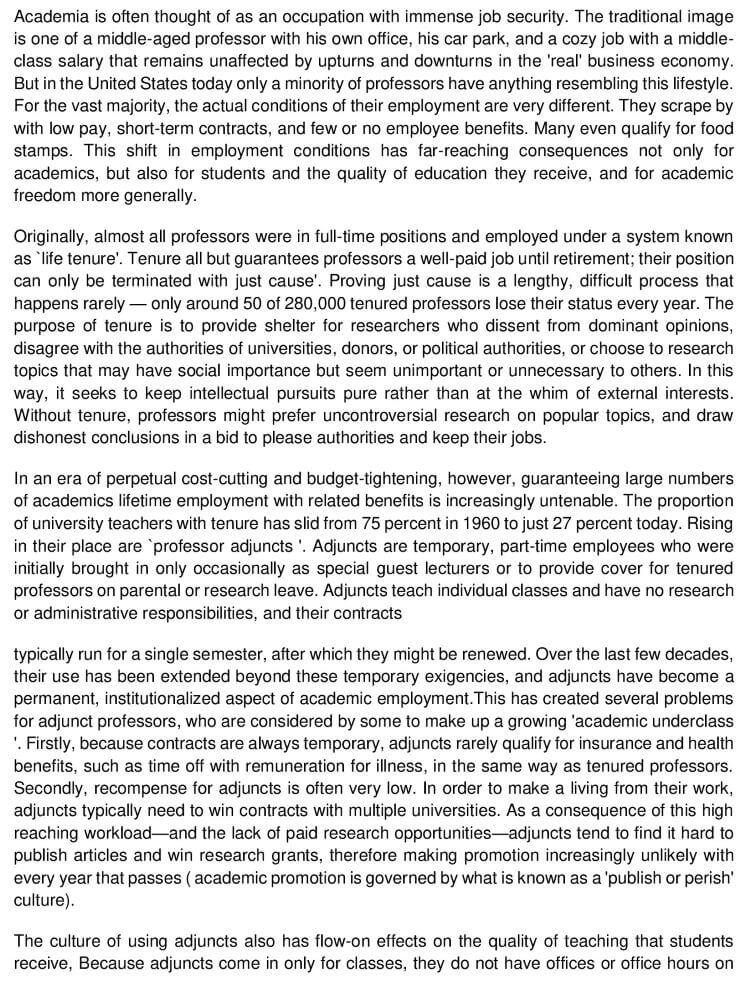
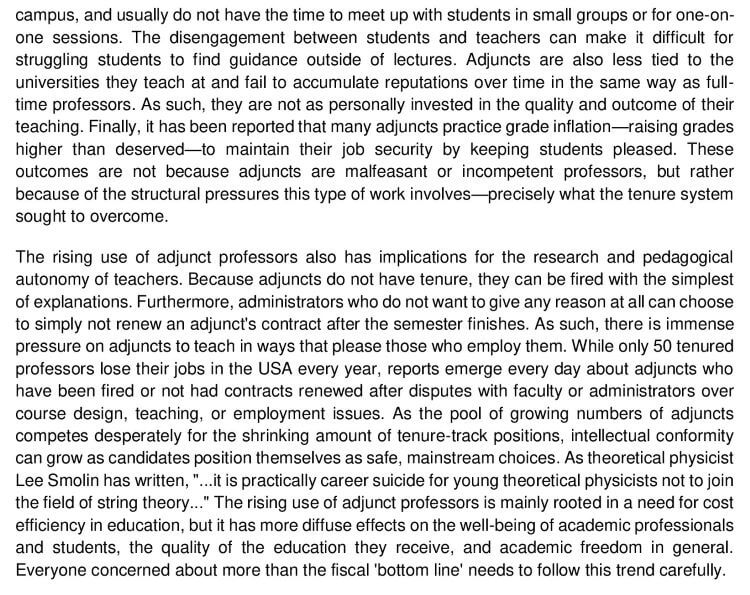
The Rise of Adjuncts
Questions for The Rise of Adjuncts IELTS Reading Answers
The passage, The Rise of Adjuncts IELTS Reading Answers, consists of 7 questions, which showcase two different IELTS Reading question types. They are:
- IELTS Reading Multiple-Choice Questions (Q. 20-22)
- IELTS Reading Sentence Completion (Q. 23-26)
Questions 20-22
Choose the correct letter, A, B, C, or D.
Write your answers in boxes 20-22 on your answer sheet.
20 What was the motivation behind the tenure system?
A To allow professors to pursue their research without outside influence.
B To prevent academic positions from being used for research that is not useful.
C To discipline professors who make claims that are not true.
D To provide professors with a secure income so that they can focus on research.
21 Which of the following is NOT a feature of adjunct employment?
A Contract that expires after a limited period
B Paid sick leave
C Lecturing responsibilities
D Difficulty securing funding for research
22 Why do adjuncts have low prospects for improving their academic position?
A They are unable to receive medical care.
B They do not have enough time for writing articles.
C They work at more than one institution.
D They are under-qualified.
Questions 23-26
Complete the sentences below with words taken from Reading Passage.
Use NO MORE THAN TWO WORDS for each answer.
Write your answers in boxes 23-26 on your answer sheet.
23 Because adjuncts are paid only to teach, they cannot always provide support for……
24 Adjuncts do not have the same bonds with one particular institution as the permanent staff does so they do not……………….. in the same way.
25 Giving better marks than warranted enhances adjuncts’…….
26 Adjuncts do not deliver quality education, not because they are bad lecturers but as a result of ………………………..
Looking for comprehensive preparation material for IELTS Academic Reading?
Check out - IELTS Reading (Academic) Actual Tests with Answers!
Answers and Explanations of The Rise of Adjuncts IELTS Reading Passage
Now, you can go through the provided answers, along with their precise locations within the given passage, and the important keywords that will help you find the answers. Check out 'The Rise of Adjuncts' answers and assess your improvement for a high IELTS band score.
20 Answer: A
Question type: Multiple Choice Question
Answer location: Paragraph B, lines 5-8
Answer explanation: “The purpose of tenure is to provide shelter for researchers who dissent from dominant opinions, disagree with the authorities of universities, donors, or political authorities, or choose to research topics that may have social importance but seem unimportant or unnecessary to others.” This suggests that tenure professors didn’t have to worry about the outside influences being an obstruction in their research and could carry out without having to bother about such influences. Hence, the answer would be A.
21 Answer: B
Question type: Multiple Choice Question
Answer location: Paragraph C, lines 12-14
Answer explanation: “Firstly, because contracts are always temporary, adjuncts rarely qualify for insurance and health benefits, such as time off with remuneration for illness, in the same way as tenured professors. “ This suggests that adjuncts don’t get subsidiary benefits such as time-offs, medical benefits, etc. Therefore, this is not the feature of adjuncts. Hence, the answer would be option B.
22 Answer: B
Question type: Multiple Choice Question
Answer location: Paragraph C, lines 16-19
Answer explanation: “As a consequence of this high reaching workload—and the lack of paid research opportunities—adjuncts tend to find it hard to publish articles and win research grants, therefore making promotion increasingly unlikely with every year that passes ( academic promotion is governed by what is known as a ‘publish or perish’ culture).” This suggests that owing to the lack of money and time, adjuncts aren’t able to write/publish their articles. This leads to the stagnancy of their career growth. Hence the answer is option B.
23 Answer: ( STRUGGLING ) STUDENTS
Question type: Sentence Completion
Answer location: Paragraph E, lines 4-5
Answer explanation: “The disengagement between students and teachers can make it difficult for struggling students to find guidance outside of lectures.” This suggests that since the adjuncts don’t impart extra time beyond the classroom hours to students who struggle with their studies, the struggling students find it difficult to improve themselves.
24 Answer: ACCUMULATE REPUTATIONS
Question type: Sentence Completion
Answer location: Paragraph E, lines 5-7
Answer explanation: “Adjuncts are also less tied to the universities they teach at and fail to accumulate reputations over time in the same way as full-time professors.” This suggests that since the adjuncts don’t generally stay in an institution for a longer duration of time, they aren’t able to make their identity/reputation among their students.
25 Answer: JOB SECURITY
Question type: Sentence Completion
Answer location: Paragraph E, lines 8-10
Answer explanation: “Finally, it has been reported that many adjuncts practice grade inflation—raising grades higher than deserved—to maintain their job security by keeping students pleased.” This suggests that the adjuncts increase the grades of students to please them and hence, ensure their job security.
26 Answer: STRUCTURAL PRESSURES
Question type: Sentence Completion
Answer location: Paragraph E, lines 10-12
Answer explanation: “These outcomes are not because adjuncts are malfeasant or incompetent professors, but rather because of the structural pressures this type of work involves—precisely what the tenure system sought to overcome.” This suggests that adjuncts practice grade inflation due to the temporary nature of their contract and hence to combat the structural pressure, they are compelled to do so.
Learn quick solving tips and reading techniques from experts!
Connect with us through our FREE IELTS online classes!
Tips for Answering the Question Types in the The Rise of Adjuncts Reading Passage
Given below are some IELTS exam preparation tips for band score of 8+ by helping you answer the types of questions in the ‘The Rise of Adjuncts’ IELTS Reading Answers.
Multiple-Choice Questions
- Identify the exact focus of the question: For example, ‘motivation behind the tenure system’ (Q. 20) or ‘NOT a feature of adjunct employment’ (Q. 21) tells you whether to look for a reason, feature, or exception. This helps you scan the passage with a clear purpose instead of reading everything.
- Pay special attention to negative words: In Q. 21, the word NOT completely changes the task. You must find three true features and eliminate them, leaving the one option that is not mentioned or contradicts the passage.
- Scan for keywords and their paraphrases: Use terms like ‘tenure system’ (Q. 20), ‘adjunct employment’ (Q. 21), and ‘low prospects’ (Q. 22) to locate the relevant paragraph. The passage may not repeat the exact words but will use synonyms like ‘job security’ or ‘temporary contracts’.
- Match meaning, not wording: For Q. 20, the passage may describe academic freedom or protection from external pressure, which matches ‘pursue research without outside influence’. Always focus on the idea behind the option, not identical vocabulary.
- Eliminate clearly incorrect options: Remove options that are too extreme or unrelated, such as ‘discipline professors who make claims that are not true’ (Q. 20) if the passage never mentions punishment. This increases accuracy even if you are unsure about the final answer.
- For cause-based questions, locate the explanation: In Q. 22, look for sentences explaining reasons or consequences, such as lack of time or resources. Choose the option that directly reflects the cause stated in the passage, not a general assumption.
- Be careful with similar-looking options: Options like ‘secure income’ or ‘academic freedom’ (Q. 20) may both seem logical. Only select the one that is explicitly supported by the passage, not what seems generally true.
Sentence Completion
- Identify keywords in each sentence: Look at phrases like ‘paid only to teach’ (Q. 23) or ‘same bonds with one institution’ (Q. 24). These keywords guide you to the exact section discussing adjunct working conditions.
- Predict the type of missing word: For example, ‘provide support for ______’ (Q. 23) suggests a noun related to students or activities. Predicting the word type helps you recognise the correct answer quickly.
- Scan for paraphrased sentences in the passage: The passage may describe the same idea differently, such as ‘cannot support students outside class’ instead of the exact wording in the question. Match the meaning of the sentence, not exact phrasing.
- Copy words exactly from the passage: The instruction says “NO MORE THAN TWO WORDS”, so you must take the answer directly from the text. Do not change the form of the word or add extra words.
- Ensure grammatical fit in the sentence: After inserting your answer, read the full sentence again, e.g., ‘enhances adjuncts’ ______’ (Q. 25). The word must fit both grammatically and logically.
- Follow the order of the passage: Sentence completion answers usually appear in sequence in the text, so answers for Q. 23–Q. 26 will follow one another in the same paragraph or nearby sections. This saves time and prevents unnecessary backtracking.
- Watch for cause-and-effect clues: For Q. 26, phrases like ‘not because… but as a result of…’ clearly signal a reason. Focus on the part after ‘as a result of’ to find the exact answer.
To conclude, reading samples from IELTS recent actual tests, such as The Rise of Adjuncts IELTS Reading Answers, is crucial. With the help of these resources, you will be able to improve your reading speed, identify any weaknesses, and become proficient in a variety of reading questions. As a result, if you persist in completing these tests, you will achieve the desired reading band score.
Useful Links:
- The Rise of Agribots - IELTS Reading Answers
- Making the Most of Trends IELTS Reading Answers
- Nineteenth Century Paperback Literature – IELTS Reading Answers
- Education Philosophy- IELTS Reading Answers
- Roller Coaster - IELTS Reading Answers
- Useful IELTS Reading Resources: Practice Tests, Study Material, Recommended Books
Practice IELTS Reading based on question types

Start Preparing for IELTS: Get Your 10-Day Study Plan Today!

Explore other Reading Actual Tests

Kasturika Samanta

Kasturika Samanta
Kasturika Samanta


Recent Articles
Nehasri Ravishenbagam
Haniya Yashfeen
Haniya Yashfeen
Haniya Yashfeen


Post your Comments