Density and Crowding - IELTS Reading Answers With Explanations
11 min read
Updated On
-
Copy link
Crack the “Density and Crowding?” as this IELTS Reading test can boost your reading skills for your final IELTS exam. Also, find the answer explanations to prepare for handling these IELTS reading question types for a band 9 in the actual exam!
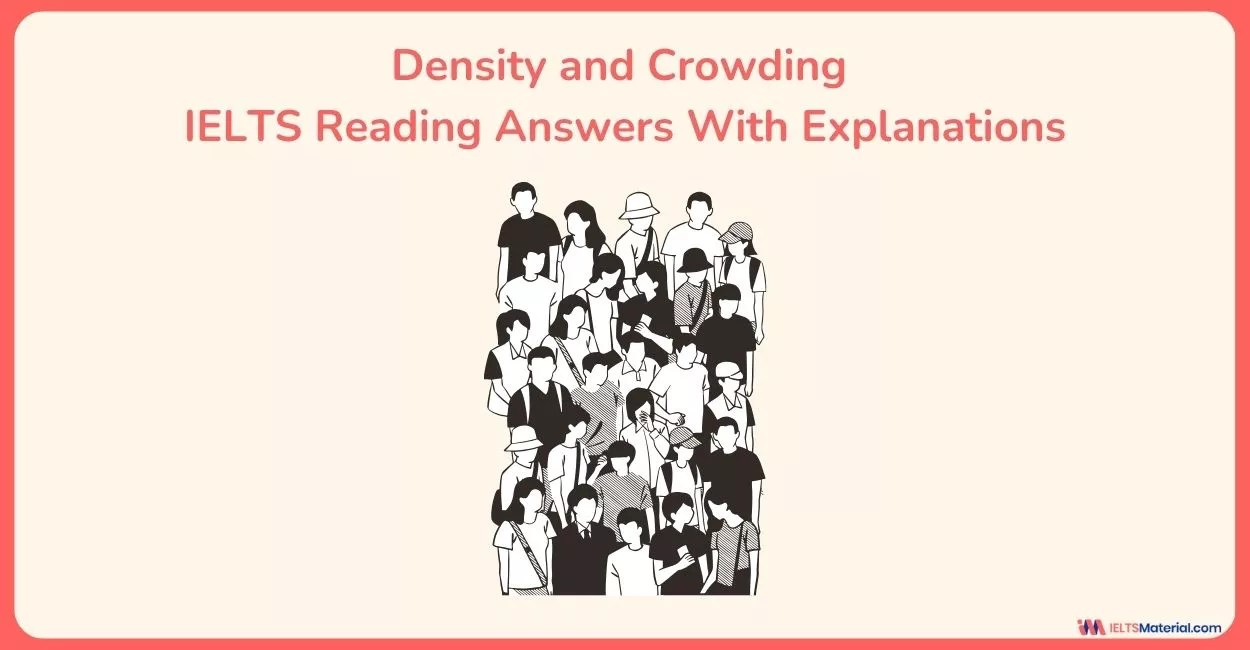
Table of Contents


Limited-Time Offer : Access a FREE 10-Day IELTS Study Plan!
Getting ready for the IELTS Reading exam can feel overwhelming, especially when you are to crack passages like “Density and Crowding?” This previously asked IELTS reading passage challenges you with its blend of context, words, and tricky question types!
If you are aiming for a band 8 or higher, this page will help you understand the passage more deeply and approach each question type with a proper strategy. In this article, we break down “Density and Crowding?” IELTS Reading passage and let you access its answers with easy-to-understand explanations given to boost your accuracy and confidence!
Types of Questions in “Density and Crowding?” IELTS Reading Passage
Practicing different types of questions in the IELTS Reading test will make it easier for you to crack passages like “Density and Crowding?” The question types in this IELTS Reading Passage include:
Reading Passage
Density and Crowding
A. Of the great myriad of problems which man and the world face today, there are three significant fiends which stand above all others in importance: the uprecedented population growth throughout the world a net increase of 1,400,000 people per week and all of its associations and consequences; the increasing urbanization of these people, so that more and more of them are rushing into cities and urban areas of the world; and the tremendous explosion of communication and social contact throughout the world, so that every part of the world is now aware of every other part. All of these fiends are producing increased crowding and the perception of crowding.
B. It is important to emphasize at the outset that crowding and density are not necessarily the same. Density is the number of individuals per unit area or unit space. It is a simple physical measurement. Crowding is a product of density, communication, contact, and activity. It implies a pressure, a force, and a psychological reaction. It may occur at widely different densities. The frontiersman may have felt crowded when someone built a homestead a mile away. The suburbanite may feel relatively uncrowded in a small house on a half-acre lot if it is surrounded by trees, bushes, and a hedgerow, even though he lives under much higher physical density than did the frontiersman. Hence, crowding is very much a psychological and ecological phenomenon, and not just a physical condition.
C. A classic crowding study was done by Calhoun (1962), who put rats into a physical environment designed to accommodate 50 rats and provided enough food, water, and nesting materials for the number of rats in the environment. The rat population peaked at 80, providing a look at ramped living conditions. Although the rats experienced no resource limitations other than space restriction, a number of negative conditions developed: the two most dominant males took harems of several female rats and occupied more than their share of space, leaving other rats even more crowded; many females stopped building nests and abandoned their infant rats; the pregnancy rate declined; infant and adult mortality rates increased; more aggressive and physical attacks occurred; sexual variation increased, including hypersexuality, inhibited sexuality, homosexuality, and bisexuality.
D. Calhoun’s results have led to other research on crowding’s effects on human beings, and these research findings have suggested that high density is not the single cause of negative effects on humans. When crowding is defined only in terms of spatial density (the amount of space per person), the effects of crowding are variable. However, if crowding is defined in terms of social density, or the number of people who must interact, then crowding better predicts negative psychological and physical effects.
E. There are several reasons why crowding makes US feel uncomfortable. One reason is related to stimulus overload there are just too many stimuli competing for our attention. We cannot notice or respond to all of them. This feeling is typical of the harried mother, who has several children competing for her attention, while she is on the phone and the doorbell is ringing. This leaves her feeling confused, fatigued and yearning to withdraw from the situation. There are strong feelings of a lack of privacy – being unable to pay attention to what you want without being repeatedly interrupted or observed by others.
F. Field studies done in a variety of settings illustrate that social density is associated with negative effects on human beings. In prison studies, males generally became more aggressive with increases in density. In male prison, inmate; living in conditions of higher densities were more likely to suffer from fight. Males rated themselves as more aggressive in small rooms (a situation of high spatial density), whilst the females rated themselves as more aggressive in large rooms (Stokols et al., 1973). These differences relate to the different personal space requirements of the genders. Besides, Baum and Greenberg found that high density leads to decreased attraction, both physical attraction and liking towards others and it appears to have gender differences in the impact that density has on attraction levels, with males experiencing a more extreme reaction. Also, the greater the density is, the less the helping behavior. One reason why the level of helping behavior may be reduced in crowded situations links to the concept of diffusion of responsibility. The more people that are present in a situation that requires help, the less often help is given. This may be due to the fact that people diffuse responsibility among themselves with no-one feeling that they ought to be the one to help.
G. Facing all these problems, what are we going to do with them? The more control a person has over the crowded environment the less negatively they experience it, thus the perceived crowding is less (Schmidt and Keating). The ability to cope with crowding is also influenced by the relationship the individual has with the other people in the situation. The high density will be interpreted less negatively if the individual experiences it with people he likes. One of the main coping strategies employed to limit the impact of high density is social withdrawal. This includes behaviors such as averting the gaze and using negative body language to attempt to block any potential intrusions.
Questions 1-7
Reading Passage 1 has seven paragraphs, A-G Choose the correct heading for paragraphs A-G from the list of headings below.
Write the correct number, i-x, in boxes 1-7 on your answer sheet.
List of headings
- Other experiments following Calhoun’s experiment offer a clearer indication
- The effects of crowding on people in the social scope
- Psychological reaction to crowding
- Problems that result in crowding
- Responsibility does not work
- What causes the upset feeling of crowding
- Definitions of crowding and density
- Advice for the crowded work environmen
- Difference between male and females’ attractiveness in a crowd
- Nature and results of Calhoun’s experiment
1 Paragraph A
2 Paragraph B
3 Paragraph C
4 Paragraph D
5 Paragraph E
6 Paragraph F
7 Paragraph G
Questions 8-13
Complete the sentences below.
Choose NO MORE THAN THREE WORDS from the passage for each answer.
Write your answers in boxes 8-13 on your answer sheet.
8 Being disturbed repeatedly, the harried mother feels frustrated for the lack of…………………..
9 Inmates in high-density settings were more aggressive in…………………..
10 The different result between male and female is associated with the varying need of………………….
11 Especially for males, Baum, and Greenberg, found that ………………………. declined with high density.
12 The idea of responsibility diffusion may explain a person’s reluctance to ………………………
13 Schmidt and Keating suggest that if more……………………. was present there would be a reduction in crowding stress.
Density and Crowding IELTS Reading Answers With Explanations
1 Answer: Ⅳ
Question type: Match the headings
Answer location: Paragraph A, lines 2-8.
Answer explanation: “…the unprecedented population growth throughout the world – a net increase of 1,400,000 people per week – and all of its associations and consequences; the increasing urbanization of these people, so that more and more of them are rushing into cities and urban areas of the world; and the tremendous explosion of communication and social contact throughout the world, so that every part of the world is now aware of every other part. All of these trends are producing increased crowding and the perception of crowding.” These lines talk about the problems that come into the picture due to overcrowding and hence, the option is Ⅳ.
2 Answer: Ⅶ
Question type: Match the headings
Answer location: Paragraph B, lines 1-4
Answer explanation: “It is important to emphasize at the outset that crowding and density are not necessarily the same. Density is the number of individuals per unit area or unit space. It is a simple physical measurement. Crowding is a product of density, communication, contact, and activity.” These lines explain the definition of crowding and density and the difference between them.
3 Answer: Ⅹ
Question type: Match the headings
Answer location: Paragraph C, lines 1-4 and last lines (7-10)
Answer explanation: “A classic crowding study was done by Calhoun (1962), who put rats into a physical environment designed to accommodate 50 rats and provided enough food, water, and nesting materials for the number of rats in the environment. The rat population peaked at 80, providing a look at cramped living conditions.” and “many females stopped building nests and abandoned their infant rats; the pregnancy rate declined; infant and adult mortality rates increased; more aggressive and physical attacks occurred; sexual variation increased, including hypersexuality, inhibited sexuality, homosexuality, and bisexuality.” These lines bring out the nature of Calhoun’s experiment and also its result and inferences.
4 Answer: Ⅰ
Question type: Match the headings
Answer location: Paragraph D, lines 1-4
Answer explanation: “Calhoun’s results have led to other research on the crowding effect on human beings, and these research findings have suggested that high density is not the single cause of negative effects on humans. When crowding is defined only in terms of spatial density (the amount of space per person), the effects of crowding are variable.” These lines indicate the tests that were taken post-Calhoun’s test on mice and their behavior concerning overcrowding.
5 Answer: Ⅵ
Question type: Match the headings
Answer location: Paragraph E, lines 1-3
Answer explanation: “There are several reasons why crowding makes us feel uncomfortable. One reason is related to stimulus overload – there are just too many stimuli competing for our attention. We cannot notice or respond to all of them.” This suggests the reasons why crowding makes us feel enervated and bothered and one of those reasons is the presence of so many factors and stimuli that trigger our brain.
6 Answer: Ⅱ
Question type: Match the headings
Answer location: Paragraph F, lines 2-6
Answer explanation: “In prison studies, males generally became more aggressive with increases in density. In male prisons, inmates living in conditions of higher densities were more likely to suffer from the fight. Males rated themselves as more aggressive in small rooms (a situation of high spatial density), whilst the females rated themselves as more aggressive in large rooms (Stokols et al., 1973).” These lines indicate the effects crowding has on people concerning their social interaction and behavior.
7 Answer: Ⅷ
Question type: Match the headings
Answer location: Paragraph G, lines 1-6
Answer explanation: “The more control a person has over the crowded environment the less negatively they experience it, thus the perceived crowding is less (Schmidt and Keating). The ability to cope with crowding is also influenced by the relationship the individual has with the other people in the situation. The high density will be interpreted less negatively if the individual experiences it with people he likes.” These lines indicate the tips and advice to handle the stress developed due to an overcrowding environment.
8 Answer: PRIVACY
Question type: Sentence completion
Answer location: Paragraph E, lines 3-8
Answer explanation: “This feeling is typical of the harried mother, who has several children competing for her attention, while she is on the phone and the doorbell is ringing. This leaves her feeling confused, fatigued, and yearning to withdraw from the situation. There are strong feelings of a lack of privacy – being unable to pay attention to what you want without being repeatedly interrupted or observed by others.” This suggests that a flustered/harried mother is irritated/frustrated because of the lack of privacy.
9 Answer: MALE PRISON
Question type: Sentence completion
Answer location: Paragraph F, lines 2-4
Answer explanation: “In prison studies, males generally became more aggressive with increases in density. In male prison, inmates living in conditions of higher densities were more likely to suffer from the fight.” These lines suggest that the prisoners/inmates were more aggressive in male prisons.
10 Answer: PERSONAL SPACE
Question type: Sentence completion
Answer location: Paragraph F, lines 5-8
Answer explanation: “Males rated themselves as more aggressive in small rooms (a situation of high spatial density), whilst the females rated themselves as more aggressive in large rooms (Stokols et al., 1973). These differences relate to the different personal space requirements of the genders.” This suggests that the reaction of males and females to the spatial density and volume of space corresponds to the personal space requirement of both genders.
11 Answer: ATTRACTION / ATTRACTION LEVELS
Question type: Sentence completion
Answer location: Paragraph F, lines 7-11
Answer explanation: “Besides, Baum and Greenberg found that high density leads to decreased attraction, both physical attraction and liking towards others and it appears to have gender differences in the impact that density has on attraction levels, with males experiencing a more extreme reaction.” These lines suggest that Baum and Greenberg deduced that high density causes a decrease in attraction.
12 Answer: HELP
Question type: Sentence completion
Answer location: Paragraph F, lines 11-16
Answer explanation: “One reason why the level of helping behavior may be reduced in crowded situations links to the concept of diffusion of responsibility. The more people that are present in a situation that requires help, the less often help is given. This may be due to the fact that people diffuse responsibility among themselves with no one feeling that they ought to be the one to help.” These lines suggest that owing to a sense of diffused responsibility, people tend to offer less help to the ones in need.
13 Answer: CONTROL
Question type: Sentence completion
Answer location: Paragraph G, lines 1-3
Answer explanation: “The more control a person has over the crowded environment the less negatively they experience it, thus the perceived crowding is less (Schmidt and Keating).” These lines clearly explain what Schmidt and Keating suggested about alleviating the stress, and that is through having more control over the crowded environment.
Check More IELTS Reading Answers
Practice IELTS Reading based on question types

Start Preparing for IELTS: Get Your 10-Day Study Plan Today!

Recent Articles

Nehasri Ravishenbagam
Haniya Yashfeen
Haniya Yashfeen
Haniya Yashfeen


Post your Comments