Ambivalent - Word of the Day for IELTS Speaking and Writing
The word ‘ambivalent’ means ‘having two opposing feelings at the same time, or being uncertain about how you feel’. Discover its usage, history, synonyms & antonyms, and practice using it with the given exercises to expand your vocabulary for a top score.
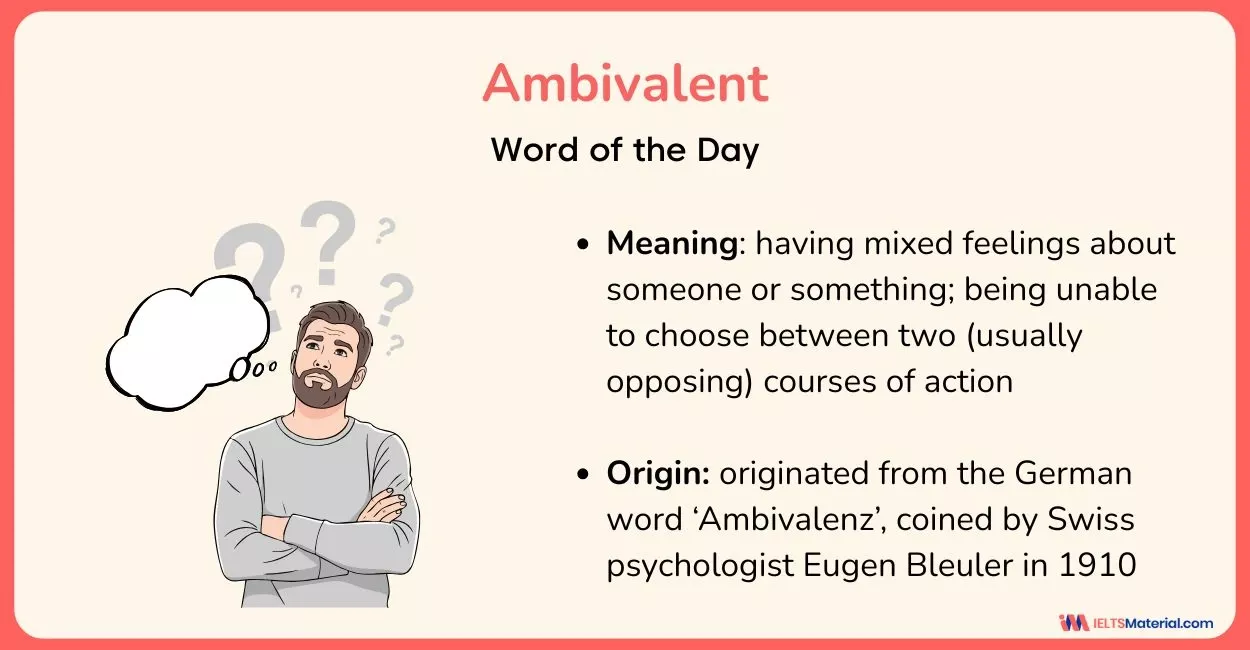
Table of Contents


Limited-Time Offer : Access a FREE 10-Day IELTS Study Plan!
Some words do not stand on one side; they exist in the grey space between two emotions, two decisions, or two opinions. Today’s word of the day, ‘ambivalent,’ is one such powerful word that perfectly captures the human state of inner conflict. Whether you are writing an IELTS essay, describing a difficult choice as one of the latest IELTS Speaking cue card topics with sample answer, or expressing mixed feelings in conversation, this word adds precision and emotional clarity.
In this blog post, we will therefore explore the meaning, history, and proper usage of the term ‘ambivalent’ within the context of the IELTS exam, to help you understand the word through practical exercises.
Meaning of Ambivalent
- Pronunciation: /æmˈbɪvələnt/ (sounds like am·bi·vuh·luhnt)
- Noun: Ambivalence
Many English learners mistake ‘ambivalent’ for ‘neutral’, but the word actually describes a situation where someone has two opposing feelings at the same time, or being uncertain about how they feel. This duality makes it an excellent word for advanced writing, especially when analyzing decisions, emotions, or complex situations.
History and Origin of ‘Ambivalent’
The adjective ‘ambivalent’, originating from the German word ‘Ambivalenz’, was coined by a Swiss psychologist, Eugen Bleuler. It combines the Latin roots ‘ambi’ (both) and ‘valentia’ (strength/power), referring to two competing forces or emotions within a person.
In the early 20th century (around 1920), the English language adopted the term, originally using it in psychology to describe the state of having mixed feelings, or simultaneous and contradictory attitudes, toward something.
Usage & Examples of Ambivalent
Here are some example sentences that show how ‘ambivalent’ is used in different formal and informal contexts:
- He felt ambivalent about his job. [=he both liked and disliked his job]
- He has an ambivalent relationship with his family.
- She has a deeply/very ambivalent attitude about/to/toward religion.
- The senator is ambivalent about running for president. [=the senator has not decided whether or not to run for president]
- Many students feel ambivalent about choosing a university, as the decision affects both their personal and professional lives.
- She remained ambivalent toward social media, recognising both its benefits and the emotional pressure it created.
- The public was ambivalent about the new policy, with equal criticism and support from different communities.
Book free IELTS online classes to maximize your vocabulary for the IELTS exam!
IELTS Usage of ‘Ambivalent’
Now, let us have a look at how you can use ‘ambivalent’ in the IELTS Speaking and Writing exams using the samples given below.
IELTS Speaking Part 2
- Cue Card: Describe a film or book that left you with mixed feelings.
- Answer Excerpt: I recently watched a documentary about technology and privacy, and I felt ambivalent after finishing it. I admired the progress society has made, but was worried about how much personal data we give away.
IELTS Writing Task 2
- Topic: While citizens recognize that monitoring systems can enhance national security and public safety, they are also concerned about the erosion of privacy and personal freedoms. To what extent do you think government surveillance is justified?
- Answer Excerpt: Many citizens today feel ambivalent about government surveillance. They understand that monitoring systems have the capacity to strengthen national security and ensure public safety, but they are also apprehensive about the possible infringement on privacy and personal freedoms.
Book a FREE demo to talk to our experts and boost your IELTS vocabulary now!
Synonyms of Ambivalent
Below are synonyms of ‘ambivalent’ with their meanings and sample sentences that will enrich your list of synonyms for IELTS Writing and Speaking.
|
Synonym |
Meaning |
Example Sentence |
|---|---|---|
|
Conflicted |
uncertain or unable to decide between opposing feelings |
She felt conflicted about leaving her hometown for better opportunities abroad. |
|
Indecisive |
not able to make a decision quickly or effectively |
The manager was indecisive, delaying the project unnecessarily. |
|
Torn |
unable to decide between two feelings or choices |
He was torn between taking a high-paying job or staying close to his family. |
|
Hesitant |
slow or uncertain in acting or deciding |
She was hesitant to give her final approval due to unclear information. |
Join us in our free webinars to learn tricks to improve IELTS vocabulary! Join Now!
Antonyms of Ambivalent
Here are some antonyms of ‘ambivalent’ to give a boost to your IELTS vocabulary.
|
Antonym |
Meaning |
Example Sentence |
|---|---|---|
|
Certain |
completely sure |
She was certain that studying abroad would improve her career prospects. |
|
Decisive |
able to make choices quickly and confidently |
A decisive leader can inspire trust during difficult situations. |
|
Clear-cut |
free from doubt; definitive |
The results of the experiment were clear-cut and easy to interpret. |
|
Unwavering |
firm and not changing |
His unwavering commitment to fairness made him respected by everyone. |
Exercise to Master the Meaning of ‘Ambivalent’
Take the following exercise and strengthen your understanding of the word ‘ambivalent’.
Exercise: Choose the correct option.
1 In which of the following situations is someone MOST likely to be described as ‘ambivalent’?
A A doctor who strongly recommends a specific treatment.
B A student who cannot decide whether to study law or medicine because both appeal to them.
C A politician who completely rejects a new policy proposal.
D A driver who is certain about the route to take.
2 Which sentence uses ‘ambivalent’ correctly?
A She was ambivalent about keeping her bedroom perfectly clean.
B The audience was ambivalent, cheering loudly throughout the performance.
C He felt ambivalent about accepting the promotion because, although it paid well, it would take time away from his family.
D The company was ambivalent and immediately approved the plan.
3 Choose the best synonym for ‘ambivalent’ in this sentence: “Many citizens are ambivalent about artificial intelligence.”
A Uninterested
B Conflicted
C Hostile
D Certain
4 Identify the sentence with the INCORRECT use of ‘ambivalent’:
A Her feelings toward moving abroad were ambivalent; she wanted new experiences but dreaded leaving her family.
B The team remained ambivalent, unsure whether the new strategy would improve performance.
C His ambivalent response showed that he fully supported the proposal.
D Public opinion on social media was ambivalent, divided between excitement and skepticism.
5 Which situation demonstrates ‘ambivalence’ in an academic context?
A A researcher who believes strongly in a single theory.
B A historian who fully supports one interpretation of events.
C A student who refuses to consider alternative ideas.
D A professor who cannot decide whether an essay deserves an A or a B due to its strengths and weaknesses.
Answer Keys
|
1 |
2 |
3 |
4 |
5 |
|
B |
C |
B |
C |
D |
To conclude, ‘Ambivalent’ is one of the most human emotions we experience: caught between yes and no, here and there, fear and excitement. Mastering such IELTS Academic high-frequency vocabulary words adds maturity and emotional depth to both writing and speaking responses. So, use it confidently when expressing complex decisions, inner conflict, or situations with two opposing viewpoints.
Useful Links:
- Ambiguous: Word Meaning, Examples, Origin & Usage in IELTS
- Mundane: Word Meaning, Examples, Origin & Usage in IELTS
- Reverie - IELTS Word of the Day for Speaking & Writing
- Volatile: Word Meaning, Examples, Origin & Usage in IELTS
- How to Improve Your Vocabulary Score in IELTS Writing and Speaking?
- How to Express Your Mixed Feelings in IELTS Writing & Speaking?
Explore IELTS Resources

Start Preparing for IELTS: Get Your 10-Day Study Plan Today!

Check out other Word of the Day Articles
Kasturika Samanta
Nehasri Ravishenbagam
Kasturika Samanta
Haniya Yashfeen

Recent Articles
Kasturika Samanta
Kasturika Samanta
Kasturika Samanta


Post your Comments