Bioluminescence - IELTS Reading Answers
12 min read
Updated On
-
Copy link
Learn how to locate answers quickly, identify keywords, and boost your band score of 8+ with the IELTS Reading passage on ‘Bioluminescence’. Dive into effective time management strategies, types of questions, and answers to improve reading accuracy.
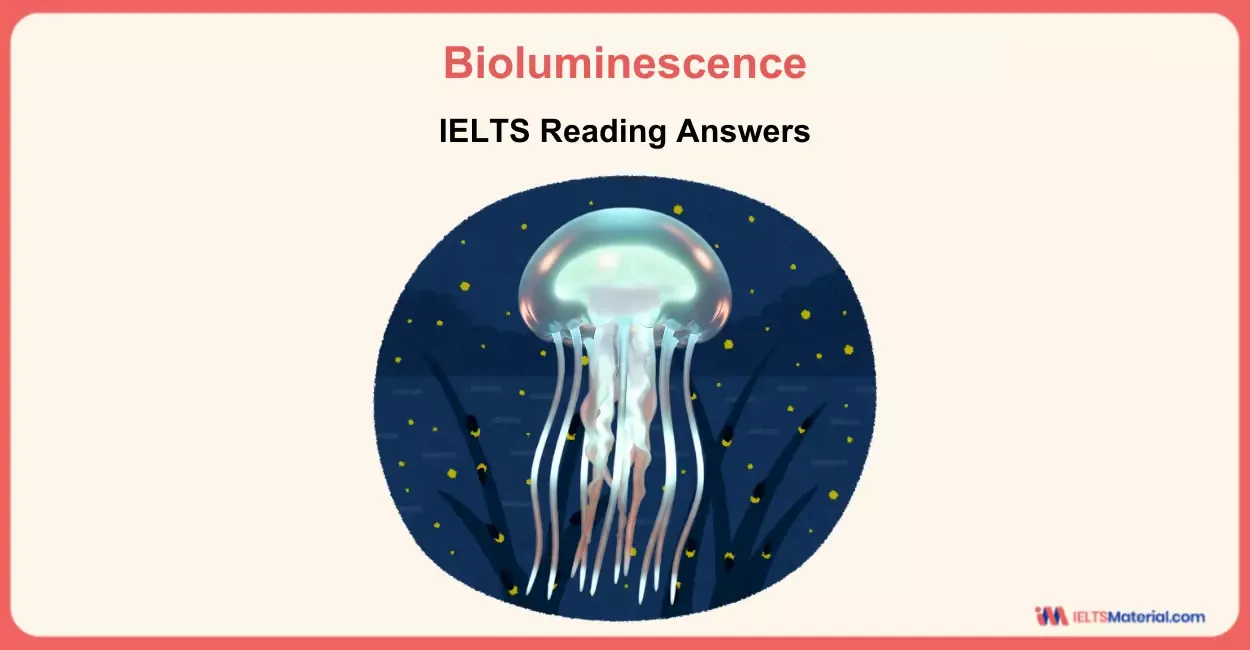
Table of Contents


Limited-Time Offer : Access a FREE 10-Day IELTS Study Plan!
The Reading Module of the IELTS can be the top-scoring category by practising diligently with topics like ‘Bioluminescence’. To achieve the best results in this section, you must understand how to approach and answer the different Question types in the IELTS Reading Module. By solving and reviewing Sample Reading Questions from past IELTS papers, you can ensure that your Reading skills are up to the mark. By getting familiar with the scientific terms, you will be able to enhance your comprehension skills and increase your knowledge on topic-based vocabulary to get a higher score of 8+.
Connect with our band 9 IELTS Trainers to crack your IELTS Reading in no time! Book a FREE Demo.
Types of Questions in IELTS Reading Passage ‘Bioluminescence’
In the passage 'Bioluminescence', it is very important to have a good grasp of the types of questions which you will attempt. There are often scientific terms included in this type of topic. Therefore, you must learn to quickly brainstorm for the needed information, make a clear division between the facts and the reasons, and infer the scientific terms. Knowledge of different question types will make it easy for you to read the text and identify what is important, use the scanning process, and increase your accuracy. Below are the three question types which you will encounter.
- IELTS Reading Matching Headings [Q.1 - Q.5]
- IELTS Reading Multiple Choice Questions [Q.6 - Q.9]
- IELTS Reading Sentence Completion [Q.10 - Q.13]
How to Manage Time When Attempting IELTS Reading ‘Bioluminescence’?
Managing time for reading is one of the major difficulties you will face, particularly with such scientific passages like 'Bioluminescence'. Such passages can be daunting to read and comprehend due to new vocabulary terms, detailed factual descriptions, and complex sentence structures. However, good planning can help you to read effectively and find the right answers during the 60 minutes allotted time. To achieve a higher IELTS Band Score of 8+, the table below showcases how you can effectively use the time while attempting the reading questions.
|
Steps |
Time |
Description |
|
Step 1: Skim the passage |
2-3 minutes |
|
|
Step 2: Identify question types |
1 minute |
|
|
Step 3: Scan paragraph by paragraph |
6-8 minutes |
|
|
Step 4: Answer easier questions first |
7-8 minutes |
|
|
Step 5: Focus on answering the difficult questions last |
4–5 minutes |
|
|
Step 6: Review |
1–2 minutes |
|
Curious to learn how to improve your reading skills to get a band 9? Check out the video below!
IELTS Reading Passage on ‘Bioluminescence’
You should spend about 20 minutes on questions 1-13, which are based on the Reading Passage below.
A In the pitch-black waters of the ocean's aphotic zone — depths from 1,000m to the sea floor — Rood eyesight does not count for very much on its own. Caves, in addition, frequently present a similar problem: the complete absence of natural light at any time of the day. This has not stopped some organisms from turning these inhospitable environments into their homes, and in the process many have created their own forms of light by developing one of the stunning visual marvels of the biological universe —bioluminescence.
B Many people will encounter bioluminescence at some point in their life, typically in some form of glowworm, which is found on most continents. North and South America are home to the "firefly", a glowing beetle which is known as a glow-worm during its larvae stage. Flightless glowing beetles and worms are also found in Europe, Asia, Australia, and New Zealand. Less common flies, centipedes, molluscs, and snails have bioluminescent qualities as well, as do some mushrooms. The most dramatic examples of bioluminescence. However, they are found deep below the ocean's surface, where no sunlight can penetrate at all. Here, anglerfish, cookie-cutter sharks, flashlight fish, lantern fish, gulper eels, viperfish, and many other species have developed bioluminescence in unique and creative ways to facilitate their lives.
C The natural uses of bioluminescence vary widely, and organisms have learnt to be very creative with its use. Fireflies employ bioluminescence primarily for reproductive means — their flashing patterns advertise a firefly's readiness to breed. Some fish use it as a handy spotlight to help them locate prey. Others use it as a lure; the anglerfish, for example, dangles a luminescent flare that draws in gullible, smaller fishes which get snapped up by the anglerfish in an automated reflex. Sometimes, bioluminescence is used to resist predators. Vampire squids eject a thick cloud of glowing liquid from the tip of its arms when threatened, which can be disorientating. Other species use a single, bright flash to temporarily blind their attacker, with an effect similar to that of an oncoming car which has not dipped its headlights.
D Humans have captured and utilized bioluminescence by developing, over the last decade, a technology known as Bioluminescence Imaging (BLI). BU involves the extraction of a DNA protein from a bioluminescent organism, and then the integration of this protein into a laboratory animal through trans-geneticism. Researchers have been able to use luminized pathogens and cancer cell lines to track the respective spread of infections and cancers. Through BLI, cancers and infections can be observed without intervening in a way that affects their independent development. In other words, while an ultra-sensitive camera and bioluminescent proteins add a visual element, they do not disrupt or mutate the natural processes. As a result, when testing drugs and treatments, researchers are permitted a single perspective of a therapy's progression.
E Once scientists learn how to engineer bioluminescence and keep it stable in large quantities, a number of other human uses for it will become available. Glowing trees have been proposed as replacements for electric lighting along busy roads, for example, which would reduce our dependence on non-renewable energy sources. The same technology used in Christmas trees for the family home would also eliminate the fire danger from electrical fairy lights. It may also be possible for crops and plants to luminesce when they require watering, and for meat and dairy products to "tell us" when they have become contaminated by bacteria. In a similar way. forensic investigators could detect bacterial species on corpses through bioluminescence. Finally, there is the element of pure novelty. Children's toys and stickers are often made with glow-in-the dark qualities, and a biological form would allow rabbits, mice, fish, and other pets to glow as well.
Questions 1-5
Reading Passage has five sections, A-E.
Choose the correct headings for sections A-E from the list of headings below.
Write the correct number i-ix in boxes 1-5 on your answer sheet.
|
List of Headings
|
1 Section A
2 Section B
3 Section C
4 Section D
5 Section E
Questions 6-9
Choose FOUR letters. A - G. Write the correct letters in boxes 6-9 on your answer sheet.
Which FOUR uses are listed for bioluminescence in nature?
|
Questions 10-13
Complete the sentences below. Choose NO MORE THAN TWO WORDS from the passage for each answer.
Write your answers in boxes 10-13 on your answer sheet.
10 The luminescent fluid that a vampire squid emits has a ____________________ effect on its predator.
11 In order to use bioluminescence in a trans-genetic environment, ____________________ must first be removed from a bioluminescent creature.
12 One advantage of BLI is that it could allow researchers to see how a treatment is working without altering or disturbing ____________________.
13 In the future, ____________________ may be able to use bioluminescence to identify evidence on dead bodies.
Answers with Explanation on IELTS Passage ‘Bioluminescence’
Now that you have attempted the questions, it is time to compare yours with the correct answers. The table below contains answers with explanations to the passage on 'Bioluminescence'. As you review them, you can write down the areas of weakness so that you can work on them before attempting to answer passages with similar questions.
|
Answer |
Question Type |
Answer Location |
Answer Explanation |
|
1. iii |
Matching Headings |
Paragraph A, last line |
If you read thoroughly, there’s a line that claims, “this has not stopped some organisms from turning these inhospitable environments into their homes, and in the process many have created their own forms of light by developing one of the stunning visual marvels of the biological universe – bioluminescence.” Hence, we can learn about the issue of the complete lack of natural light at any time of day. Bioluminescence is the process by which species living in dark environments, such as the seafloor or caves, make their own kinds of light to solve the problem (solution). Thus, the appropriate title for this paragraph would be evolution’s solution. |
|
2. ii |
Matching Headings |
Paragraph B, line 1 |
If you read thoroughly, the author in the given paragraph mentions that “many people will encounter bioluminescence at some point in their life, typically in some form of glowworm, which is found on most continents. North and South America are home to the “firefly”, a glowing beetle which is known as a glow-worm during its larvae stage.” Here, we can deduce that author listed many animals and plants (creature) like glowworm, firefly, glowing beetles and worms, flies, centipedes, mollusks, and snails, anglerfish, cookie-cutter sharks, flashlight fish, lantern fish, gulper eels, viperfish, and many other species with bioluminescent qualities (bright) on some continents (land) and below the ocean’s surface (sea). Thus, the appropriate title for this paragraph would be bright creatures on land and in the sea. |
|
3. viii |
Matching Headings |
Paragraph C, line 1 |
The opening line of paragraph C suggests that “the natural uses of bioluminescence vary widely, and organisms have learnt to be very creative with its use. Fireflies employ bioluminescence primarily for reproductive means – their flashing patterns advertise a firefly’s readiness to breed.” Thus, we can conclude that the author is trying to prove that some creatures with bioluminescent qualities use them for a purpose. Therefore, the purpose of bioluminescence in the wild is the appropriate title for this paragraph. |
|
4. vi |
Matching Headings |
Paragraph D, line 3 |
The answer is clearly mentioned in the said paragraph and line. In the passage, it is said that“researchers have been able to use luminized pathogens and cancer cell lines to track the respective spread of infections and cancers.” Also, “as a result, when testing drugs and treatments, researchers are permitted a single perspective of a therapy’s progression.” Thus, we can conclude that scientists devised a technique based on bioluminescence (from wild animals) that might be used to track and detect diseases and malignancies, as well as evaluate pharmaceuticals and treatments (parts of medicine). Hence, nature’s Gift to medicine is the appropriate title for this paragraph. |
Signup/Login and get access to the answers
|
5. v |
Matching Headings |
Paragraph E, line 1 |
The opening line of paragraph E suggests that “once scientists learn how to engineer bioluminescence and keep it stable in large quantities, a number of other human uses for it will become available.”Thus, when scientists figure out how to design bioluminescence and keep it stable in huge amounts, it will be employed for a variety of applications in the future. Hence, the appropriate title for this paragraph would be future opportunities in biological engineering. |
|
6. 1 (1,3,6,7 : in any order) |
Multiple Choice questions |
Paragraph C, line 4 |
If you read clearly, it is mentioned that “others use it as a lure; the anglerfish, for example, dangles a luminescent flare that draws in gullible, smaller fishes which get snapped up by the anglerfish in an automated reflex.”Here, the term lure has been paraphrased to attract. Hence, from this given information we can confirm that the anglerfish uses bioluminescence to attract smaller fishes, which are their food. |
|
7. 3 (1,3,6,7 : in any order) |
Multiple Choice questions |
Paragraph C, line 2 |
The answer is clearly mentioned in the said paragraph and line. You must note the paraphrasing here. In the passage, it is said that “fireflies employ bioluminescence primarily for reproductive means – their flashing patterns advertise a firefly’s readiness to breed. Some fish use it as a handy spotlight to help them locate prey.” Here, firefly’s readiness to breed can be inferred as mating signals. |
|
8. 6 (1,3,6,7 : in any order) |
Multiple Choice questions |
Paragraph C, line 6 |
Few lines in the said paragraph convey that “vampire squids eject a thick cloud of glowing liquid from the tip of its arms when threatened, which can be disorientating. Other species use a single, bright flash to temporarily blind their attacker, with an effect similar to that of an oncoming car which has not dipped its headlights.“ Since it is mentioned that vampire squids use bioluminescence to resist when threatened, it can be considered a defensive tactic. |
|
9. 7 (1,3,6,7 : in any order) |
Multiple Choice questions |
Paragraph C, line 3 |
A line in the passage mentions that “some fish use it as a handy spotlight to help them locate prey.” This line confirms that some fishes use bioluminescence as a torch (handy spotlight) to identify (locate) their food as prey. |
|
10. disorienting |
Sentence Completion |
Paragraph C, line 6 |
If you observe, in the said paragraph to the fact that “vampire squids eject a thick cloud of glowing liquid from the tip of its arms when threatened, which can be disorientating. “ Here, the term eject has been paraphrased to emit. Hence, we can say that the glowing luminescent liquid from the squid can be disorientating. |
|
11. DNA protein |
Sentence Completion |
Paragraph D, line 2 |
A few lines in said paragraph discuss that “BU involves the extraction of a DNA protein from a bioluminescent organism, and then the integration of this protein into a laboratory animal through trans- geneticism.” Here, extracted has been paraphrased to remove and the organism is paraphrased to creatures. Hence, it is a DNA protein that must be extracted from bioluminescent creatures. |
|
12. natural processes |
Sentence Completion |
Paragraph D, line 5 |
If you read thoroughly, the author in the given paragraph mentions that “in other words, while an ultra-sensitive camera and bioluminescent proteins add a visual element, they do not disrupt or mutate the natural processes.” We can deduce that one advantage of (through) BLI is that it allows treatment without disrupting or mutating (altering) the natural processes. |
|
13. forensic investigators/scientists |
Sentence Completion |
Paragraph E, line 5 |
Paragraph E puts forward the information that “in a similar way, forensic investigators could detect bacterial species on corpses through bioluminescence.” We can infer that the term corpses has been paraphrased to dead bodies. Hence, forensic investigators could use bioluminescence to detect (identify) bacterial species on corpses. |
Enroll into our Free IELTS Webinar and learn more about techniques to improve your reading speed.
To effectively apply the skills such as keyword searching, skimming, distributing time by question type, and recognizing paraphrasing formats, you need to become more exact and quicker at locating answers. The IELTS Academic Reading Passage on ‘Bioluminescence' would help you to measure your capability to comprehend scientific content under the time constraints. If you regularly practice with academic passages and apply band 8+ strategies on time management, then you will answer with confidence and increase your chances of securing a higher band score.
Check More IELTS Reading Answers
Also Check:
Practice IELTS Reading based on question types

Start Preparing for IELTS: Get Your 10-Day Study Plan Today!

Explore other Reading Practice Tests
Nehasri Ravishenbagam
Kasturika Samanta
Kasturika Samanta

Kasturika Samanta

Recent Articles

Nehasri Ravishenbagam
Haniya Yashfeen

Haniya Yashfeen

Haniya Yashfeen


Post your Comments