Networking - IELTS Reading Answers with Explanation
15 min read
Updated On
-
Copy link
Get ready for the IELTS Academic Reading section with topics like ‘Networking IELTS Reading Answers’ with explanation and significantly improve your comprehension skills. This blog provides tips & answers for those aiming for an IELTS reading score of 8+.
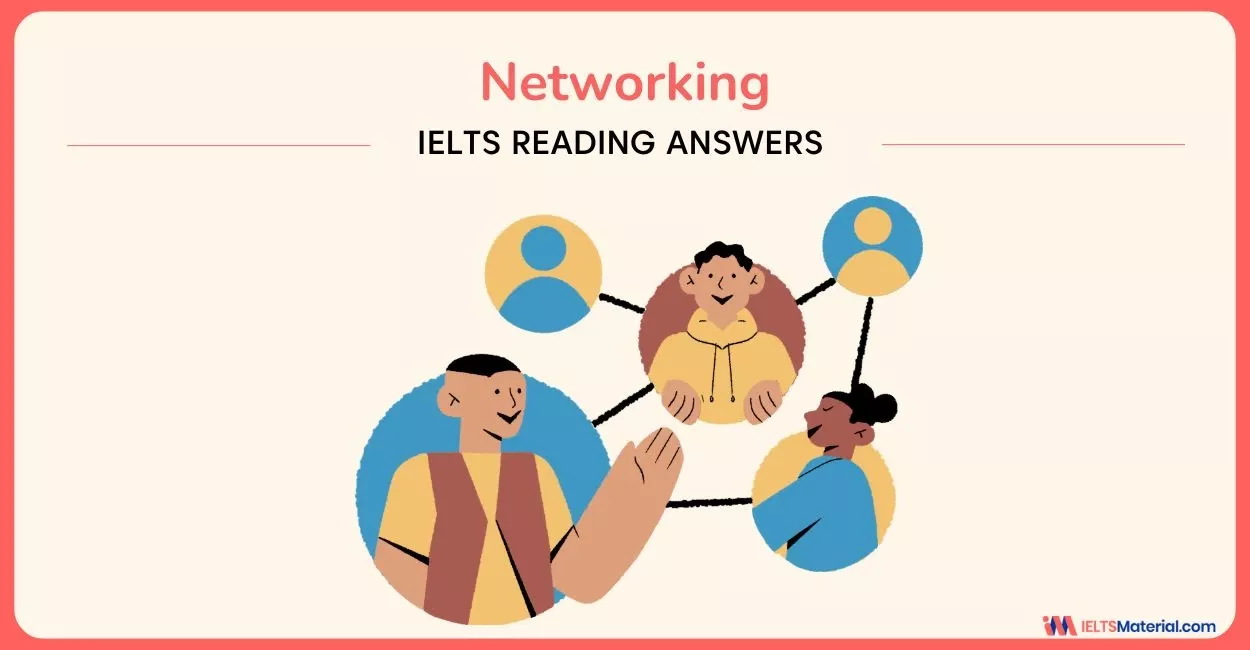
Table of Contents


Limited-Time Offer : Access a FREE 10-Day IELTS Study Plan!
If you start working on a passage without a clear strategy, you may find that you lose valuable time. And to create an effective reading strategy, you must practice single passages like ‘Networking IELTS Reading Answers’ and move your way up to complete IELTS Reading practice tests. They help you determine areas you need to improve, based on which you can strategise.
Therefore, to improve your performance in the reading module, check your answers against the provided Networking Reading Answers with explanations and tips in this blog.
Passage for Networking IELTS Reading Answers
Solving this passage will enhance your focus, accuracy, and comprehension skills, all of which are vital for achieving a high IELTS band score in the reading module. So, to answer the questions based on it, read the Networking passage that is provided below.
You should spend about 20 minutes on Questions 1-15, which are based on the Reading Passage below.
Networking
Networking as a concept has acquired what is in all truth an unjustified air of modernity. It is considered in the corporate world as an essential tool for the modern businessperson, as they trot round the globe drumming up business for themselves or a corporation. The concept is worn like a badge of distinction, and not just in the business world.
People can be divided basically into those who keep knowledge and their personal contacts to themselves, and those who are prepared to share what they know and indeed their friends with others. A person who is insecure, for example someone who finds it difficult to share information with others and who is unable to bring people, including friends, together does not make a good networker. The classic networker is someone who is strong enough within themselves to connect different people including close friends with each other. For example, a businessman or an academic may meet someone who is likely to be a valuable contact in the future, but at the moment that person may benefit from meeting another associate or friend.
It takes quite a secure person to bring these people together and allow a relationship to develop independently of himself. From the non-networker's point of view such a development may be intolerable, especially if it is happening outside their control. The unfortunate thing here is that the initiator of the contact, if he did but know it, would be the one to benefit most. And why?
Because all things being equal, people move within circles and that person has the potential of being sucked into ever growing spheres of new contacts. It is said that, if you know eight people, you are in touch with everyone in the world. It does not take much common sense to realize the potential for any kind of venture as one is able to draw on the experience of more and more people.
Unfortunately, making new contacts, business or otherwise, while it brings success, does cause problems. It enlarges the individual's world. This is in truth not altogether a bad thing, but it puts more pressure on the networker through his having to maintain an ever larger circle of people. The most convenient way out is, perhaps, to cull old contacts, but this would be anathema to our networker as it would defeat the whole purpose of networking. Another problem is the reaction of friends and associates. Spreading oneself thinly gives one less time for others who were perhaps closer to one in the past. In the workplace, this can cause tension with jealous colleagues, and even with superiors who might be tempted to rein in a more successful inferior. Jealousy and envy can prove to be very detrimental if one is faced with a very insecure manager, as this person may seek to stifle someone's career or even block it completely.
The answer here is to let one's superiors share in the glory; to throw them a few crumbs of comfort. It is called leadership from the bottom. In the present business climate, companies and enterprises need to co-operate with each other in order to expand. As globalization grows apace, companies need to be able to span not just countries but continents. Whilst people may rail against this development it is for the moment here to stay. Without co-operation and contacts, specialist companies will not survive for long. Computer components, for example, need to be compatible with the various machines on the market and to achieve this, firms need to work in conjunction with others. No business or institution can afford to be an island in today's environment. In the not very distant past, it was possible for companies to go it alone, but it is now more difficult to do so.
The same applies in the academic world, where ideas have been jealously guarded. The opening-up of universities and colleges to the outside world in recent years has been of enormous benefit to industry and educational institutions. The stereotypical academic is one who moves in a rarefied atmosphere living a life of sometimes splendid isolation, a prisoner of their own genius. This sort of person does not fit easily into the mould of the modern networker. Yet even this insular world is changing. The ivory towers are being left ever more frequently as educational experts forge links with other bodies; sometimes to stunning effect as in Silicon Valley in America and around Cambridge in England, which now has one of the most concentrated clusters of high tech companies in Europe.
It is the networkers, the wheeler-dealers, the movers and shakers, call them what you will, that carry the world along. The world of the Neanderthals was shaken between 35,000 and 40,000 BC; they were superseded by Homo Sapiens with the very 'networking' skills that separate us from other animals: understanding, thought abstraction and culture, which are inextricably linked to planning survival and productivity in humans. It is said the meek will inherit the earth. But will they?
Questions for Networking Reading Answers
The ‘Networking’ is an IELTS Academic Reading passage with 15 questions. It will help you understand what kind of reading passages you will encounter and the questions that you will be asked to solve.
The question types in this reading passage include:
- IELTS Reading Yes, No, Not Given (Q. 1-5)
- IELTS Reading Sentence Completion (Q. 6-10)
- IELTS Reading Short Answer Questions (Q. 11-15)
Questions 1-5
Do the following statements agree with the information given in Reading Passage 1? In boxes 1-5 on your answer sheet, write
YES if the statement agrees with the writer's claims
NO if the statement contradicts the writer's claims
NOT GIVEN if there is impossible to say what the writer thinks about this
1 Networking is not a modern idea.
2 Networking is worn like a badge exclusively in the business world.
3 People fall into two basic categories.
4 A person who shares knowledge and friends makes a better networker than one who does not.
5 The classic networker is physically strong and generally in good health.
Questions 6-10
Using NO MORE THAN THREE WORDS from the passage, complete the sentences below.
6 Making new acquaintances ……………… but also has its disadvantages.
7 At work, problems can be caused if the manager is ………………
8 A manager can suppress, or even totally ……………… the career of an employee.
9 In business today, working together is necessary in order for ……………… to grow.
10 Businesses that specialize will not last for long without ………………
Questions 11-15
Using NO MORE THAN THREE WORDS from the passage, complete the sentences below.
11 In which sphere of life have ideas been protected jealously?
12 Which type of individual does not easily become a modern networker?
13 Where is one of the greatest concentrations of high tech companies in Europe?
14 Who replaced the Neanderthals?
15 What, as well as understanding and thought abstraction, sets us apart from other animals?
Book a FREE Demo with our experts to learn tricks and techniques to ace the IELTS Reading!
Answers and Explanations of Networking IELTS Reading Passage
Now it is time to cross-check your answers using the answer key below for the Networking IELTS Reading Answers. Don’t forget to create strategies based on the feedback from this practice and master IELTS Reading question types with examples.
1 Answer: YES
Question Type: Yes/No/Not Given Questions
Answer location: Paragraph 1, line 1
Answer explanation: In the given paragraph, the writer claims ‘Network as a concept has acquired what is in all truth an unjustified air of modernity.’ Here, ‘air of modernity’ means a modern idea which is paraphrased in the statement as ‘Networking is not a modern idea.’
2 Answer: NO
Question Type: Yes/No/Not Given Questions
Answer location: Paragraph 1, last line
Answer explanation: If you read through, the writer says that ‘the concept is worn like a badge of distinction, not just in the business world.’ Here, the writer says that networking is a badge that is worn by everyone and not just the business people. In the statement given, it is said ‘Networking is worn like a badge exclusively to the business world.’ The phrase ‘exclusively in the business world’ means excluding everyone and limiting it only to the business world. This statement contradicts the claim given by the writer.
Question Type: Yes/No/Not Given Questions
Answer location: Paragraph 2, line 1
Answer explanation: The answer is clearly mentioned in the said paragraph and line. In the passage, it is given that ‘People can be divided basically into those who keep knowledge and their personal contact to themselves, and those who are prepared to share what they know and indeed their friends with others.’ The writer says that people are divided and has explained the two types of people. The statement says that ‘People fall into two basic categories.’ Here, the words ‘fall’ means come in between and categories mean the types of people. So, we can conclude that the statement given agrees with the writer’s claim.
Question Type: Yes/No/Not Given Questions
Answer location: Paragraph 2, line 2
Answer explanation: A line in the said paragraph infers that ‘a person who is insecure, such as someone who has difficulty sharing information with others and who cannot bring people, including friends, together, is not a good network worker.’ which means that those who are not willing to share their knowledge and friends with others are not good networkers and those are willing to share the knowledge are better networkers. This claim has been paraphrased in the statement as a person who shares knowledge and friends makes a better networker than one who does not.
5 Answer: NOT GIVEN
Question Type: Yes/No/Not Given Questions
Answer location: N/A
Answer explanation: Not given in the passage.
6 Answer: Bring success
Question Type: Sentence Completion
Answer location: Paragraph 5, line 1
Answer explanation: If you read thoroughly, a line in the passage specifies that that ‘making new contacts, business or otherwise brings success, does cause problems,’ which is paraphrased in the question as ‘Making new acquaintances brings success but also has its disadvantages.’ Here the words, acquaintances refer to contacts and disadvantages refer to the problems.
7 Answer: (very) insecure/ jealous/ envious
Question Type: Sentence Completion
Answer location: Paragraph 5, last line
Answer explanation: If you clearly observe, it is given that ‘jealousy and envy can prove to be very detrimental if one is faced with a very insecure manager.’ Here detrimental means to cause harm or problems. This can be paraphrased as, ‘At work, problems can be caused if the manager is very insecure,’ which is the given statement in the question. Hence, the answer will be (very) insecure or jealous or envious.
8 Answer: block
Question Type: Sentence Completion
Answer location: Paragraph 5, last line
Answer explanation: It is given that ‘a very insecure manager, as this person may seek to stifle someone’s career or even block it completely.’ Here, the word ‘stifle’ means suppress. The statement is paraphrased as ‘A manager can suppress, or even totally block the career of an employee.’
9 Answer: Companies and enterprises
Question Type: Sentence Completion
Answer location: Paragraph 6, line 3
Answer explanation: A line in the said paragraph infers that, ‘in the present business climate, companies and enterprises need to cooperate with each other in order to expand.’ Here the phrase ‘present business climate’ means the business environment today. This sentence is paraphrased as ‘in business today, working together is necessary in order for companies and enterprises to grow.’
10 Answer: Co-operation and contacts
Question Type: Sentence Completion
Answer location: Paragraph 6, last line
Answer explanation: In the paragraph, the writer says that ‘without cooperation and contacts specialist companies would not survive for long.’ In this sentence, ‘specialist companies’ means ‘businesses that specialize’, When the sentence is paraphrased, ‘Businesses that specialize will not last for long without the cooperation and contacts.’
11 Answer: Academic World
Question Type: Short Answer Questions
Answer location: Paragraph 7, line 1
Answer explanation: The statement asks ‘which sphere of life have ideas been protected by jealousy.’ Here, protected by jealousy means guarded by jealousy and in the seventh paragraph, it is given that ‘the same applies in the academic world, where ideas have been jealously guarded.’
12 Answer: Stereotypical academic
Question Type: Short Answer Questions
Answer location: Paragraph 7, line 3
Answer explanation: Paragraph 7 puts forward the information that ‘the stereotypical academic is one who moves in a rarefied atmosphere living a life of sometimes splendid isolation, a prisoner of their own genius.’ and the next line says that ‘This sort of person does not fit easily into this mould of the modern networker.’ Here the writer talks about a stereotypical academic who is highly dense and basks in his own ingeniousness and also says that this person does not easily become a modern networker. According to the question, it was asked to find the type of individual that does not easily become a modern networker.
13 Answer: Cambridge/ around Cambridge/ Cambridge in England
Question Type: Short Answer Questions
Answer location: Paragraph 7, last line
Answer explanation: In the question, it was asked to name the places with the greatest concentrations of high tech companies in Europe. In the last line of the seventh paragraph, it is said that ‘Cambridge and England are now one of the most concentrated clusters of high-tech companies in Europe.’ Hence the greatest/ most concentrated clusters currently are in Cambridge and England.
14 Answer: Homo Sapiens
Question Type: Short Answer Questions
Answer location: Paragraph 8, line 2
Answer explanation: If you observe clearly, it is mentioned that ‘the world of Neanderthals was shaken between 35,000 and 40,000 BC; they were superseded by homo sapiens with the very networking skills that separate us from other animals.’ Here ‘superseded’ means replaced. According to the question, it was asked to find who had replaced the Neanderthals. So, the answer to the question is Neanderthals were replaced by homo sapiens.
15 Answer: Culture
Question Type: Short Answer Questions
Answer location: Paragraph 8, last line
Answer explanation: The given question asks about the factor that sets apart humans from the animals other than understanding thought abstraction. The answer to this question is given in the last line of the eighth paragraph which states that ‘understanding thought abstraction and current culture are inextricably linked to planning survival and productivity in humans,’ and this sets us apart from other humans.
Learn quick solving tips and reading techniques from experts!
Connect with us through our FREE IELTS online classes!
Tips for Answering the Question Types in the Networking Reading Passage
Now, let us check out some quick IELTS exam preparation tips for band score of 8+ to answer the passage question types in the Networking IELTS Reading Answer to help you create your own strategy.
Yes, No, Not Given
- Look for the writer’s opinion (these are opinion-based questions): YES/NO/NOT GIVEN in IELTS always test the writer’s claims, not general facts. So find phrases like ‘the writer claims…’, ‘according to the writer…’ and evaluations or judgements (‘unjustified’, ‘not a good network worker’, etc.)
- For YES, the statement must match the meaning, not the exact words: The passage often paraphrases ideas. For example, ‘unjustified air of modernity’ means networking is not actually modern. So check sense, not vocabulary.
- For NO, look for contradiction words: A statement contradicts the passage if you see opposite meaning signals like ‘not just …’, ‘on the contrary…’, ‘instead…’ or a direct negation. For example, the passage says networking is not just in the business world, which contradicts ‘exclusively in the business world’.
- For NOT GIVEN, check if the passage mentions none of the statement’s key ideas: NOT GIVEN is chosen when a relevant topic appears, but without the precise detail asked, or the passage says nothing about it. For example: No paragraph mentions physical strength or health means it is NOT GIVEN.
- Scan by key nouns, and not by verbs or adjectives: For these statements, the nouns carry the meaning, like ‘networking’, ‘business world’, ‘people’, ‘knowledge’, ‘classic networker’, etc. Find these nouns quickly; then examine the sentence closely to see whether it agrees.
Sentence Completion
- Look for grammatical clues before searching the passage: Identify what type of word you need - a noun? a verb? or noun phrase? For example: ‘Making new acquaintances ______ but also has its disadvantages.’ needs a verb phrase (something it ‘does’).
- The answer is usually in the first half of the sentence in the passage: Sentence completion questions almost always paraphrase the passage’s clause order.
So if the prompt begins with ‘Making new acquaintances…’, search for a similar phrase early in a sentence. - Paraphrasing will hide the answer: It is important to match meaning, not words. For example, common paraphrases are: acquaintances → contacts, disadvantages → problems, last long → survive, working together → cooperate, business today → present business climate.
- Strictly follow the 3-word limit and take answers exactly from the passage: If the passage says ‘brings success, does cause problems’, you must take exactly: brings success (2 words). Never change form and never add/remove words.
- Watch out for multiple correct answers: IELTS sometimes allows any of them. For example, ‘insecure’, ‘jealous’, ‘envious’ all fit the grammar and appear in the text.
Short Answer Questions
- Each question is directly answerable using a direct noun phrase. These are factual questions. So, do NOT answer using full sentences and only copy the needed 2–3 words.
- Find the exact noun after the WH-word in the question. It narrows your scanning direction. For example:
- “In which sphere of life…” → look for a sphere/area/field
- “Which type of individual…” → look for a description of a person
- “Where…” → look for a location
- “Who replaced…” → look for a species/human group
- “What … sets us apart…” → look for a feature/quality.
- Use the question word to predict the paragraph. This passage shifts from business → academics → evolution of humans. So, Q. 11–12 → academic world paragraph, Q. 13 → location of high-tech companies and Q. 14–15 → final paragraph about Neanderthals & Homo sapiens.
- The answer is never paraphrased in short-answer questions: Unlike True/False, short answer questions require exact text. For example, ‘Homo sapiens’ will appear exactly that way.
- Answers must be short: To keep the answer concise, remove articles and unnecessary words. So, if the text says ‘the academic world’, you can write academic world.
In summary, to achieve a high score on the IELTS Reading, it is essential to focus on enhancing your reading speed, becoming familiar with the types of questions, and honing your information retrieval skills. So, to crack IELTS Reading in the first go, try solving more of the IELTS reading recent actual tests, work on your comprehension skills and create your own reading success strategy.
Useful Links:
- A Silent Force - IELTS Reading Answers
- Money As The Unit Of Account – IELTS Reading Answers
- Variations on a Theme: the Sonnet Form in English Poetry - IELTS Reading Answers
- Keep the Water Away Reading Answers
- Air Rage Reading Answers
- The Life And Work Of Marie Curie Reading Answers
- Effects Of Noise Reading Answers
- Is There Anybody Out There Reading Answers
- Johnsons Dictionary Reading Answers
- Bakelite Reading Answers
- Best IELTS Reading Books 2025
- How to Get 6.5 in IELTS Academic?
Practice IELTS Reading based on question types

Start Preparing for IELTS: Get Your 10-Day Study Plan Today!

Explore other Reading Practice Tests
Nehasri Ravishenbagam
Kasturika Samanta
Kasturika Samanta
Kasturika Samanta

Recent Articles
Nehasri Ravishenbagam
Haniya Yashfeen
Haniya Yashfeen
Haniya Yashfeen


Post your Comments