We can See more Disasters and Violence Shown on TV - IELTS Writing Task 2
8 min read
Updated On
-
Copy link
Prepare for IELTS Writing Task 2 with the cause and effect essay ‘We can see more disasters and violence shown on TV.’ In this blog, you will discover an in-depth outline, sample answers, and vocabulary that will enhance your writing for a Band 7+ score.
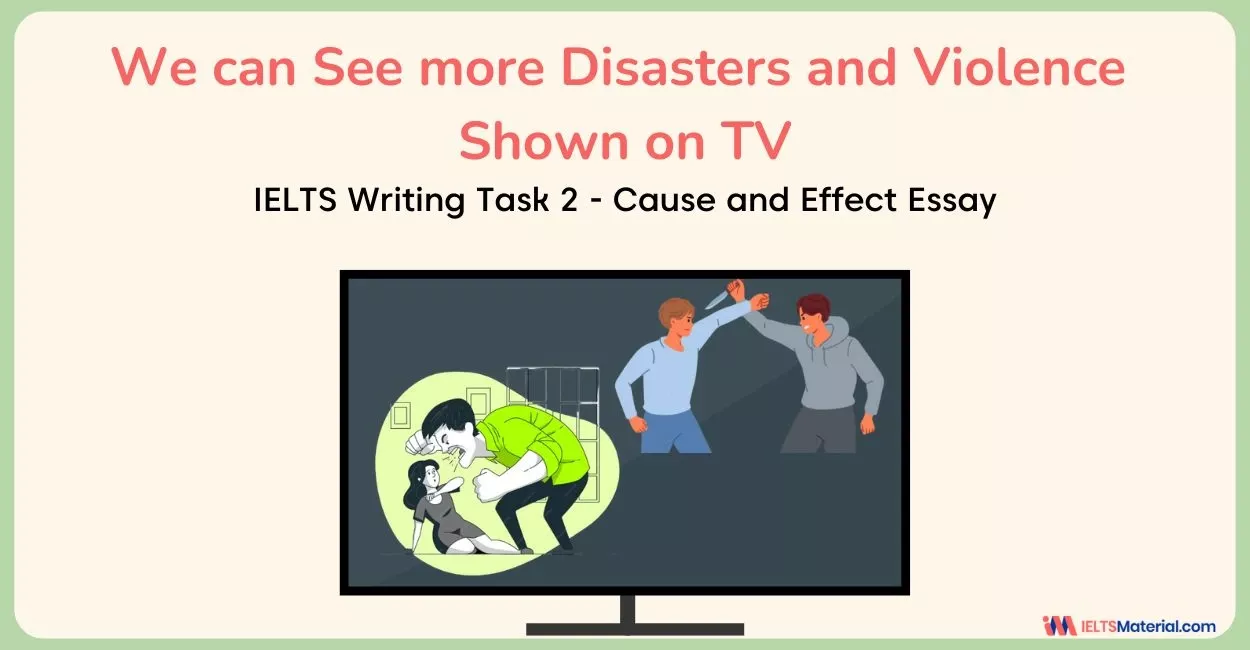
Table of Contents


Try AI Essay Checker for Instant Band Score
In recent decades, television news has shifted from merely reporting events to continuously broadcasting dramatic footage of natural disasters, armed conflicts, and violent crimes. The IELTS Writing Task 2 topic ‘We can see more disasters and violence shown on TV’ is particularly important because it combines media influence, social behaviour, and psychological impact, all of which frequently appear in cause and effect essays.
In this blog, we present three expertly curated sample answers along with a comprehensive table of relevant vocabulary on the pressing issue 'We can see more disasters and violence shown on TV'.
Essay Question for ‘We can See more Disasters and Violence Shown on TV’
You should spend about 40 minutes on this task.
We can see more disasters and violence shown on TV. What are its causes and what effects will they exert on the individual and the society? Give reasons for your answer and include any relevant examples from your own knowledge or experience.
You should write at least 250 words.
Outline for IELTS Cause & Effect Essay
Here is an outline for a cause-and-effect essay, which is similar to the IELTS Problem Solution essay and is specifically designed for the topic ‘We can see more disasters and violence shown on TV’.
|
Introduction
Body Paragraph 1 (Causes):
Body Paragraph 2 (Effects on Individuals and Society)
Conclusion:
|
Sample Answers for We can See more Disasters and Violence Shown on TV IELTS Writing Task 2
You can find three IELTS Band 9 essay samples on the topic ‘We can see more disasters and violence shown on TV’, which will help you write your own essay and achieve a high score.
We can See more Disasters and Violence Shown on TV - Sample Answer 1
Television screens today are frequently dominated by images of natural catastrophes and violent incidents. This growing exposure is largely driven by commercial pressures and technological advancements, and it has significant consequences for both individuals and society.
To begin with, one major cause of this trend is the competitive nature of modern media. News channels prioritise sensational content because dramatic visuals attract higher viewership and advertising revenue. For example, during the ongoing Gaza war, images and videos showing dramatic scenes of destruction and military action, including viral clips of soldiers and civilians in distress, were widely circulated and replayed across global news outlets, often accompanied by highly emotional commentary to keep audiences engaged. In addition, the widespread availability of smartphones and live reporting technology enables broadcasters to deliver real-time footage, making such events more visible than ever before.
At an individual level, constant exposure to disasters and violence can lead to emotional desensitisation. Viewers may become less empathetic toward victims, as repeated exposure normalises suffering. Moreover, excessive consumption of violent news has been linked to anxiety, fear, and a distorted perception of reality, particularly among children and vulnerable adults. From a societal perspective, the effects can make communities develop a heightened sense of insecurity, even in relatively safe environments. This can erode social trust and encourage aggressive attitudes, as violence appears to be a common and unavoidable aspect of daily life. Additionally, continuous coverage of disasters can also overwhelm audiences, reducing public responsiveness to genuine emergencies.
In conclusion, while the increased broadcasting of disasters and violence is driven by media competition and technological progress, its effects on mental well-being and social stability are profound. A more responsible approach to news reporting is essential to minimise these negative outcomes.
Book IELTS online classes, chat with our experts NOW, and ace your IELTS journey!
We can See more Disasters and Violence Shown on TV - Sample Answer 2
The frequent broadcasting of disasters and violent incidents on television has become a noticeable characteristic of contemporary news coverage. This essay will examine the main causes behind this trend and analyse its effects on both individuals and society.
One major reason why disasters and violence dominate television screens is the commercial nature of modern media. News organisations depend heavily on viewership ratings to attract advertisers, and dramatic events such as terrorist attacks, wars, or natural calamities tend to draw larger audiences than routine or positive stories. For instance, breaking news related to earthquakes or mass shootings is often repeatedly aired for hours, even when there are no new developments. In addition, globalisation and technological advancements have made it easier to access real-time footage from across the world. As a result, incidents occurring thousands of kilometres away are instantly transmitted to local audiences, increasing the overall volume of violent and catastrophic content shown on TV.
On a personal level, repeated viewing of distressing images may lead to anxiety, fear, and emotional exhaustion. In some cases, prolonged exposure can also desensitise viewers, particularly young people, making them less empathetic towards others’ suffering or more accepting of aggressive behaviour. From a broader social perspective, the normalisation of violence can gradually influence collective attitudes. When brutality becomes a routine part of media consumption, societies may grow more tolerant of conflict and less focused on peaceful solutions. Moreover, the constant emphasis on negative events can create a climate of pessimism, overshadowing positive social progress and undermining public morale.
In conclusion, the increasing portrayal of disasters and violence on television is largely driven by commercial pressures and the global flow of information. However, its harmful psychological effects on individuals and its potential to erode social values highlight the need for responsible media practices. Therefore, news organizations should avoid excessive sensationalism to ensure a better balance between awareness and well-being.
Come learn proven tips for handling IELTS Writing in our IELTS webinars! Explore Now!
We can See more Disasters and Violence Shown on TV - Sample Answer 3
As we all know, the 21st century is an era of advancements in technology and human civilization. The progress that humanity has made in the last two decades is undeniable and astonishing. However, the world has seen far more atrocious circumstances in these last few decades than ever before. Acts of violence, social injustices and adversities caused by humans occur on a day to day basis. Such occurrences are now observable by everyone, owing to the advent of the media. In this essay, I will delve into the causes and effects of the pervasiveness of violence on television.
First and foremost, we must acknowledge the surge in social violence and the brutal nature of present-day society. Presently, people are more aggressive, heedless and apathetic towards others, and intolerance of one community towards another has led to societal catastrophes. Amidst these appalling conditions, the entire world is bearing witness to such events through news or social media. Moreover, since reports and headlines that are negative are unbeaten in catching the attention of the general public, similar broadcasts are shown more frequently.
It is a well-known fact that the media has a considerable influence over the masses. News media being one of the most powerful channels of communication of the current generation, the content showcased through such mediums hold significant sway over the viewers. Thus, when the audience is subjected to the barbaric affairs that are taking place across the globe regularly, it is bound to have a detrimental effect on their psyche. It is an evident fact that such reports affect every individual differently. Also, the positivity of the collective populace is lowered with such dreadful stories and instances.
In conclusion, the increase in the frequency of unfavourable news is a byproduct of the disastrous circumstances of society and the acquisitive nature of media in this day and age. Such happenings have a destructive effect on people and society as a whole.
Book a FREE Demo to learn tips and writing techniques from experts!
Vocabulary to Use for We can See more Disasters and Violence Shown on TV - IELTS Writing Task 2
Here is a comprehensive list of advanced vocabulary for IELTS 7.0+: crime and punishment, relevant for the topic ‘We can see more disasters and violence shown on TV’. It will equip you with the necessary language tools to articulate your thoughts clearly and effectively when addressing essay questions related to the representation of crises and violence in media.
|
Word/Phrase |
Meaning |
Example Sentence |
|---|---|---|
|
Sensational content |
material designed to provoke strong emotional reactions, often by exaggeration |
The novel relied on sensational content to keep readers hooked until the final chapter. |
|
Broadcasters |
organisations or individuals that transmit programmes by radio or television |
Local broadcasters played traditional music throughout the festival week. |
|
Real-time |
happening immediately as events occur |
The app allows users to track deliveries in real-time. |
|
Desensitisation |
reduced emotional responsiveness after repeated exposure |
Continuous criticism led to her emotional desensitisation over the years. |
|
Empathetic |
able to understand and share the feelings of others |
The teacher was empathetic toward students struggling with exams. |
|
Distorted perception |
an inaccurate or misleading understanding of reality |
His lack of sleep resulted in a distorted perception of time. |
|
Vulnerable |
easily harmed or influenced physically or emotionally |
Newly planted saplings are vulnerable to extreme weather. |
|
Erode |
to gradually weaken or destroy |
Constant delays began to erode the team’s confidence. |
|
Collective attitudes |
shared beliefs or opinions held by a group |
The company aimed to change collective attitudes toward remote work. |
|
Brutality |
extreme cruelty or harshness |
The coach was criticised for the brutality of his training methods. |
|
Pessimism |
a tendency to expect the worst outcome |
Her pessimism made it difficult to enjoy small successes. |
|
Overshadowing |
making something seem less important by comparison |
His achievements were overshadowing his earlier failures. |
|
Sensationalism |
the use of exciting or shocking elements to attract attention |
Sensationalism in advertising often misleads consumers. |
|
Astonishing |
extremely surprising or impressive |
The magician’s final trick was astonishing. |
|
Atrocious |
extremely bad or unpleasant |
The service at the restaurant was atrocious. |
|
Pervasiveness |
the quality of being widespread |
The pervasiveness of smartphones has changed daily routines. |
|
Surge |
a sudden large increase |
There was a surge in applications after the announcement. |
|
Heedless |
showing careless disregard |
His heedless spending caused financial trouble. |
|
Apathetic |
showing little interest or concern |
The audience appeared apathetic during the long speech. |
|
Catastrophes |
events causing great damage or suffering |
Poor planning can turn minor issues into catastrophes. |
|
Unbeaten |
not defeated or surpassed |
The chess champion remained unbeaten for years. |
|
Byproduct |
an unintended secondary result |
Increased traffic was a byproduct of urban expansion. |
To conclude, this topic is highly relevant to IELTS Writing Task 2 because it allows candidates to demonstrate logical cause–effect reasoning, topic-specific vocabulary, and balanced analysis. So, to improve your writing skills, go through more recent IELTS Writing topics with answers and master this essay writing module in IELTS.
Useful Links:
- Many People Believe that High Level of Violence in Films - IELTS Writing Task 2
- Increase in violent crime: IELTS Writing Task 2
- Violence in The Media Promote Violent in Society – IELTS Writing Task 2
- Violence and Conflict were more Evident under Male Leadership than under Female Leadership - IELTS Writing Task 2
- Many countries not enough students are choosing to study science as a subject - IELTS Writing Task 2
- Discuss the cause and effects of widespread drug abuse by young people - IELTS Writing Task 2
- Build Your Vocabulary for IELTS - Key Word: Violence
Practice IELTS Writing Task 2 based on Essay types

Start Preparing for IELTS: Get Your 10-Day Study Plan Today!

Explore other Problem Solution Essays



Recent Articles
Haniya Yashfeen
Prity Mallick

Kasturika Samanta


Post your Comments