Describe an Event You Attended But Didn’t Like the Music Played - IELTS Speaking Cue Card & Part 3 Questions
Use the guide to practice with the IELTS Speaking Cue Card & Part 3 Questions on ‘Describe an Event You Attended But Didn’t Like the Music Played’. Dive into common mistakes to avoid, sample answers, vocabulary, and follow-up questions to prepare.
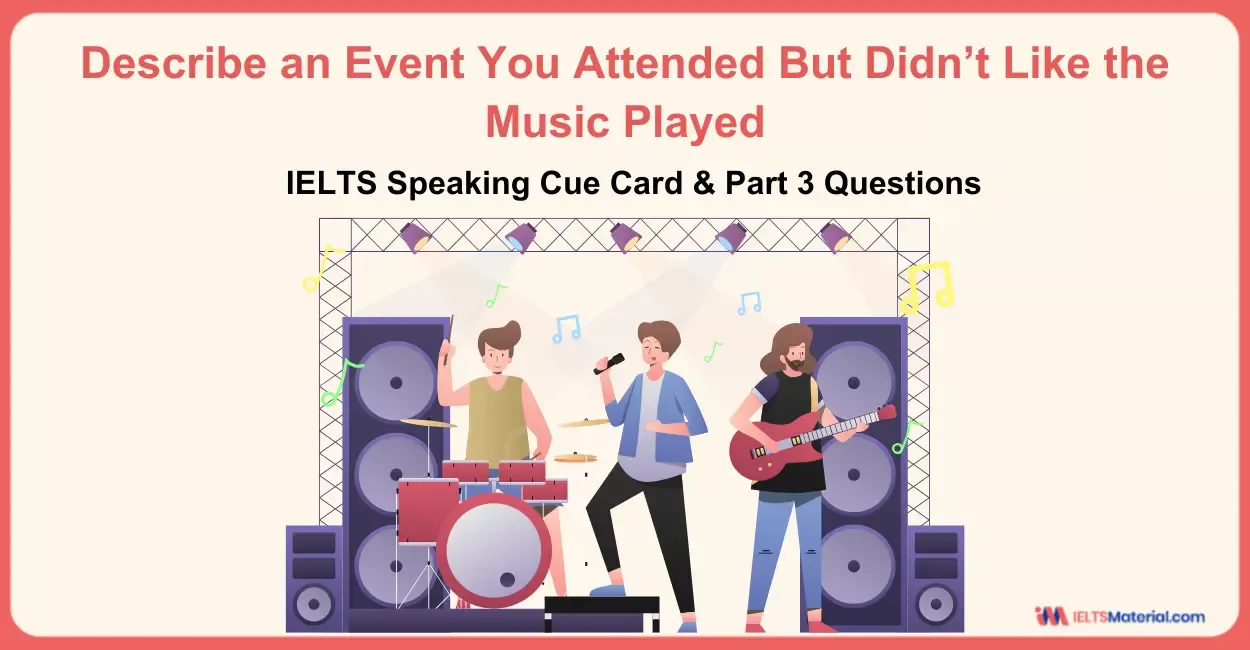
Table of Contents
- Common Mistakes to Avoid in ‘Describe an Event You Attended But Didn’t Like the Music Played’
- Sample Answer 1 on ‘Describe an Event You Attended But Didn’t Like the Music Played’
- Sample Answer 2 on ‘Describe an Event You Attended But Didn’t Like the Music Played’
- IELTS Speaking Part 3 Questions on ‘Describe an Event You Attended But Didn’t Like the Music Played’


Limited-Time Offer : Access a FREE 10-Day IELTS Study Plan!
The IELTS Cue Card topic, ‘Describe an Event You Attended But Didn’t Like the Music Played’, provides you with an opportunity to display advanced vocabulary and storytelling skills along with a structured response. This IELTS cue card gives you an opportunity to share one of your experiences of an event you attended in which you didn’t like the music played. In this way, you will learn how to approach it with strategies in order to maintain coherence in the answer while developing critical analysis skills. As you practice with this IELTS Speaking topic, you can showcase your confidence and advanced language skills by analysing the sample answers of the cue card and the analytical Part 3 responses.
IELTS Speaking Cue Card on ‘Describe an Event You Attended But Didn’t Like the Music Played’
Describe an event you attended in which you didn’t like the music played.
You should say:
- What was the event?
- Where were you?
- What was the music like?
- And explain why you didn’t like the music?
Common Mistakes to Avoid in ‘Describe an Event You Attended But Didn’t Like the Music Played’
Every cue card would help you to focus on your ability to speak clearly and fluently while learning to think critically. Remember that you need to spend two minutes to answer the cue card while describing your ideas and mentioning your personal thoughts about the topic. Without a structure in place, your answer might lack coherence which can affect your IELTS Band Score. The table below mentions the top 5 common mistakes which you need to avoid while practising with the topic, ‘Describe an Event You Attended But Didn’t Like the Music Played’.
|
Common Mistake |
Description |
Tips to Avoid it |
|
Only discussing about music and not explaining specific details |
|
|
|
Being too negative or emotional in your tone |
|
|
|
No structure in the answer |
|
|
|
Failing to provide reasons as to why you didn’t like the event |
|
|
|
Either the answer is too long or it is very short |
|
|
Want to learn how to score a band 9 in the IELTS Speaking Section? Check out the video below!
Sample Answer 1 on ‘Describe an Event You Attended But Didn’t Like the Music Played’
I’m an ardent music lover. I don’t restrict myself to music at concerts. I sense and appreciate beautiful voices wherever they are, be it on the roadside or in a music hall. I’m a regular reader of music reviews in the papers and even grown accustomed to how certain critics judge the performances. So I’ve fairly good knowledge of distinguishing between good and bad music. My friend was about to get married and her parents had arranged for a vocal concert by a famous singer. So I was very much excited to attend the marriage. The day arrived, and I was desperate to watch her performing live.
Much to my disappointment, her rendering was very average. It was obvious that she had not practised for it. Her voice was out of chord with the musical instruments. In fact, she forgot some notes in between and was trying to adjust. Many did not notice it and showered appreciations on her. But I could not tolerate it. She had been overconfident of her skills and tried to manage everything with her voice. She sang five songs out of which four were complete disasters. In fact, I noticed that the musicians had a tough time aligning with her voice. It was a shock to me as she had sung some of the best songs in films and had even received many awards. My friend’s parents had paid a huge amount of money for arranging the concert. I felt that she was not worthy of that payment. Had she performed the same way in a music hall, the critics would have torn her apart.
Connect with our IELTS Experts to crack your IELTS Speaking and ace the exam with a band 8+! Book a Free Demo.
Sample Answer 2 on ‘Describe an Event You Attended But Didn’t Like the Music Played’
Since childhood, I just don’t enjoy crowded, noisy locations. Therefore, I’m not too fond of loud music and concerts. When the music is so loud, and you can feel the beat on the ground, and everyone is jumping and singing along, it might be a little overwhelming. Different people respond differently. So, my worst experience was going to a local open-venue concert with my friends during my college years. I wish I liked concerts more because my friends always say they wish I would join them.
Even though I’m of the idea that there is no such thing as bad music, I did not enjoy this experience because of the lack of artistic integrity of the band that was performing. What frustrates me enough to label music as bad is when the artist is blatantly uninterested in being creative. Some music seems like it is only created for fame, money, to impress girls, prestige, and so on. This irritates me, and I deeply dislike this type of music.
It’s simply that there is so much fantastic material out there that it doesn’t make sense to waste your time with things you don’t enjoy. “Bad music” is a phrase I typically used to express my opinion. For example, I despise cover bands.
Join our IELTS webinars to learn master tips to ace your IELTS Writing exam! Click here to explore!
Vocabulary for Cue Card on ‘Describe an Old Friend You Got in Contact with Again’
- Ardent: to display strong feelings
Eg: I have never met such an ardent politician as the current president. - Accustomed: being used to something
Eg: He can be trusted; he is accustomed to keeping others’ secrets safe. - Rendering: a way something is performed, written, drawn, etc.
Eg: Her rendering of the art is delightful. - Aligning: to arrange things in a straight way
Eg: She has an OCD; thus, she wants everything to be in an aligning position. - Torn: to pull apart or rip
Eg: One grave mistake and his reputation at office was torn apart. - Overwhelming: something that has such strong power that people find it impossible to control
Eg: The announcement brought her overwhelming happiness which she experienced as soon as she received the news. - Integrity: quality of being honest while following strong moral standards
Eg: Leaders should demonstrate integrity along with being fair to others while they are in their leadership roles. - Blatantly: in an obvious way
Eg: The warning system had already provided multiple alerts before he decided to blatantly break the rules. - Despise: strongly hate something
Eg: She despises dishonesty, especially in her professional life.
Explore the Event-Cue Cards to level up your speaking preparation.
IELTS Speaking Part 3 Questions on ‘Describe an Event You Attended But Didn’t Like the Music Played’
The IELTS Speaking Part 3 requires you to explain topics related to your Part 2; however, these are not based on your answers. These questions investigate musical tastes, cultural differences, musical functions at events, and the impact of music on emotions and social interactions. To achieve a high score, you need to provide answers with justifications to show understanding of different perspectives. The following are the part 3 questions along with the answers.
-
What factors make people listen to different types of music?
People develop their musical preferences through their cultural heritage and personal life experiences which start from their childhood. A person who grows up listening to classical music will develop a penchant for instrumental sounds while others who experience popular music or current music styles. People have an inclination towards their musical preferences through their personal experiences which they acquire from their surroundings and through their emotional states.
-
Do you think music is an important part of social events?
Music creates an essential social gathering environment because it is a fundamental element of social events. With a specific atmosphere, the audience can experience two different states of energy for either active participation or for relaxation. For instance, wedding and festival events use pulsating music to create a social atmosphere which encourages guests to dance and interact with each other.
-
How has technology changed the way people listen to music?
Technology has created easier access to music for people. People today can directly stream music from their smartphones instead of purchasing physical CDs. The platform has introduced its audience to both international musicians and various music styles. People have obtained broader options for selection than what they used to have.
-
Do you think traditional music is becoming less popular?
Yes, traditional music has lost its appeal to younger generations who prefer modern music. However, the traditional music of the past remains essential for festivals and cultural programs. Many artists are now combining traditional and modern styles. Such a method helps people to keep traditional music alive.
-
How does music affect people’s mood?
Music has the ability to create powerful emotional responses through its sound. Upbeat songs create an energetic and euphoric atmosphere for listeners, while slow music creates a state of relaxation with emotional effects. Many people listen to music to reduce stress which has a profound impact on one’s daily activities.
-
Do you think younger and older people have different musical preferences?
Yes, generally they do. Young people often prefer modern genres like pop, rap, or electronic music, while older generations may enjoy classical or traditional songs. The difference between these two groups emanates from the time period which they experienced. However, there are always exceptions.
Vocabulary for IELTS Speaking Part 3 on ‘Describe an Old Friend You Got in Contact with Again’
- Penchant: liking something very much
Eg: I have a penchant for reading storybooks. - Inclination: preferences
Eg: They have an inclination towards listening to jazz music. - Pulsating: very energetic
Eg: The concert created a pulsating atmosphere which made the audience members feel excited. - Euphoric: extremely happy
Eg: The team experienced an euphoric environment after they achieved victory in the championship match. - Emanate: spread from something
Eg: A source produces power which emanates into the surrounding area. - Profound: very intense
Eg: The documentary showed profound information about climate change which affected my entire view of the subject.
Join our IELTS online classes for expert guidance. Sign up today!
Attempt the topics so that you can improve your performance and develop your vocabulary to showcase fluency in your IELTS Exam. Such cue cards on diverse topics in Part 2 would help you to speak on personal experiences while Part 3 improves your critical thinking skills. Remember to maintain consistency in practising with common topics so that you can develop your speaking skills and build confidence.
Explore Other Cue Cards:
Also Check:

Start Preparing for IELTS: Get Your 10-Day Study Plan Today!

Explore other Cue Cards
Kasturika Samanta
Kasturika Samanta
Nehasri Ravishenbagam

Recent Articles

Haniya Yashfeen
Kasturika Samanta
Nehasri Ravishenbagam


Post your Comments