Mission To Mars IELTS Reading Answers
8 min read
Updated On
-
Copy link
This blog explores the Mission To Mars IELTS Reading Answers with detailed explanations, keyword locations, and expert tips for every questions types to improve your reading accuracy and boost your IELTS Reading score.
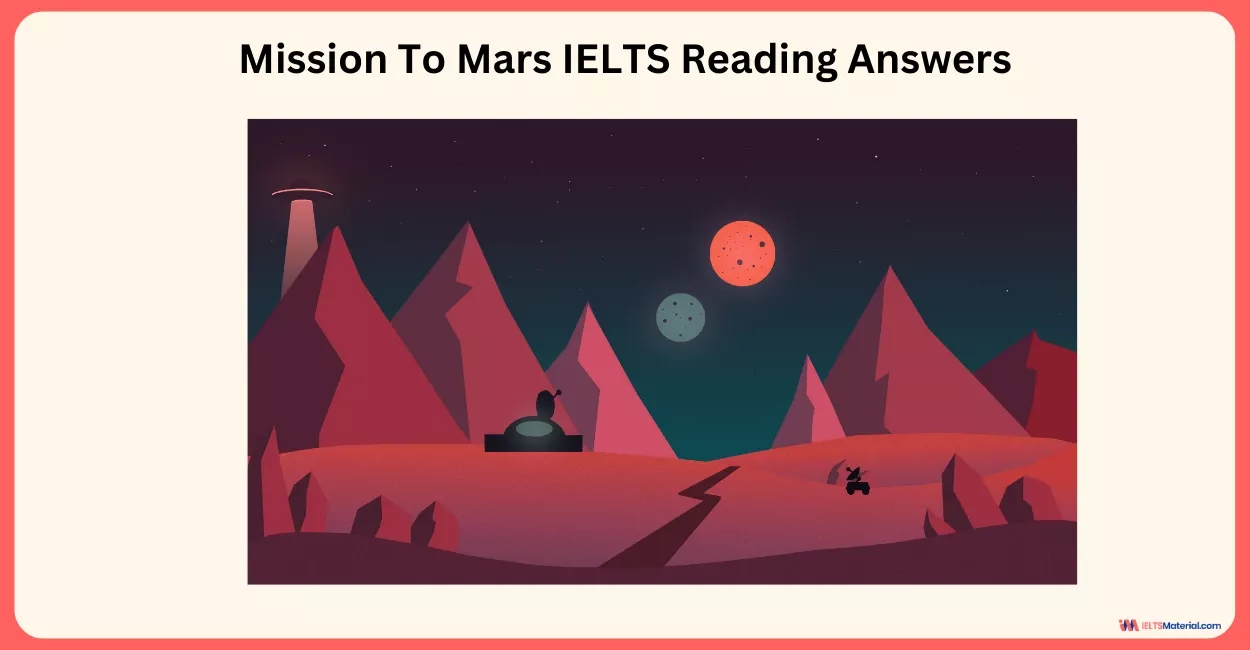
Table of Contents


Limited-Time Offer : Access a FREE 10-Day IELTS Study Plan!
The Academic reading passage “Mission to Mars” is an authentic IELTS test passage that has appeared in previous exams. As IELTS often repeats question patterns, practising with such passages is highly beneficial. To strengthen your skills further, attempt additional IELTS Reading practice tests to improve accuracy and confidence.
Mission To Mars IELTS Reading Passage
You should spend about 20 minutes on Questions 28 - 40, which are based on the Reading Passage below.
2011 Mars One Founded
In 2011 Bas Lansdorp and Arno Wielders lay the foundation of Mars One mission plan. Discussion meetings are held with potential suppliers of aerospace components in the USA, Canada, Italy and United Kingdom. Mission architecture, budgets and timeline are solidified from the feedback of supplier engineers and business developers. A baseline design for a mission of permanent human settlement on Mars achievable with existing technology is the result.
2013 Start Crew Selection
In April 2013, the Astronaut Selection Program is launched at press conferences in New York and Shangai. Round One is an online application open to all nationalities. The selection program proceeds with three additional rounds over the course of two years. At the end of it around six teams of four individuals are selected for training. A new batch of the Astronaut Selection Program begins every year to replenish the training pool regularly. An analogue of the Mars habitat is constructed on Earth for technology testing and training purposes.
2015 Start of Crew Training
Selected candidates from the first batch of applicants enter full-time training groups. This training continues until the launch in 2024. The group's ability to deal with prolonged periods of time in a remote location is the most important part of their training. They learn to repair components of the habitat and rover, learn to grow their own food, and train in medical procedures. The first outpost simulation, a Mars-like terrain that is relatively easy to reach is chosen. A second training outpost is located at a more remote environment like the Arctic desert.
2018 Demo and Comsat Mission
A Demonstration Mission is launched to Mars in May 2018, it provides proof of concept for some of the technologies that are important for a human mission. A communication satellite is also launched that is placed into a Mars stationary orbit. It enables 24/7 communication between the two planets. It can relay images, videos and other data from the Mars surface.
2020 Rover Mission Launched
One intelligent rover and one trailer are launched. The rover can use the trailer to transport the landers to the outpost location. On Mars, the rover drivers around the chosen region to find the best location for the settlement. An ideal location for the settlement is far enough north for the soil to certain enough water, equatorial enough for maximum solar power and flat enough to facilitate construction of the settlement. When the settlement location is determined, the rover prepares the surface for arrival of the cargo missions. It also clears large areas where solar panels will lie. A second communications satellite is launched into orbit around the Sun
2022 Cargo Missions Launched
Six cargo missions are launched and two living units, two life support systems, and two supply units are sent to Mars in July 2022. In February 2023 all units land on Mars using a rover signal as a beacon.
2023 Outpost Operational
The six cargo units land on Mars, up to 10 km away from the outpost. The rover picks up the first life support unit using the trailer, takes it to the right place, and deploys the thin film solar panel of the life support unit. The rover can now connect to the life support unit to recharge its batteries much faster than using only its own panels, allowing it to do much more work. The rover picks up all the other cargo units and then deploys the thin film solar panel of the second life support unit and the inflatable sections of the living units. The life support unit is connected to the living units by a hose that can transport water, air and electricity.
The life support is now activated. The rover feeds Martian soil into the life support system. Water is extracted from the Martian soil by evaporating the subsurface ice particle in an oven. The evaporated water is condensed back to its liquid state and stored. Part of the water is used for producing oxygen. Nitrogen and argon, filtered from the Martian atmosphere make up the other components of the breathable air inside the habitat.
2024 Departure Crew One
In April 2024, the components of the Mars transit vehicle are launched to Earth orbit om receiving the green light on the status of the system on Mars. First, a transit habitat and a Mars lander with an assembly crew on-board are launched into an orbit around the Earth. The assembly crew docks the Mars lander to the transit habitat. Two propellant stages are launched a month later and are also connected. The first Mars crew, now fully trained, is launched into the same Earth orbit. In orbit the Mars One crew switches places with the assembly crew, who descend back to Earth. Engines of the propellant stages are fixed and the transit vehicle is launched on a Mars transit trajectory. This is the point of no return; the crew is now bound to a 210 day flight to Mars.
Limited Seats are Available for our IELTS Webinars! Book yours now!
Mission To Mars IELTS Reading Questions
Questions 28–31
Choose the correct letter A, B, C, or D.
-
What is the plan to have a permanent human settlement on Mars based on?
A. New Technology
B. New & Old Technology
C. Existing Technology
D. Recent Technology -
How is the ideal site for the settlement found?
A. GPS
B. Rover
C. Settler
D. Some luck -
After the outpost is operational, how does the rover recharge its batteries?
A. From the living units
B. From the life support unit
C. From its own solar panels
D. From the cargo units -
Where does oxygen come from?
A. Nitrogen and Argon
B. Water
C. Martian atmosphere
D. Life Support System
Questions 32–38
Complete the summary below.
Choose NO MORE THAN TWO WORDS AND/OR A NUMBER from the passage.
-
To begin the process of selecting suitable astronauts, two __________ are held in two cities around the world.
-
The first application is __________ and available to every nationality.
-
This is followed by a further __________ rounds.
-
This results in the selection of __________ teams that then start training.
-
During training, they learn how to cope with life in an isolated __________.
-
They learn to cultivate __________.
-
They also perform __________.
Questions 39–40
Answer the questions below.
Choose NO MORE THAN TWO WORDS from the passage.
-
How will it be possible for people on Mars to contact people on Earth?
-
What point is reached when the crew start their journey to Mars?
Boost your IELTS Academic Reading score today! Grab Get Your IELTS Reading Ebook Now!
Mission To Mars IELTS Reading Answers with Explanation
Let’s now review the answers to the questions from the passage in the reading section, Koalas IELTS Reading Answers, and assess your improvement for a high IELTS Reading band score.
| Question number | Answer | Keywords | Location of keywords |
|---|---|---|---|
| 28 | C | A baseline design for a mission of permanent human settlement on Mars achievable with existing technology is the result. | 2011 Mars One Founded; Last line |
| 29 | B | When the settlement location is determined, the rover prepares the surface for arrival of the cargo missions. | 2020 Rover Mission Launched; Line 4 |
| 30 | B | The rover can now connect to the life support unit to recharge its batteries much faster than using only its own panels, allowing it to do much more work. | 2023 Outpost Operational;
First para, Line 3 |
| 31 | B | Part of the water is used for producing oxygen. | 2023 Outpost Operational;
First para, Line 5 |
| 32 | Press conferences | In April 2013, the Astronaut Selection Program is launched at press conferences in New York and Shanghai. | 2013 Start Crew Selection; Line 1 |
| 33 | online | Round One is an online application open to all nationalities. | 2013 Start Crew Selection; Line 2 |
| 34 | 3/three | The selection program proceeds with three additional rounds over the course of two years. | 2013 Start Crew Selection; Line 3 |
| 35 | 6/six | At the end of it around six teams of four individuals are selected for training. | 2013 Start Crew Selection; Line 4 |
| 36 | location | The group’s ability to deal with prolonged periods of time in a remote location is the most important part of their training. | 2015 Start of Crew Training; Line 3 |
| 37 | food | They learn to repair components of the habitat and rover, learn to grow their own food, | 2015 Start of Crew Training; Line 4 |
| 38 | Medical procedures | They learn to repair components of the habitat and rover, learn to grow their own food, and train in medical procedures. | 2015 Start of Crew Training; Line 4 |
| 39 | Communication satellite | A communication satellite is also launched that is placed into a Mars stationary orbit. It enables 24/7 communication between the two planets. | 2018 Demo and Comsat Mission; Lines 2 – 3 |
| 40 | No return | This is the point of no return; the crew is now bound to a 210-day flight to Mars. | 2024 Departure Crew One; Last line |
Tips to Ace Mission To Mars IELTS Reading Answers
Let us check out some quick IELTS Exam Preparation Tips for Band Score of 8+ to answer the types of questions in the Reading Answers.
Multiple Choice Questions (MCQ)
- Read the question and options first to understand what information you need to look for.
- Scan the passage for keywords or their synonyms rather than exact words.
- Eliminate incorrect options carefully before choosing the best answer.
- Watch out for distractors that use similar wording but give incorrect details.
- Always base your answer on information directly stated in the passage, not assumptions.
Summary Completion
- Read the summary first to understand the overall idea and context.
- Predict the type of word needed (noun, verb, number, or adjective).
- Follow the word limit strictly to avoid losing marks.
- Locate the relevant paragraph and look for paraphrased information.
- Check grammar and spelling so the completed summary makes sense.
Short Answer Questions
- Read the question carefully and underline key words.
- Find the exact information in the passage that answers the question.
- Use words directly from the passage wherever possible.
- Stick to the word limit and avoid adding unnecessary information.
- Double-check spelling and ensure the answer fits grammatically.
Want to boost your IELTS score? Enroll in our expert-led IELTS online classes today!
Mastering passages like Mission To Mars IELTS Reading Answers requires careful attention to keywords, paraphrasing, and logical connections in the text. Using this guide’s answers, explanations, and tips, you can strengthen your reading strategies, boost accuracy, and enhance your overall IELTS Reading performance. Keep practising with more IELTS Reading Recent Actual Tests and answers on IELTSMaterial.com to improve your speed, accuracy, and overall performance.
Check More IELTS Reading Answers
Practice IELTS Reading based on question types

Start Preparing for IELTS: Get Your 10-Day Study Plan Today!

Recent Articles
Nehasri Ravishenbagam
Haniya Yashfeen
Haniya Yashfeen
Haniya Yashfeen


Post your Comments