Saving Language - IELTS Reading Answers
4 min read
Updated On
-
Copy link
This blog helps you practice the “Saving Language” IELTS Academic Reading passage with detailed answers, explanations, and tips for question types such as Matching Features and Yes/No/Not Given, boosting speed, understanding, and confidence.
Table of Contents


Limited-Time Offer : Access a FREE 10-Day IELTS Study Plan!
The Academic passage “Saving Language” is a reading passage that appeared in an IELTS Test. Ideally, you should not spend more than 20 minutes on a passage. In this guide, you will find the answers, detailed explanations, and useful tips to help you understand the passage thoroughly and improve your speed and accuracy. Let’s see how easy this passage is for you and whether you can complete it within 20 minutes. If not, you can practice more IELTS reading passages and tests from IELTSMaterial.com to build your confidence and skills.
Saving Language - IELTS Reading Passage
You should spend about 20 minutes on Questions 28 - 40, which are based on the Reading Passage below.
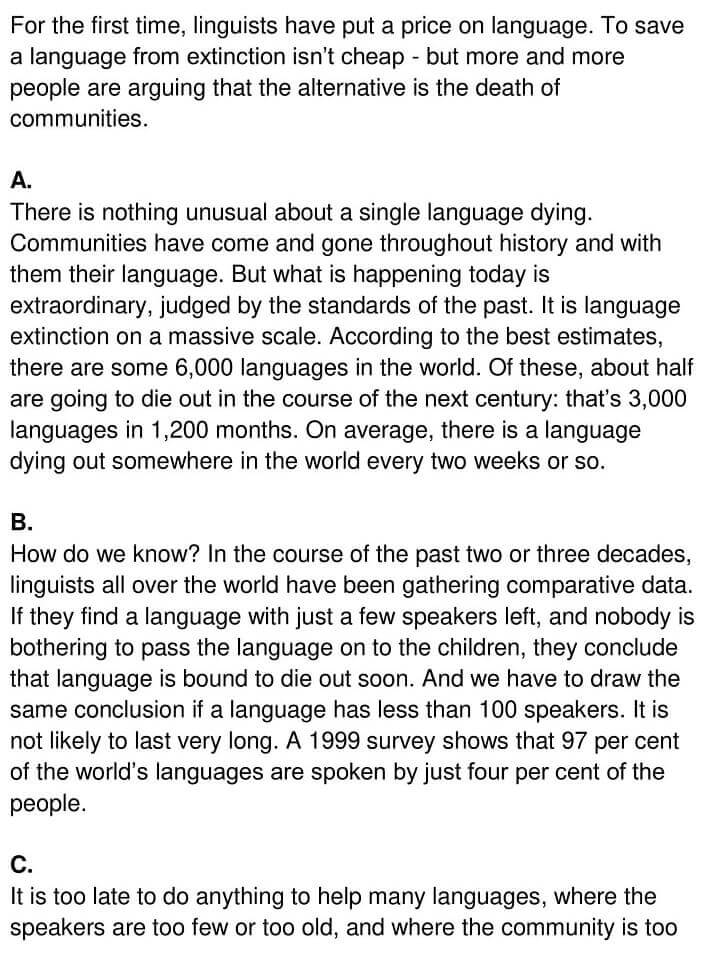
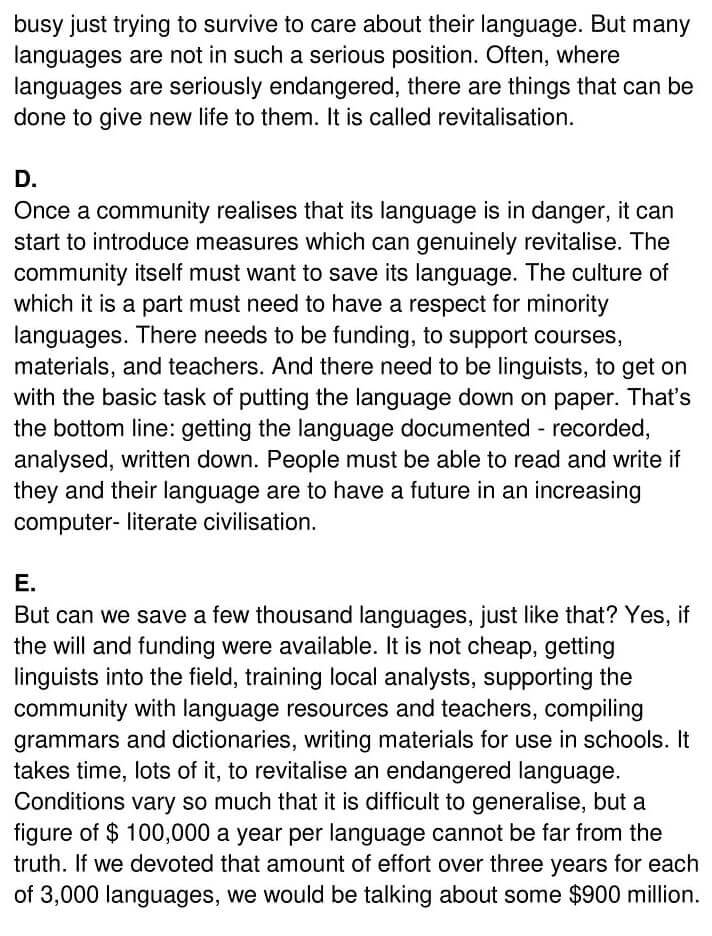
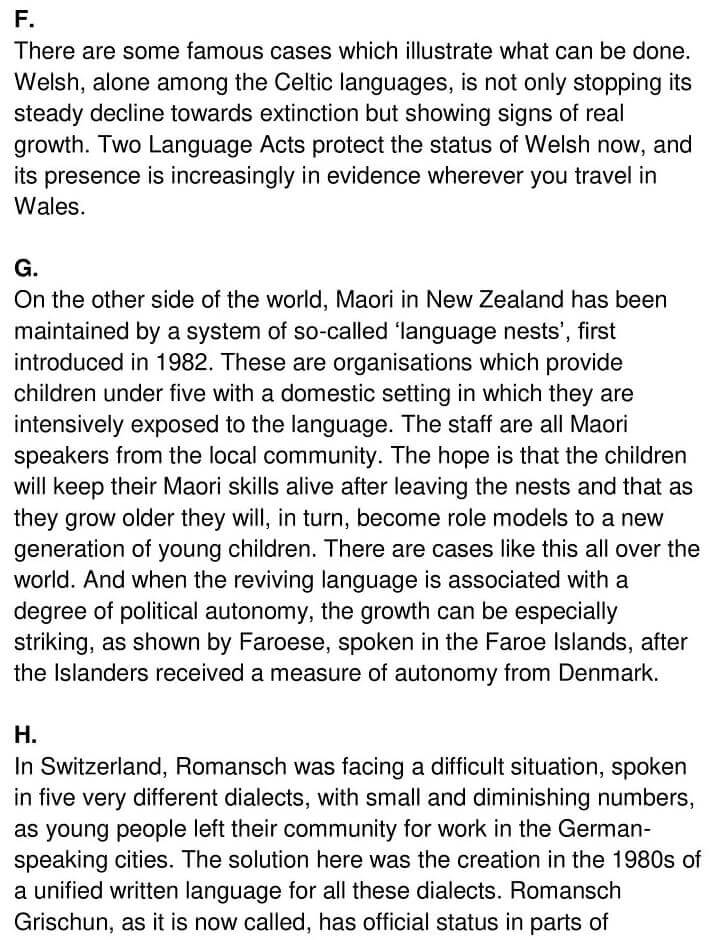
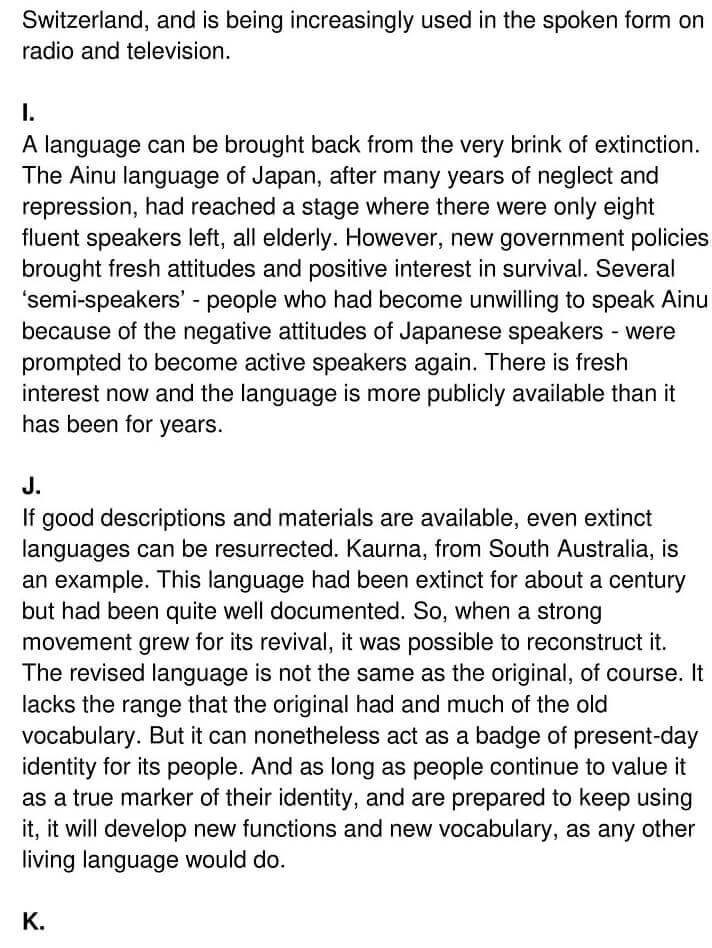
Boost your IELTS Academic Reading score today! Grab Get Your IELTS Reading Ebook Now!
Saving Language - IELTS Reading Answers
Let’s now review the answers to the questions from the passage in the reading section, Saving Language - IELTS Reading Answers, and assess your improvement for a high IELTS Reading band score.
-
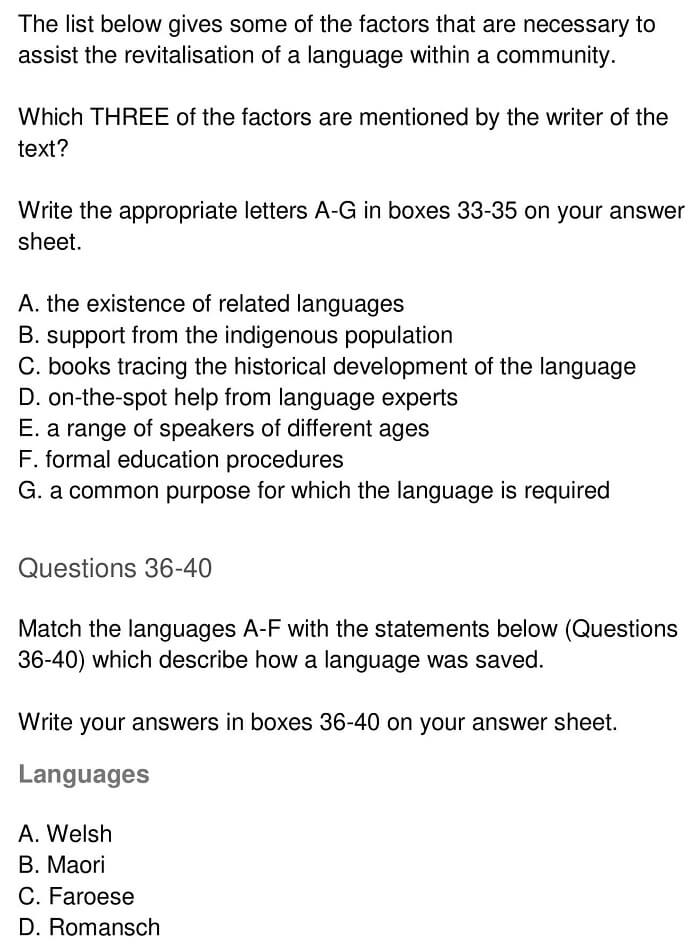
A
Answer Location: Paragraph D, 2nd line
Explanation: The author explains that for any community to revive its native language, its native speakers must actively put in effort within that community. -
C
Answer Location: Paragraph D, 4th line
Explanation: Language experts need to help indigenous communities preserve their language by recording, analyzing, and documenting it. -
E
Answer Location: Paragraph E, 2nd line
Explanation: Revitalizing a language is challenging but possible if formal education processes, like creating school materials in that language, are implemented. -
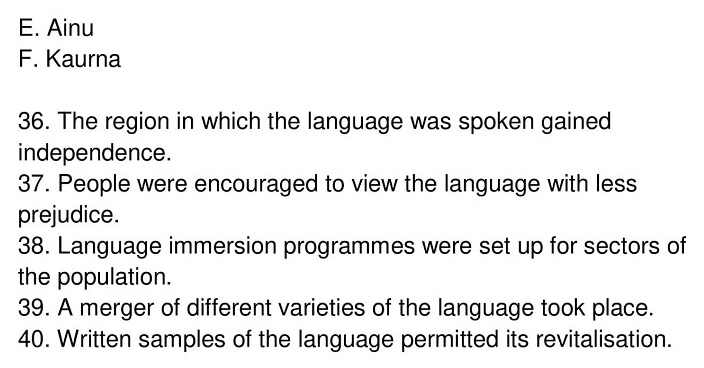
F
Answer Location: Paragraph J, 1st line
Explanation: A language can be revived if good records exist, as was the case with the Kaurna language. -
D
Answer Location: Paragraph H, 3rd line
Explanation: Switzerland had five Romansch dialects; unifying them into a similar language helped preserve it. -
B
Answer Location: Paragraph G, 1st line
Explanation: In New Zealand, Maori language nests are created as part of immersion programs to ensure children continue speaking the language and pass it on. -
E
Answer Location: Paragraph I, 3rd line
Explanation: Government encouragement for hesitant speakers helped the Ainu language gain popularity. -
C
Answer Location: Paragraph G, last line
Explanation: Regions that attained freedom had a higher chance of preserving their native tongue, such as the Faroese. -
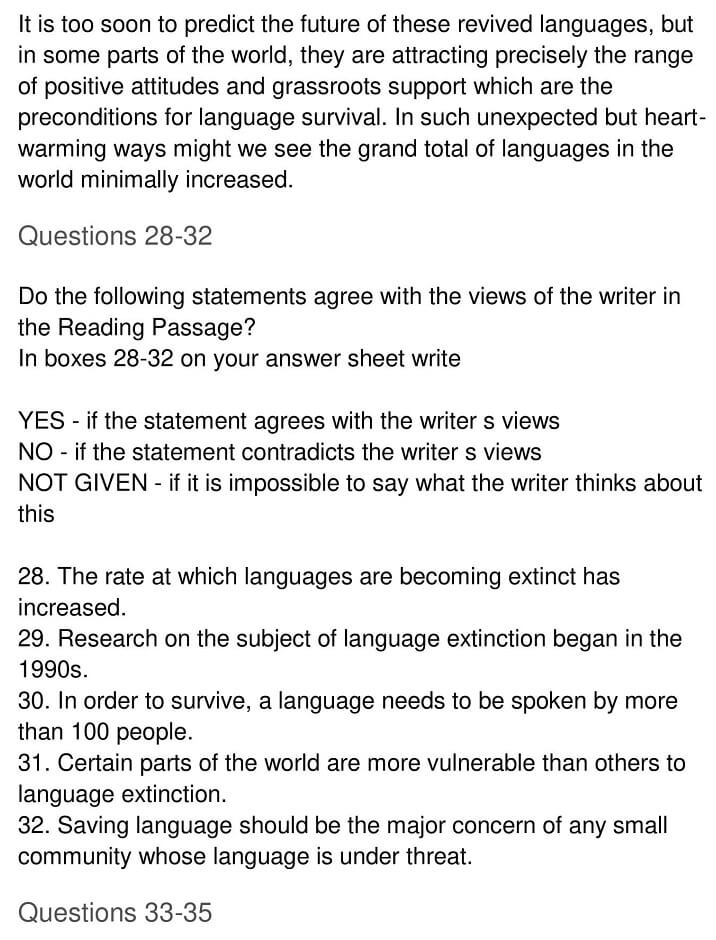
NO
Answer Location: Paragraph C, 1st line
Explanation: The passage states that when very few people speak a language, there’s nothing that can be done to save it. -
NOT GIVEN
Answer Location: Not available
Explanation: The passage does not mention whether some parts of the world are more likely to lose their language than others. -
YES
Answer Location: Paragraph B, 2nd line
Explanation: The text states that at least 100 people must speak a language for it to survive. -
NO
Answer Location: Paragraph B, 1st line
Explanation: The passage mentions that the study of language loss has only been ongoing for the last two or three decades. -
YES
Answer Location: Paragraph A, 4th line
Explanation: Data in the passage shows that language loss is occurring on a large scale.
Tips to Ace Saving Language - IELTS Reading Answers
Let us check out some quick IELTS Exam Preparation Tips for Band Score of 8+ to answer the types of questions in the Reading Answers.
IELTS Reading – Matching Features
-
Understand the feature list carefully – Read all options/features before scanning the passage. Know what each feature refers to.
-
Scan for keywords – Look for synonyms and related phrases in the passage rather than exact words from the question.
-
Check each paragraph systematically – Don’t assume the answers appear in the same order as the features. Read carefully and mark potential matches.
-
Eliminate options – Cross out features that clearly do not match to narrow down your choices.
-
Watch for multiple matches – Some features may match more than one paragraph or sentence. Pay attention to context and details.
IELTS Reading – Yes/No/Not Given
-
Focus on facts, not opinions – “Yes” means the statement agrees with the passage, “No” means it contradicts, and “Not Given” means there’s no information.
-
Use keywords and synonyms – Match the meaning rather than the exact words in the statement.
-
Don’t assume extra information – Only use what is explicitly stated or clearly implied in the passage.
-
Read surrounding sentences – Sometimes context around the keywords clarifies whether a statement is true, false, or not mentioned.
-
Mark uncertain answers as Not Given – If the passage does not clearly confirm or contradict the statement, choose “Not Given” rather than guessing.
Want to boost your IELTS score? Enroll in our expert-led IELTS online classes today!
Overall, practicing the “Saving Language” passage can help you improve reading speed, comprehension, and accuracy. By reviewing the answers, detailed explanations, and tips, you can better understand different IELTS Reading question types, including Matching Features and Yes/No/Not Given, avoid common mistakes, and boost your confidence for the actual test. Regular practice with similar passages will make it easier to manage time and achieve a higher band score.
Keep practising with more IELTS Reading Recent Actual Tests and answers on IELTSMaterial.com to improve your speed, accuracy, and overall performance.
Check More IELTS Reading Answers
Practice IELTS Reading based on question types

Start Preparing for IELTS: Get Your 10-Day Study Plan Today!

Recent Articles
Nehasri Ravishenbagam
Haniya Yashfeen
Haniya Yashfeen
Haniya Yashfeen


Post your Comments