The Nature and Aims of Archaeology - IELTS Reading Answers
11 min read
Updated On
-
Copy link
Improve your IELTS reading score by using the ‘The Nature and Aims of Archaeology’ IELTS reading passage and its answer key. Learn how to approach a variety of IELTS reading questions using tips that will assist you in improving your reading strategy.
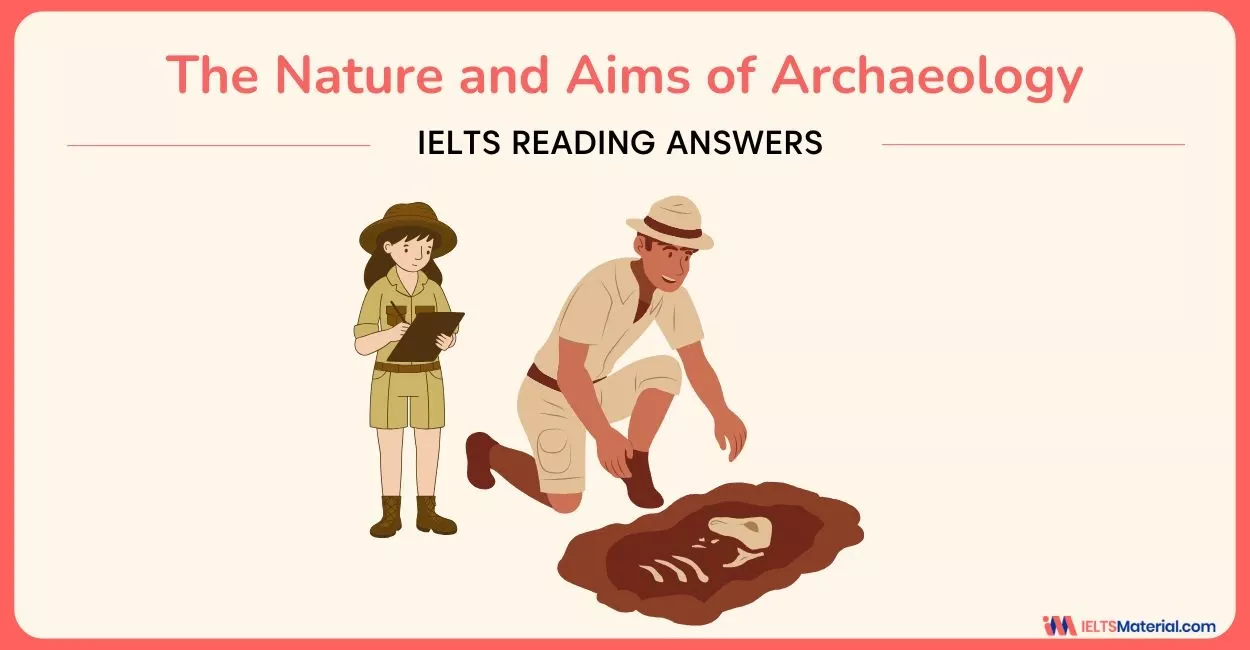
Table of Contents
- Passage for The Nature and Aims of Archaeology IELTS Reading Answers
- Questions for The Nature and Aims of Archaeology Reading Answers
- Answers and Explanations of The Nature and Aims of Archaeology IELTS Reading Passage
- Tips for Answering the Question Types in the The Nature and Aims of Archaeology Reading Passage


Limited-Time Offer : Access a FREE 10-Day IELTS Study Plan!
Unlike complete practice tests, while practicing single passages like ‘The Nature and Aims of Archaeology IELTS Reading Answers’, you can train yourself to spot signpost words, topic shifts, and main ideas more efficiently. Over time, this improves your ability to navigate text quickly, which becomes crucial when handling three passages under time pressure during the actual IELTS Reading exam.
Take up the questions for The Nature and Aims of Archaeology reading passage and then check your answers against the provided answer key and tips to improve your performance in the reading module.
Passage for The Nature and Aims of Archaeology IELTS Reading Answers
The following passage, ‘The Nature and Aims of Archaeology,’ is helpful practice for the IELTS reading exam. Practicing this passage and focusing on similar IELTS Reading topics for General and Academic will significantly enhance your ability to handle different reading passages.
You should spend about 20 minutes on Questions 14-27, which are based on the Reading Passage below.
The Nature and Aims of Archaeology
A Archaeology is partly the discovery of the treasures of the past, partly the careful work of the scientific analyst, partly the exercise of the creative imagination. It is toiling in the sun on an excavation in the Middle East, it is working with living Inuit in the snows of Alaska, and it is investigating the sewers of Roman Britain. But it is also the painstaking task of interpretation, so that we come to understand what these things mean for the human story. And it is the conservation of the world's cultural heritage against looting and careless harm.
B Archaeology, then, is both a physical activity out in the field and an intellectual pursuit in the study or laboratory. That is part of its great attraction. The rich mixture of danger and detective work has also made it the perfect vehicle for fiction writers and film-makers, from Agatha Christie with Murder in Mesopotamia to Stephen Spielberg with Indiana Jones. However far from reality such portrayals are, they capture the essential truth that archaeology is an exciting quest - the quest for knowledge about ourselves and our past.
C But how does archaeology relate to disciplines such as anthropology and history, that are also concerned with the human story? Is archaeology itself a science? And what are the responsibilities of the archaeologist in today's world?
D Anthropology, at its broadest, is the study of humanity - our physical characteristics as animals and our unique non-biological characteristics that we call culture. Culture in this sense includes what the anthropologist, Edward Tylor, summarised in 1871 as 'knowledge, belief, art, morals, custom and any other capabilities and habits acquired by man as a member of society'. Anthropologists also use the term 'culture’ in a more restricted sense when they refer to the ‘culture’ of a particular society, meaning the non-biological characteristics unique to that society, which distinguish it from other societies. Anthropology is thus a broad discipline - so broad that it is generally broken down into three smaller disciplines: physical anthropology, cultural anthropology and archaeology.
E Physical anthropology, or biological anthropology as it is also called, concerns the study of human biological or physical characteristics and how they evolved. Cultural anthropology - or social anthropology - analyses human culture and society. Two of its branches are ethnography (the study at first hand of individual living cultures) and ethnology (which sets out to compare cultures using ethnographic evidence to derive general principles about human society). Archaeology is the ‘past tense of cultural anthropology’. Whereas cultural anthropologists will often base their conclusions on the experience of living within contemporary communities, archaeologists study past societies primarily through their material remains - the buildings, tools, and other artefacts that constitute what is known as the material culture left over from former societies.
F Nevertheless, one of the most important tasks for the archaeologist today is to know how to interpret material culture in human terms. How were those pots used? Why are some dwellings round and others square? Here, the methods of archaeology and ethnography overlap. Archaeologists in recent decades have developed ‘ethnoarchaeology’, where, like ethnographers, they live among contemporary communities, but with the specific purpose of learning how such societies use material culture - how they make their tools and weapons, why they build their settlements where they do, and so on. Moreover, archaeology has an active role to play in the field of conservation. Heritage studies constitute a developing field, where it is realised that the world's cultural heritage is a diminishing resource which holds different meanings for different people.
G If, then, archaeology deals with the past, in what way does it differ from history? In the broadest sense, just as archaeology is an aspect of anthropology, so too is it a part of history - where we mean the whole history of humankind from its beginnings over three million years ago. Indeed, for more than ninety-nine per cent of that huge span of time, archaeology - the study of past material culture - is the only significant source of information. Conventional historical sources begin only with the introduction of written records around 3,000 BC in western Asia, and much later in most other parts of the world.
H A commonly drawn distinction is between pre-history, i.e. the period before written records - and history in the narrow sense, meaning the study of the past using written evidence. To archaeology, which studies all cultures and periods, whether with or without writing, the distinction between history and pre-history is a convenient dividing line that recognises the importance of the written word, but in no way lessens the importance of the useful information contained in oral histories.
I Since the aim of archaeology is the understanding of humankind, it is a humanistic study, and since it deals with the human past, it is a historical discipline. But it differs from the study of written history in a fundamental way. The material the archaeologist finds does not tell us directly what to think. Historical records make statements, offer opinions and pass judgements. The objects the archaeologists discover, on the other hand, tell us nothing directly in themselves. In this respect, the practice of the archaeologist is rather like that of the scientist, who collects data, conducts experiments, formulates a hypothesis, tests the hypothesis against more data, and then, in conclusion, devises a model that seems best to summarise the pattern observed in the data. The archaeologist has to develop a picture of the past, just as the scientist has to develop a coherent view of the natural world.
Questions for The Nature and Aims of Archaeology Reading Answers
The IELTS Academic Reading passage, ‘The Nature and Aims of Archaeology’, comes with 14 questions. While working through them, you can begin to understand the kinds of questions that will be posed to you and the degree of complexity you should anticipate.
The question types in this reading passage include:
- IELTS Reading Yes, No, Not Given (Q. 14-19)
- IELTS Reading Multiple Choice Questions (Q. 20-21) & (Q. 22-23)
- IELTS Reading Summary Completion (Q. 24-27)
Questions 14-19
Do the following statements agree with the claims of the writer in the Reading Passage?
In boxes 1-6 on your answer sheet, write
YES if the statement agrees with the claims of the writer
NO if the statement contradicts the claims of the writer
NOT GIVEN if it is impossible to say what the writer thinks about this
14 Archaeology involves creativity as well as careful investigative work.
15 Archaeologists must be able to translate texts from ancient languages.
16 Movies give a realistic picture of the work of archaeologists.
17 Anthropologists define culture in more than one way.
18 Archaeology is a more demanding field of study than anthropology.
19 The history of Europe has been documented since 3,000 BC.
Questions 20-21
Choose TWO letters A-E.
Write your answers in boxes 7-8 on your answer sheet.
The list below gives some statements about anthropology.
Which TWO statements are mentioned by the writer of the text?
A It is important for government planners.
B It is a continually growing field of study.
C It often involves long periods of fieldwork.
D It is subdivided for study purposes.
E It studies human evolutionary patterns.
20 …………
21 …………
Questions 22-23
Choose TWO letters A-E.
Write your answers in boxes 9-10 on your answer sheet.
The list below gives some of the tasks of an archaeologist.
Which TWO of these tasks are mentioned by the writer of the text?
A examining ancient waste sites to investigate diet
B studying cave art to determine its significance
C deducing reasons for the shape of domestic buildings
D investigating the way different cultures make and use objects
E examining evidence for past climate changes
22…………
23…………
Questions 24-27
Complete the summary of the last two paragraphs of the Reading Passage.
Choose NO MORE THAN TWO WORDS from the passage for each answer.
Write your answers in boxes 24-27 on your answer sheet.
Much of the work of archaeologists can be done using written records but they find 24………… equally valuable. The writer describes archaeology as both a 25………… and a 26………… . However, as archaeologists do not try to influence human behaviour, the writer compares their style of working to that of a 27………… .
Learn quick methods to conquer passages like this within 20 minutes.
Join our FREE IELTS webinars!
Answers and Explanations of The Nature and Aims of Archaeology IELTS Reading Passage
It's time to cross-check your answers to The Nature and Aims of Archaeology IELTS Reading passage using the answer key provided below. Do not forget to create strategies based on the feedback from this practice, and master IELTS Reading question types with examples.
Unlock Answer Key
| Question Number | Answers | Keywords | Location of Keywords |
|---|---|---|---|
| 14. | Yes | Partly the discovery of treasures of the past, exercise of the creative imagination | Paragraph A, First 3 lines |
| 15. | Not Given | Not Given | Not Given |
| 16. | No | film-makers, far from reality, such portrayals are | Paragraph B, Lines 5-7 |
| 17. | Yes | Anthropology, thus a broad discipline | Paragraph D, Last 4 lines |
| 18. | Not Given | Not Given | Not Given |
| 19. | No | Around 3,000 BC in western Asia, much later in most other parts in the world. | Paragraph G, Last 3 lines |
| 20. | D, E (in any order) D | Anthropology is thus a broad discipline, broken down into three smaller disciplines | Paragraph D, Last 3 lines |
| 21. | D, E (in any order) E | Anthropology, characteristics and how they evolved. | Paragraph E, First 3 lines |
| 22. | C, D (in any order) C | How to interpret material culture, Why are some dwellings round and others square? | Paragraph F, First 4 lines |
| 23. | C, D (in any order) D | Interpret material culture, how they make their tools and weapons | Paragraph 7 First 2 lines and Lines 8-9 |
| 24. | Oral histories | no way lessens the importance, contained in oral histories. | Paragraph H, Last 2 lines |
| 25. | Humanistic study (in any order) | Understanding of humankind, it is a humanistic study | Paragraph I, First 3 lines |
| 26. | Historical discipline (in any order) | Deals with the human past, it is a historical discipline. | Paragraph I, First 3 lines |
| 27. | scientist | Practice of the archaeologist, like that of the scientist, | Paragraph I, Lines 8-9 |
Learn quick solving tips and reading techniques from experts!
Connect with us through our FREE IELTS online classes!
Tips for Answering the Question Types in the The Nature and Aims of Archaeology Reading Passage
Now, let us check out some quick IELTS exam preparation tips for band score of 8+ to answer the question types in the passage, The Nature and Aims of Archaeology Reading Answers.
Yes/No/Not Given
- Match ideas, not words. If a sentence rephrases the passage’s idea, it is still a YES. For example, in Paragraph A, the writer says archaeology is “partly the discovery of treasures of the past” and an “exercise of the creative imagination.” These phrases directly support the idea of creativity and investigation. As a result, the answer to Q. 14 is YES.
- Beware of assumptions. If a statement feels related but is not explicitly stated, choose NOT GIVEN. The passage never mentions archaeologists translating ancient languages. Even though it sounds logical, IELTS passages only reward text evidence.
- Look for contrast language. Words like ‘far from’, ‘unrealistic’, ‘misleading’, etc., usually signal NO answers. For example, Paragraph B says “film-makers, far from reality, such portrayals are…”. This directly contradicts the statement in Q. 16.
- General statements often signal YES. If the writer clearly supports a general academic view, it’s often YES. For example, Paragraph D describes anthropology as “a broad discipline”. A broad discipline naturally includes multiple definitions of culture, making the answer to Q. 17, YES.
- Watch for scope and geography. If a statement overgeneralises (e.g., applies one region’s history to another), it is often NO. For example, Paragraph G states history began around 3,000 BC in western Asia, “much later in most other parts of the world.” Europe is included in “other parts”, so the statement is incorrect.
Multiple-Choice Questions
- Do not assume general truths; only choose what is explicitly mentioned.
- Skim for lists or classifications, as MCQs often come from them.
- Cross out options that are logical but unstated.
- The answer choices may appear across different paragraphs.
- Correct choices often restate ideas clearly or match definitions or classifications, while incorrect choices often sound logical but are not stated or add new information.
- For Q. 20-21, read the question stem carefully, scan for lists, classifications, or explanations, and eliminate options with examples but no statement, general truth but no mention, and strong wording not used by the writer.
- For Q. 22-23, scan for examples of work archaeologists do, match the example directly to an option, and reject choices that are too scientific/general or belong more to anthropology than archaeology.
Summary Completion
- Identify the grammar form required (noun/adjective/comparison): Check the sentence structure around the blank for articles, prepositions, or verbs that usually signal whether a noun, adjective, or comparative/superlative form is needed.
- Answers must come exactly from the passage (NO MORE THAN TWO WORDS): Do not change word forms or paraphrase in your answer, even if the meaning is correct. Even if you alter the grammar, the answer will be marked wrong.
- Look for paraphrased clues, not identical wording: The question often rephrases ideas using synonyms, so match meaning, not surface vocabulary.
- Check comparison structures carefully: Words like ‘more’, ‘less’, ‘most’, ‘-er’, ‘-est’, ‘than’, etc. indicate a comparative or superlative is required, and the exact form must appear in the passage. For example, Paragraph I states “the practice of the archaeologist, like that of the scientist”, and so the correct answer for Q. 27 is ‘scientist’.
Well done on completing the passage ‘The Nature and Aims of Archaeology’! Now, with the help of the feedback and IELTS Reading tips and techniques to increase your reading speed, continue to solve more recent IELTS reading tests, focusing on enhancing your comprehension abilities and formulating your own personalized strategy for succeeding in the reading module.
Useful Links:
- Time Travel - IELTS Reading Answers
- The Power of Light IELTS Reading Answers
- Crop Circles IELTS Reading Answers
- How Much Higher How Much Faster - IELTS Reading Answers
- The Problem Of Scarce Resources IELTS Reading Answers
- The Role of Government in Environmental Management - IELTS Reading Answers
- Saving The Soil - IELTS Reading Answers
- Makete Integrated Rural Transport Project - IELTS Reading Answers
- Band Score for 25 Correct Answers in IELTS Reading
Practice IELTS Reading based on question types

Start Preparing for IELTS: Get Your 10-Day Study Plan Today!

Explore other Reading Actual Tests
Kasturika Samanta
Prity Mallick
Kasturika Samanta
Kasturika Samanta

Recent Articles
Nehasri Ravishenbagam
Haniya Yashfeen
Haniya Yashfeen
Haniya Yashfeen


Post your Comments