The Romantic Poets - IELTS Reading Answers
7 min read
Updated On
-
Copy link
Find complete The Romantic Poets IELTS Reading answers with detailed explanations, keyword location, and expert strategies. Practise real exam questions, improve comprehension skills, and boost your IELTS Reading band score.
Table of Contents


Limited-Time Offer : Access a FREE 10-Day IELTS Study Plan!
The Academic IELTS Reading passage “The Romantic Poets” is a real exam passage that has appeared in past IELTS tests. This article provides complete answers with clear explanations, along with useful tips for each question type, to help you understand the logic behind every answer. Ideally, you should spend no more than 20 minutes on a single passage, so use this practice to assess your speed and accuracy. If you need more practice, explore additional IELTS Reading tests on IELTSMaterial.com to strengthen your performance and boost your band score.
The Romantic Poets IELTS Reading Passage
You should spend about 20 minutes on Questions 1 - 13, which are based on the Reading Passage below.
Limited Seats are Available for our IELTS Webinars! Book yours now!
The Romantic Poets IELTS Reading Answer with Explanation
Let’s now review the answers to the questions from the passage in the reading section, The Romantic Poets - IELTS Reading Answers, and assess your improvement for a high IELTS Reading band score.
| Question number | Answer | Explanation |
|---|---|---|
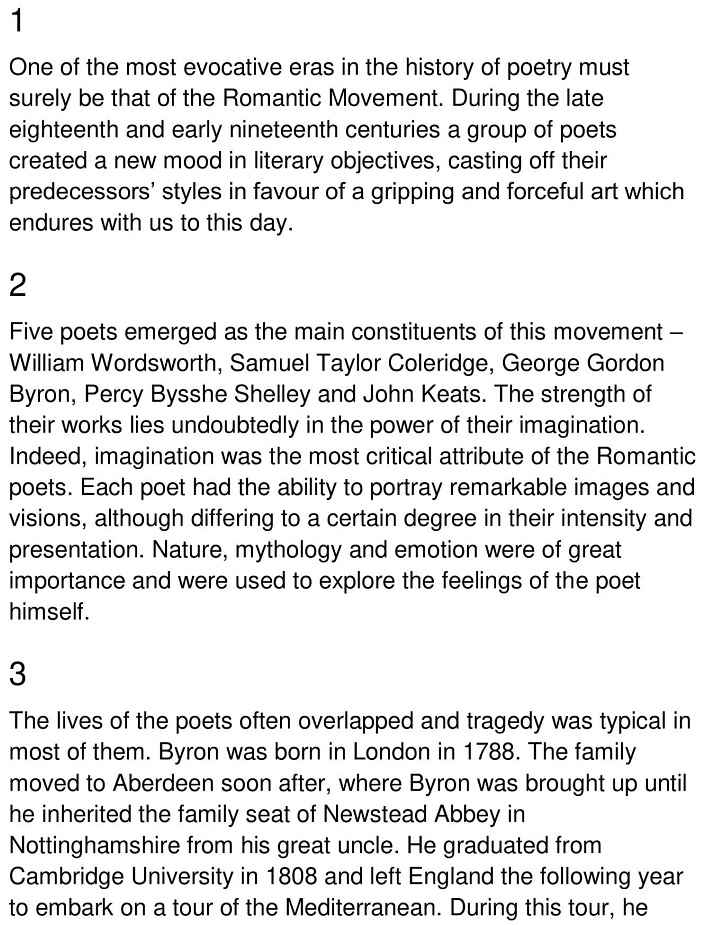
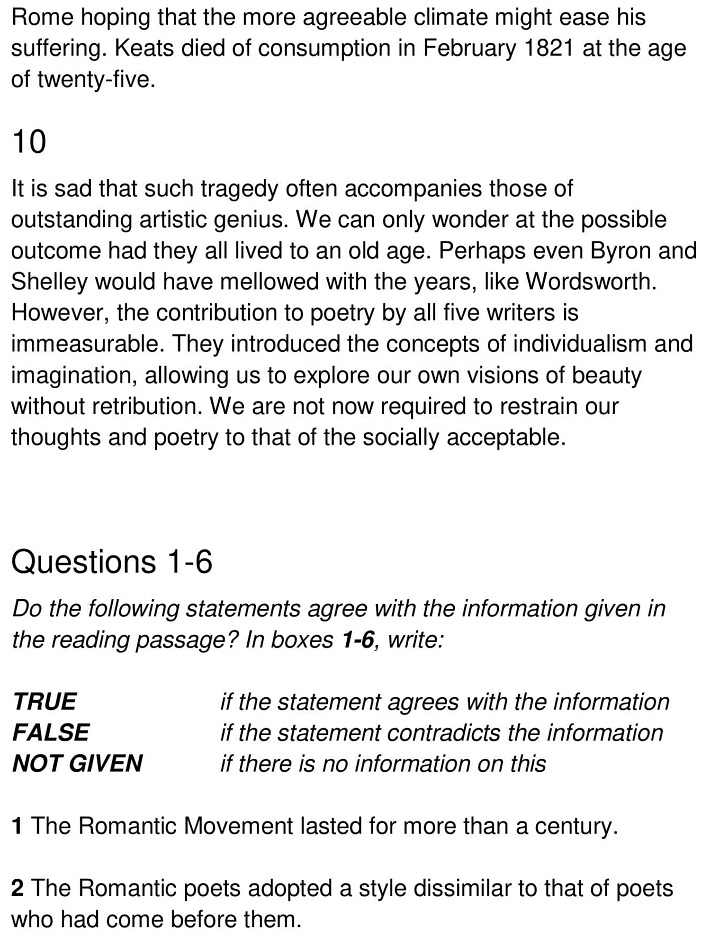
| 1 | FALSE | Paragraph 1 puts forward the idea that ‘during the late eighteenth and early nineteenth centuries a group of poets created a new mood.’ Since the movement started at the end of the eighteenth century and lasted till the early nineteenth, it means that it did not last for more than a century. As the statement contradicts the information, the correct answer is “FALSE.” |
| 2 | TRUE | According to paragraph 1, ‘a group off created a new mood in literary objectives, casting off their predecessors.’ The phrase ‘casting off their predecessor’ indicates that romantic poets created a new mood and dismissed the mood created by earlier poets. As the statement agrees with the information, the correct answer is “TRUE.” |
| 3 | FALSE | As per paragraph 1, ‘a gripping and forceful art which endures with us to this day.’ Hence, it means that it still has a lasting impression on us even today. As the statement agrees with the information, the correct answer is “FALSE.” |
| 4 | NOT GIVEN | In paragraph 2, a line mentions that ‘each poet had the ability to portray remarkable images and visions, although differing to a certain degree.’ According to this line, romantic poets had a different style from other poets. However, it is not mentioned that they had no respect for any style besides their own. Hence, the correct answer is “NOT GIVEN.” |
| 5 | TRUE | Paragraph 2 mentions that ‘indeed, imagination was the most crucial attribute of the Romantic poets.’ The word attribute suggests that the Romantic poet’s greatest quality was their imagination. Therefore, we can infer that they were gifted with a strong imagination. As the statement agrees with the information, the correct answer is “TRUE.” |
| 6 | TRUE | There’s a line in paragraph 2 that states that ‘nature, mythology and emotion were of great importance and were used to explore the feelings of the poet himself.’ So nature, mythology and emotions were of great importance to Romantic poets. Therefore, we can infer that the natural word inspired romantic poetry. As the statement agrees with the information, the correct answer is “TRUE.” |
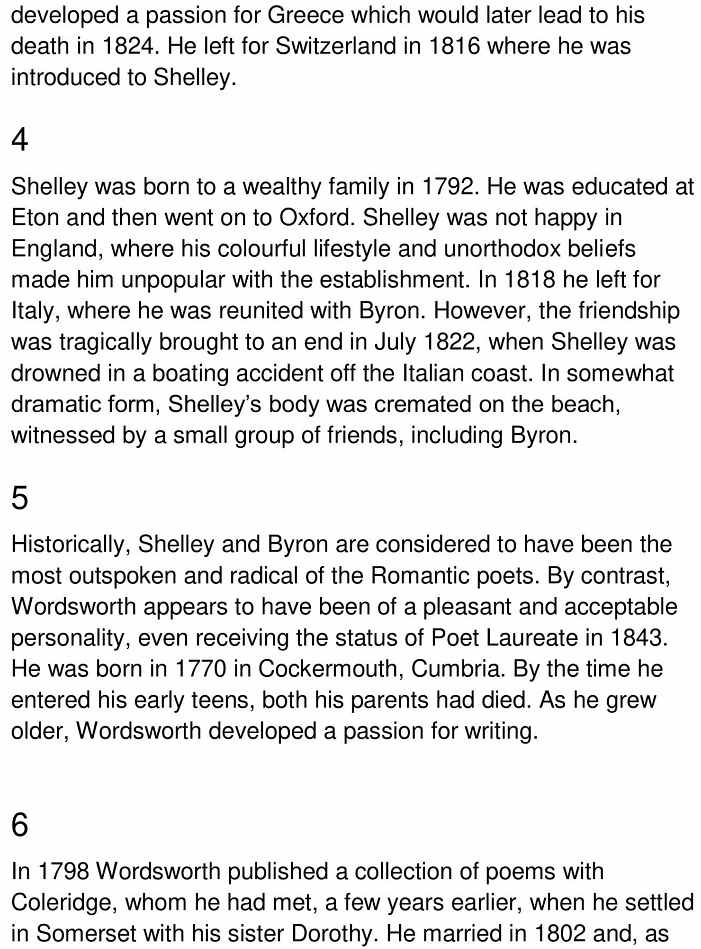
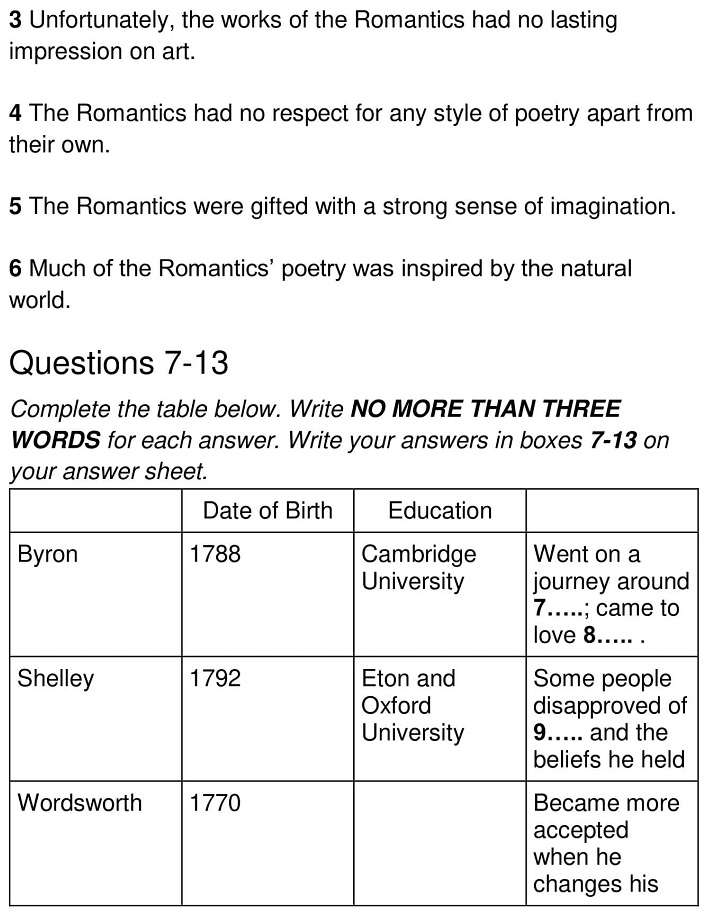
| 7 | (the) Mediterranean | In paragraph 3, there’s a line that states, ‘he graduated from Cambridge University in 1808, and left England the following year to embark on a tour of the Mediterranean.’ The term ’embark on a tour of the Mediterranean’ suggests that we went on a journey around the Mediterranean. Hence, the correct answer is “the Mediterranean.” |
| 8 | Greece | Paragraph 3 conveys that, ‘during this tour, he developed a passion for Greece.’ Since Byron developed a passion for Greece, we can deduce that he came in love with this place. Hence, the correct answer is “Greece.” |
| 9 | His (colourful) lifestyle | Paragraph 4 states that, ‘Shelly was not happy in England, where his colourful lifestyle and unorthodox beliefs made him unpopular.’ As Shelly was ‘unpopular because of his lifestyle and beliefs’, it signifies that some people disapproved of his colourful lifestyle and beliefs. Hence, the correct answer is “his colourful lifestyle.” |
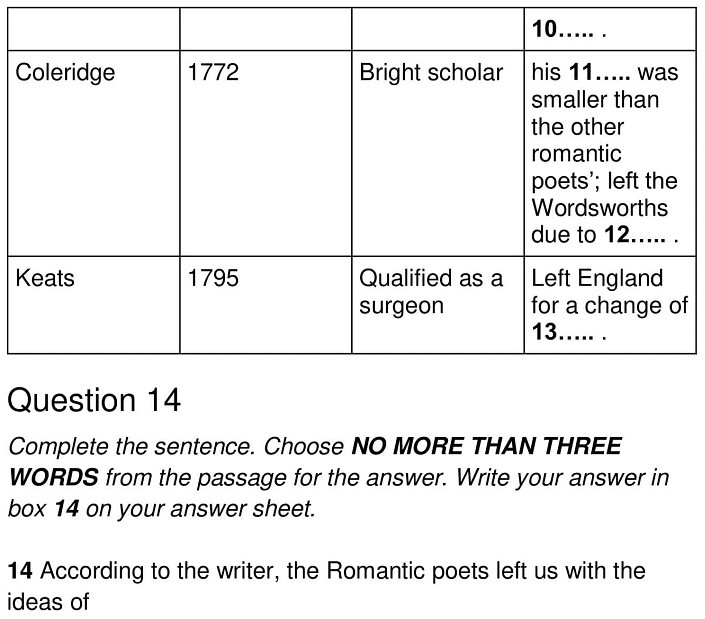
| 10 | political views | Paragraph 6 puts forward the idea that ‘as time passed, he deserted his former political views and became increasingly acceptable to popular society.’ This line confirms that Wordsworth became more acceptable when he changed his former political views. Hence, the correct answer is “political views.” |
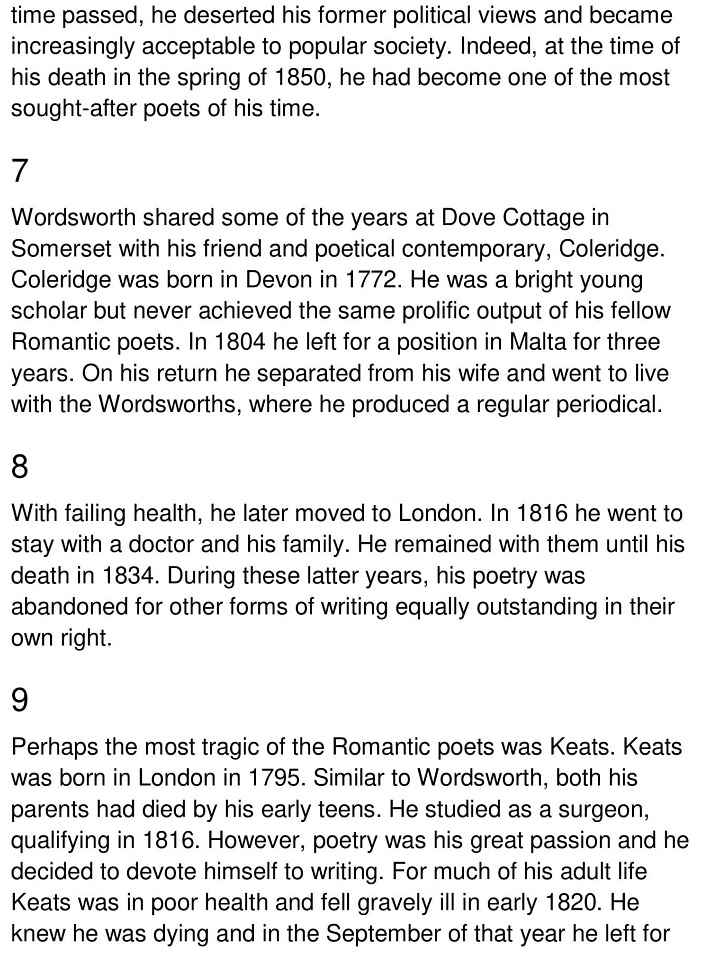
| 11 | output | According to paragraph 7, ‘he was a bright young scholar but never achieved the same prolific output of his fellow Romantic poets.’ The phrase ‘never achieved the same prolific output’ implies that his output was smaller than other Romantic poets. Hence, the correct answer is “output.” |
| 12 | failing health | In paragraph 8, a line suggests that ‘with failing health, he later moved to London.’ Therefore, we can deduce that because of his failing health, Coleridge moved to London. Hence, the correct answer is “failing health.” |
| 13 | climate | Paragraph 9 claims that ‘he knew he was dying and in the September of that year he left of Rome hoping that the more agreeable climate might ease his suffering.’ Thus, from the earlier line, we can infer that Keats left England hoping that climate change might relieve him from his suffering. Hence, the correct answer is “climate.” |
| 14 | Individualism and imagination | As per paragraph 10, ‘they introduced the concepts of individualism and imagination.’ The word ‘concept’ can be referred to as idea, which means that Romantic poets left us with ideas of individualism and imagination.
Hence, the correct answer is “individualism and imagination.” |
Check Out – IELTS Reading Tips and Techniques to Increase your Reading Speed
Tips to Ace The Romantic Poets - IELTS Reading Answers
Let us check out some quick IELTS Exam Preparation Tips for Band Score of 8+ to answer the types of questions in the Reading Answers.
True / False / Not Given
- Understand the options clearly:
- True = matches the passage
- False = contradicts the passage
- Not Given = information is missing
- Locate keywords from the statement and find the exact paragraph in the passage.
- Look for paraphrasing, not exact word matches.
- Avoid assumptions—only use what is clearly stated in the text.
- Watch for extreme words like always, never, all, and only, as they often signal False or Not Given.
Table Completion
- Read the table headings carefully to understand what type of information is needed.
- Check word limits and grammar (singular/plural, tense) before writing answers.
- Scan the passage to locate relevant data rather than reading line by line.
- Use surrounding words in the table to predict the answer type (noun, verb, number).
- Copy words directly from the passage—do not change their form unless required.
Sentence Completion
- Read the incomplete sentence first to understand its meaning.
- Predict the type of word needed (noun, verb, adjective, or number).
- Scan for synonyms—the sentence will be paraphrased in the passage.
- Follow the word limit strictly, as extra words will be marked incorrect.
- Check grammar and meaning after filling in the answer to ensure it fits naturally.
Want to boost your IELTS score? Enroll in our expert-led IELTS online classes today!
In conclusion, the IELTS Reading passage “The Romantic Poets - IELTS Reading Answers” allows candidates to practise a range of question types while improving comprehension and information-identifying skills. With complete answers, keyword locations, and explanations, this article helps learners understand the passage more effectively, enhance accuracy, and boost their overall IELTS Reading score. Keep practising with more IELTS Reading Recent Actual Tests and answers on IELTSMaterial.com to improve your speed, accuracy, and overall performance.
Check More IELTS Reading Answers
Practice IELTS Reading based on question types

Start Preparing for IELTS: Get Your 10-Day Study Plan Today!

Recent Articles
Nehasri Ravishenbagam
Haniya Yashfeen
Haniya Yashfeen
Haniya Yashfeen


Post your Comments