Describe an Aquatic Animal - IELTS Cue Card
6 min read
Updated On
-
Copy link
This blog covers the IELTS cue card Describe an Aquatic Animal with 3 sample answers and tips for handling Part 3 discussion questions. It helps candidates improve fluency, coherence, and topic-specific vocabulary for better IELTS Speaking performance.
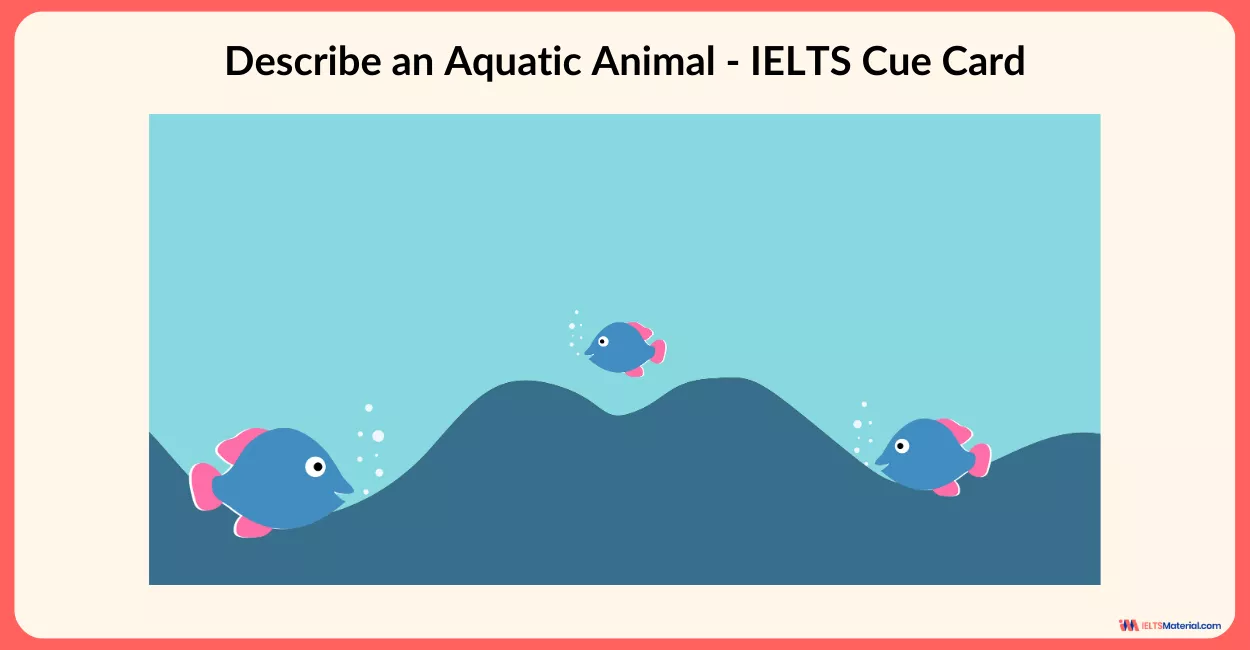
Table of Contents


Limited-Time Offer : Access a FREE 10-Day IELTS Study Plan!
The IELTS cue card “Describe an Aquatic Animal” gives candidates an excellent chance to showcase descriptive language while talking about a creature that lives in water. This topic encourages test-takers to discuss the animal’s appearance, habitat, and unique characteristics, while also expressing personal ideas clearly and confidently. It also prepares you for Part 3 follow-up questions, helping you discuss related topics confidently. This blog provides 3 sample answers to help you organize your thoughts, expand your vocabulary, and perform well in the IELTS Speaking test.
Before you start, learn how to avoid grammar errors in IELTS Speaking with the guide below!
Learn How to Prepare a Cue Card now! For more Cue Cards, take a look at IELTS Speaking Part 2 | Topics, Questions and Samples Answers.
Describe an Aquatic Animal - IELTS Cue Card
- What it looks like?
- When did you see it?
- Where did you see it?
- Explain why it is interesting?
Describe an Aquatic Animal - Sample Answer 1
Aquatic animals dwell in water bodies and are mainly found only in water. Some of the most common aquatic animals are fishes, octopuses, turtles, and so forth. Some aquatic animals are found in freshwater, while others are found in marine water, depending upon their anatomical and morphological features to adapt to particular environments.
I saw a fish the first time my family took me to a nearby pond at my native place when I was around five years old. I remember how fascinated and enthralled I was to have had a look at those beautiful creatures swimming with their exquisite fins, which looked so pleasing to the eyes. I even wanted to have a fin like them back then, to which we still reminisce and laugh about.
Apart from the fishes, I have seen lots of other aquatic animals as well. For instance, a crocodile, which can survive on land as well, spends most of its life in water. Crocodiles are fascinating creatures, right from the way they hunt to the way they look. I saw a crocodile in a zoo for the first time and I used to get a lot of perplexity in deciphering the difference between a crocodile and an alligator.
I, personally, love water and being an ardent water-lover, I find these animals very intriguing. It’s about the way they are so different from the terrestrial creatures. Their gills or other respiratory organs are a matter of interest for me and each time I look at them, I thank nature for its diversity and variegated beauty.
Boost your IELTS Speaking score with expert guidance - join our online webinar now!
Describe an Aquatic Animal - Sample Answer 2
I would like to talk about a clownfish, a small, colorful fish that lives in coral reefs. It has bright orange skin with white stripes and tiny fins, which make it very easy to recognize.
I first saw a clownfish about two years ago when I visited a large public aquarium in Dubai Aquarium, Dubai, UAE. The tank was beautifully set up with corals and other tropical fish, and the clownfish was swimming energetically among them.
What makes this fish interesting is its symbiotic relationship with sea anemones. The clownfish gets protection from predators by hiding among the anemone’s poisonous tentacles, which do not harm it. I find this behavior fascinating because it shows how animals adapt and survive in their environment.
Describe an Aquatic Animal - Sample Answer 3
The aquatic animal I want to describe is a dolphin, which is sleek and gray in color, with a smooth body and a curved dorsal fin. Dolphins are known for their intelligence and playful nature.
I saw dolphins for the first time during a boat trip in Kaafu Atoll, Maldives last year. They were jumping gracefully out of the water, and some even swam close to our boat, which was thrilling to watch.
What makes dolphins particularly interesting is their social behavior. They live in pods, communicate using clicks and whistles, and even seem to help each other when in danger. I was amazed by their friendliness and intelligence, which is why dolphins are one of my favorite aquatic animals.
Join us in our free webinars to learn tricks to drive away your IELTS exam blues! Explore Now!
Describe an Aquatic Animal - IELTS Vocabulary
Here are some IELTS Speaking vocabulary words used in the sample answers for the topic: Describe an Aquatic Animal - IELTS Cue Card.
- Dwell
Meaning: to live
Eg.- They used to dwell in the northern part of India for the most prolonged period of their life.
- Anatomical
Meaning- related to the internal structure
Eg.- The anatomical structure of human beings is very complex.
- Enthralled
Meaning- excited
Eg.- I have always been enthralled by the beauty of our planet.
- Exquisite
Meaning- Beautiful
Eg.- The scenic beauty and the exquisite vagary of that place is insuperable.
- Perplexity
Meaning- Confusion
Eg.- The perplexity of such difficult subjects can be eased by a mentor.
Speaking Part 3 Questions
To be better prepared, review the IELTS Speaking Part 3 questions related to the Describe an Aquatic Animal - IELTS Cue Card given below, and then try to develop your own sample answers.
1. Why do people like to keep pets?
There are umpteen reasons to have a pet, including companionship, love for animals, medical conditions, etc. Pets are proven to be one of the most effective ways to relieve a patient from a lot of mental disorders. For instance, dogs are considered to have a significant therapeutic effect on people in acute depression or are agonised for some reason. Moreover, they are great companions.
2. What should we do to protect endangered animals?
The most effective and the first step that we should take in protecting endangered animals is being acquainted with the list of animals that are imperilled and likely to go extinct. Secondly, we should support the animal protection confederation by voicing in favour of animals and their safety and should ensure that others are aware of the consequences of threatening such animals.
3 Do you support doing experiments on animals?
I believe experimenting on animals is, in a way, necessary to mankind as we tend to get a lot of facts and discoveries upon such experiments. For instance, we would have never got to know the molecular basis of inheritance had Griffith not used the rats to carry out his transformation experiment. However, we should also be vigilant in carrying out such experiments, especially on species that might be endangered.
4 Why do some people refuse to eat animals?
Some people might not want to eat animals owing to their love for them and might find it as an ethical corruption to feed on them, while some might not have them owing to their digestive problems and on medical grounds.
5 What would happen when some species disappear on earth?
If some species disappear from the face of Earth, a lot of turbulence and disarrangement shall take place. Nature has always carried it forth by maintaining balance and sync among various organisms. Therefore, it would be a huge loss to our ecosystem and make our planet naturally impecunious.
Grab Our 4.5+ Rated Speaking Course Now to Level Up! Join Now!
Vocabulary
- Vigilant
Meaning- Careful
Eg.- You should be vigilant about how we carry out this work.
- Acquainted
Meaning- To know
Eg.- They are well acquainted with their tasks.
- Ethical
Meaning- Related to morality
Eg.- Ethical values are learnt from the way one has been brought up.
- Turbulence
Meaning- Disturbance
Eg.- There was severe turbulence in the city yesterday.
- Impecunious
Meaning- Impoverished
Eg.- The economic downpour made them impecunious.
Check out our IELTS Speaking Practice Tests to improve your performance & boost your band score!
Talking about an aquatic animal allows candidates to practice descriptive language, organize ideas clearly, and express personal opinions. By preparing examples like a clownfish or dolphin, and thinking about related Part 3 questions, you can improve fluency, expand vocabulary, and feel confident during the IELTS Speaking test.
Useful Links:
- IELTS Speaking Part 2 & 3: Describe a New Public Building in Your Place
- Describe a Modern Building – IELTS Cue Card Sample Answers
- Describe an old building that you like - IELTS Cue Card
- Buildings and Architecture - IELTS Speaking Part 3 Sample Answer
- How to Agree and Disagree in IELTS Speaking?
- Self-Introduction for IELTS Speaking Test: A Complete Guide

Start Preparing for IELTS: Get Your 10-Day Study Plan Today!

Recent Articles

Haniya Yashfeen
Kasturika Samanta

Nehasri Ravishenbagam


Post your Comments