Freebie Marketing - IELTS Reading Answers
11 min read
Updated On
-
Copy link
Practice the Freebie Marketing IELTS reading answers, along with locations and explanations, to raise your reading band score to 8 or higher. Also, learn to tackle various IELTS reading questions with the tips provided here and refine your strategy.
Table of Contents


Limited-Time Offer : Access a FREE 10-Day IELTS Study Plan!
Reviewing mistakes becomes more manageable when focusing on a single passage like ‘Freebie Marketing IELTS Reading Answers’. Engaging in single-passage practice allows for a detailed examination of questions in relation to the text, facilitating a deeper analysis of incorrect answers. This approach helps you understand how IELTS paraphrases information, ultimately contributing to more effective long-term retention of concepts and strategies.
So, let’s proceed to solve the passage ‘Freebie Marketing IELTS Reading Answers,’ after which we will tally the answers with the provided explanations for the correct answers and go through the IELTS Reading tips and techniques to increase your reading speed.
Passage and Questions for Freebie Marketing IELTS Reading Answers
The passage, Freebie Marketing IELTS Reading Answers, consists of 13 questions, which showcase three different IELTS Reading question types. They are:
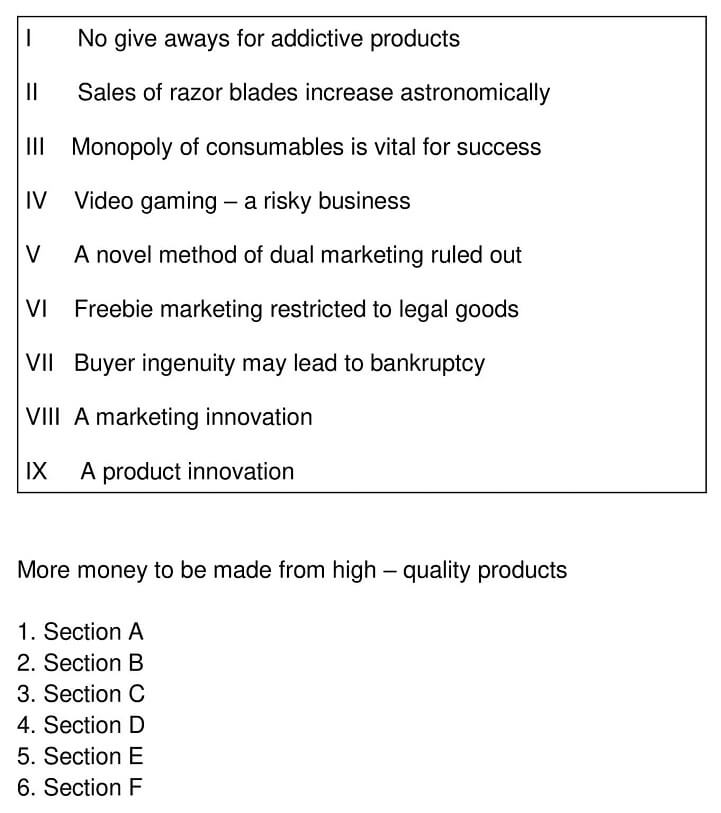
- IELTS Reading Matching Headings (Q. 1-6)
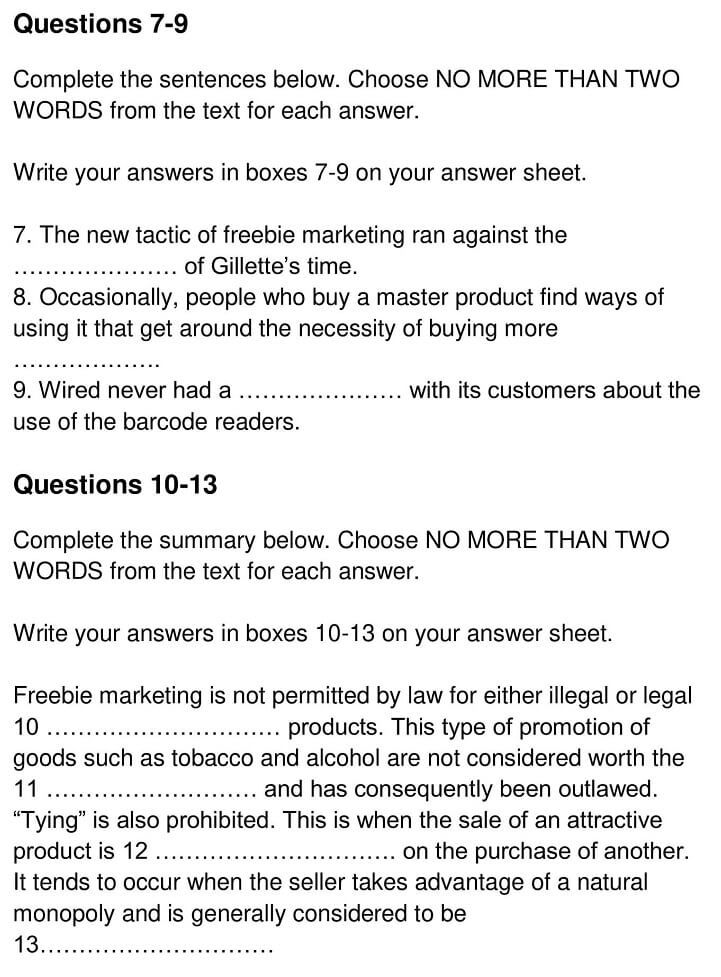
- IELTS Reading Sentence Completion (Q. 7-9)
- IELTS Reading Summary Completion (Q. 10-13)
Now go through the passage for ‘Freebie Marketing’ IELTS Reading Answers given below, and be prepared to solve similar IELTS Reading topics for General and Academic for the reading section.
You should spend about 20 minutes on Questions 1-13, which are based on the Reading Passage below.
Freebie Marketing
Looking for comprehensive preparation material for IELTS Academic Reading?
Check out - IELTS Reading (Academic) Actual Tests with Answers!
Answers and Explanations of Freebie Marketing IELTS Reading Passage
Check out the detailed explanations for the Freebie Marketing reading passage questions given above and get an idea of how to solve different IELTS Reading question types with examples and improve your reading skills.
1 Answer: ix
Question Type: Matching Heading
Answer location: Paragraph A, line 4
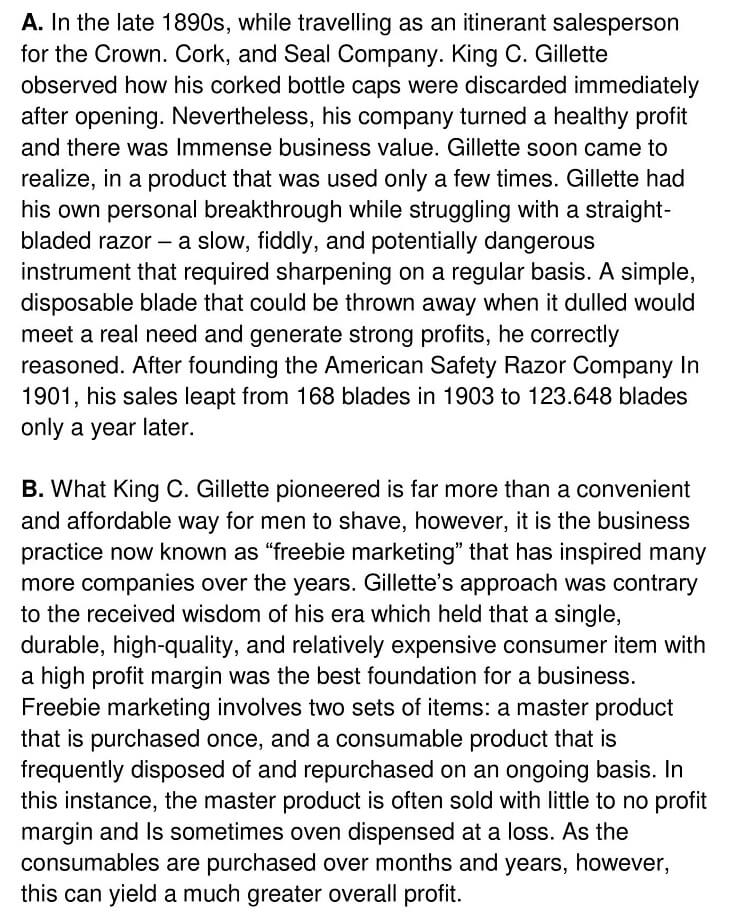
Answer explanation: If you read thoroughly, a line in the passage specifies that “Gillette soon came to realise, in a product that was used only a few times. Gillette had his own personal breakthrough while Struggling with a straight-bladed razor – a slow, fiddly, and potentially dangerous instrument that required sharpening on a regular basis. A simple, disposable blade that could be thrown away when it dulled would meet a real need and generate strong profits, he correctly reasoned.” In the 1890s Gillette realized the simple and dangerous product had the potential to generate great sales, hence, we can deduce that this passage discusses the innovation of the product ‘razor’.
2 Answer: viii
Question Type: Matching Heading
Answer location: Paragraph B, line 1
Answer explanation: The opening line of paragraph B infers that “what King C. Gillette pioneered is far more than a convenient and affordable way for men to shave, however, it is the business practice now known as “freebie marketing” that has inspired many more companies over the years.” Gillette’s method of selling razors is considered to have ushered in a new marketing tactic known as freebie marketing. Thus, the most appropriate title for this paragraph is marketing innovation.
3 Answer: iii
Question Type: Matching Heading
Answer location: Paragraph C, line 1
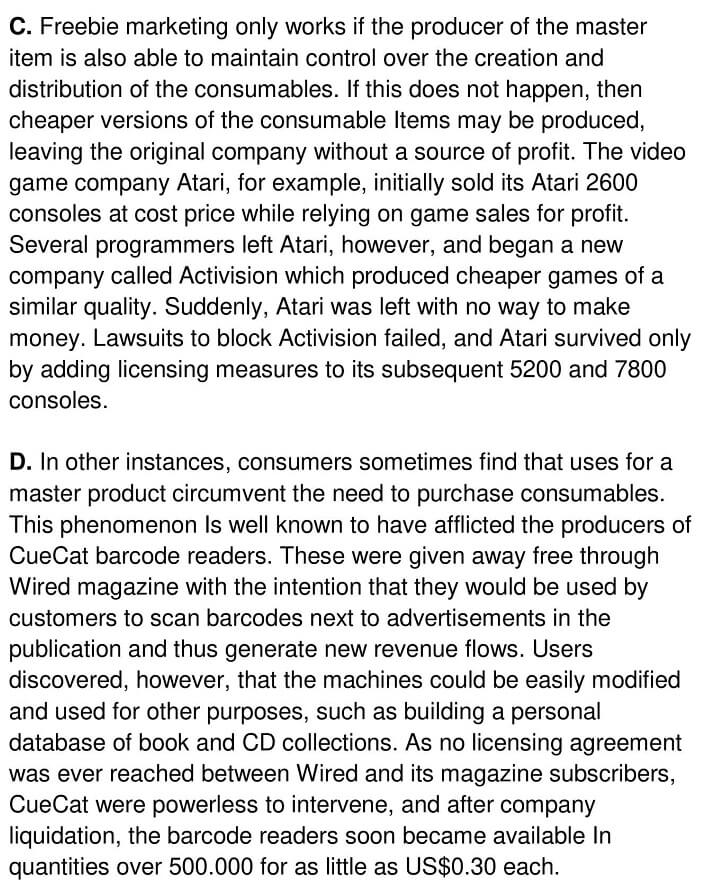
Answer explanation: In the said paragraph, refer that, “freebie marketing only works If the producer of the master item is also able to maintain control over the creation and distribution of the consumables.” The author suggests that freebie marketing is believed to succeed only when the manufacturer has complete control or monopoly over the development and distribution of his goods. Hence, the most appropriate title for this paragraph is a consumables monopoly is essential for success.
4 Answer: vii
Question Type: Matching Heading
Answer location: Paragraph D, line 4
Answer explanation: A few lines in said paragraph discuss that “users discovered, however, that the machines could be easily modified and used for other purposes, such as building a personal database of book and CD collections. As no licensing agreement was ever reached between Wired and its magazine subscribers. CueCat was powerless to intervene, and after company liquidation, the barcode readers soon became available In quantities over 500.000 for as little as US$0.30 each.” From this information we can infer that users realised that they could change things to utilise them in new ways, causing the maker to lose money. Hence, the most appropriate title for this paragraph would be buyer ingenuity may lead to bankruptcy.
5 Answer: i
Question Type: Matching Heading
Answer location: Paragraph E, last line
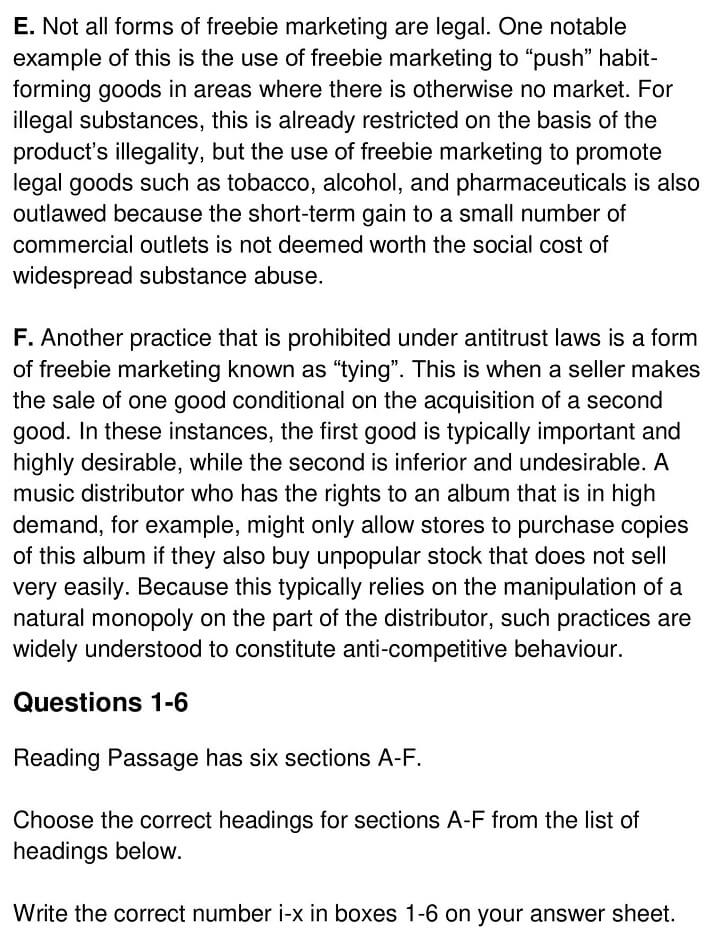
Answer explanation: If you read thoroughly, the author in the given paragraph mentions that “for illegal substances, this is already restricted on the basis of the product’s illegality, but the use of freebie marketing to promote legal goods such as tobacco, alcohol and pharmaceuticals is also outlawed because the short-term gain to a small number of commercial outlets is not deemed worth the social cost of widespread substance abuse.” Hence, we can imply that freebie marketing for illicit substances and illegal substances like cigarettes have been banned in order to prevent it from becoming a social problem. Therefore, no giveaways for addictive products is the appropriate title for this paragraph.
6 Answer: v
Question Type: Matching Heading
Answer location: Paragraph F, line 1
Answer explanation: If you read thoroughly, there’s a line that claims, “another practice that is prohibited under antitrust laws is a form of freebie marketing known as “tying”. This is when a seller makes the sale of one good conditional on the acquisition of a second good.” Here, we understand that the practice of tying, also known as dual marketing, is claimed to be illegal under antitrust rules. Therefore, a novel method of dual marketing ruled out is the appropriate title for this paragraph.
7 Answer: received wisdom
Question Type: Sentence Completion
Answer location: Paragraph B, line 2
Answer explanation: In the said paragraph, refer that, “Gillette’s approach was contrary to the received wisdom of his era. which held that a single, durable, high-quality, and relatively expensive consumer item with a high-profit margin was the best foundation for a business.” This line confirms that the new approach (tactic) of Gillette freebie marketing is against (contrary) to the received wisdom of his era.
8 Answer: consumables
Question Type: Sentence Completion
Answer location: Paragraph D, line 1
Answer explanation: Paragraph D puts forward the information that “in other instances, consumers sometimes find that uses for a master product circumvent the need to purchase consumables.” It can be observed that some customers discover new applications (find ways of using it ) for the master product after purchasing it, perhaps reducing the number of consumable purchases.
9 Answer: licensing agreement
Question Type: Sentence Completion
Answer location: Paragraph D, last line
Answer explanation: The answer is clearly mentioned in the said paragraph and line. In the passage, it is said that “as no licensing agreement was ever reached between Wired and its magazine subscribers. CueCat were powerless to intervene, and after company liquidation, the barcode readers soon became available In quantities over 500.000 for as little as US$0.30 each.” The author states that Wired did not enter into any licence agreements with its subscribers.
10 Answer: habit-forming
Question Type: Summary Completion
Answer location: Paragraph E, line 1
Answer explanation: In the reference paragraph, the author mentions that “not all forms of freebie marketing are legal. One notable example of this is the use of freebie marketing to “push” habit-forming goods in areas where there is otherwise no market.” Hence, freebie marketing is not permitted for illegal and legal habit-forming products.
11 Answer: social cost
Question Type: Summary Completion
Answer location: Paragraph E, line 2
Answer explanation: Few lines in the said paragraph discuss that “for illegal substances, this is already restricted on the basis of the product’s illegality, but the use of freebie marketing to promote legal goods such as tobacco, alcohol and pharmaceuticals is also outlawed because the short-term gain to a small number of commercial outlets is not deemed worth the social cost of widespread substance abuse.” The author states that the freebie type of promotion of goods such as tobacco, alcohol, and pharmaceuticals is not deemed (considered) worth the social cost.
12 Answer: conditional
Question Type: Summary Completion
Answer location: Paragraph F, line 2
Answer explanation: In the said paragraph, you can find out that “this is when a seller makes the sale of one good conditional on the acquisition of a second good. In these instances, the first good is typically important and highly desirable, while the .second is inferior and undesirable.” From this information, we can confirm that seller makes the sale of one good conditional on the purchase of another.
13 Answer: anti-competitive behaviour
Question Type: Summary Completion
Answer location: Paragraph F, 2nd last line
Answer explanation: If you read thoroughly, a line in the said paragraph discusses that “a music distributor who has the rights to an album that it is in high demand, for example, might only allow stores to purchase copies of this album if they also buy an unpopular stock that does not sell very easily. Because this typically relies on the manipulation of a natural monopoly on the part of the distributor, such practices are widely understood to constitute anti-competitive behaviour.” The selling of one good product conditional on the purchase of another product is known as ‘tying,’ and it is used to sell items that aren’t popular/good. And such practices are widely understood (generally considered) to constitute anti-competitive behaviour.
Learn quick solving tips and reading techniques from experts!
Connect with us through our FREE IELTS online classes!
How to Solve the Question Types in the Freebie Marketing Reading Passage?
Now, let’s check out some IELTS exam preparation tips for achieving a band score of 8+ for each question type in the Freebie Marketing IELTS Reading Answers.
Matching Headings
- Read the list of headings before reading the paragraphs: Start by scanning the given headings. This helps you understand the possible themes so you can quickly recognise the main idea when reading each paragraph.
- Focus on the main idea of each paragraph: When reading Paragraph A, identify the central idea rather than details like dates or examples. If the paragraph mainly explains the invention of the disposable razor, it matches ‘A product innovation’.
- Look for topic sentences at the beginning or end of paragraphs: Many paragraphs introduce the main idea in the first sentence, such as Paragraph B describing Gillette’s ‘freebie marketing’ approach. This directly links to the heading ‘A marketing innovation’.
- Match repeated or emphasised concepts: In Paragraph C, the text emphasises that freebie marketing works only if the company controls the consumables used with the product. This repeated idea clearly matches the heading ‘The monopoly of consumables is vital for success’.
- Identify examples that illustrate problems or consequences: Paragraph D describes how users modified the barcode reader so the company could not profit from consumables. This situation reflects the heading ‘Buyer ingenuity may lead to bankruptcy’.
- Eliminate headings that refer to ideas not discussed in the paragraph: For example, headings like ‘Video gaming – a risky business’ should be ignored if the paragraph discusses legal restrictions on addictive products. Removing irrelevant headings helps identify the correct match faster.
Sentence Completion
- Identify keywords in the sentence: Look for strong clues like ‘Gillette’s time’ (Q. 7) or ‘master product’ (Q. 8). These keywords help you quickly locate the relevant paragraph in the passage.
- Predict the type of word needed: For example, ‘ran against ______ Gillette’s time’ (Q. 7) suggests a phrase describing a belief or idea. Predicting the word type helps you recognise the correct phrase when scanning the text.
- Find the exact phrase in the passage: Scan for paraphrases such as ‘contrary to the received wisdom of his era’. Because the instructions say NO MORE THAN TWO WORDS, the correct answer becomes ‘received wisdom’.
- Ensure the answer fits grammatically: After inserting the word, read the sentence again to confirm it makes sense, such as ‘get around the necessity of buying more consumables’. The word ‘consumables’ logically completes Question 8.
Summary Completion
- Read the whole summary before filling in the blanks: The summary discusses legal restrictions on freebie marketing and the concept of “tying.” Understanding the overall topic helps you predict what type of words might appear in each blank.
- Identify keywords from the summary: Look for clues such as ‘illegal or legal ___ products’ (Q. 10) and ‘promotion of goods such as tobacco and alcohol’. These hints lead you to the paragraph discussing habit-forming products.
- Locate the matching information in the passage: Scan the relevant paragraph to find the phrase ‘habit-forming goods’. Since the instructions allow two words, the correct answer becomes ‘habit-forming’.
- Look for paraphrasing rather than exact wording: For example, the summary says ‘not considered worth …’ (Q. 11) while the passage states ‘not deemed worth the social cost’. Recognising this paraphrase helps you identify the correct answer ‘social cost’.
- Follow the logical order of the passage: Summary answers usually appear in the same sequence as the original text. After finding the paragraph about legal restrictions, the next answers relating to ‘tying’ and anti-competitive behaviour will appear shortly afterward.
- Check the word limit and grammar: Ensure that each answer does not exceed two words and fits logically into the sentence. For example, ‘conditional’ and ‘anti-competitive behaviour’ correctly complete the summary sentences.
In summary, we finished the Freebie Marketing IELTS Reading Answers, emphasizing important locations and keywords so you can confidently answer those challenging questions. In order to strengthen your areas of weakness on the reading test, it would be advantageous for you to take a variety of IELTS Reading practice tests.
Useful Links:
- Literacy in Freedonia’s Prisons - IELTS Reading Answers
- Internal and External Marketing - IELTS Reading Answers
- What Does the Consumer Think - IELTS Reading Answers
- Palm Oil – IELTS Academic Reading Answers
- Australia’s Platypus, Creature Sleeps, The Search For Freshwater – IELTS Reading Answers
- Best IELTS Reading Books
Practice IELTS Reading based on question types

Start Preparing for IELTS: Get Your 10-Day Study Plan Today!

Explore other Reading Actual Tests
Kasturika Samanta
Prity Mallick
Kasturika Samanta
Kasturika Samanta

Recent Articles
Nehasri Ravishenbagam
Haniya Yashfeen
Haniya Yashfeen
Haniya Yashfeen


Post your Comments