Giant Camel Fossil Found in Arctic – IELTS Reading Answers
8 min read
Updated On
-
Copy link
Explore the guide to answer summary and note completion types of questions in the IELTS Reading passage, ‘Giant Camel Fossil Found in Arctic’. Improve your band scores by analyzing the answers and dive into the explanation and keywords.
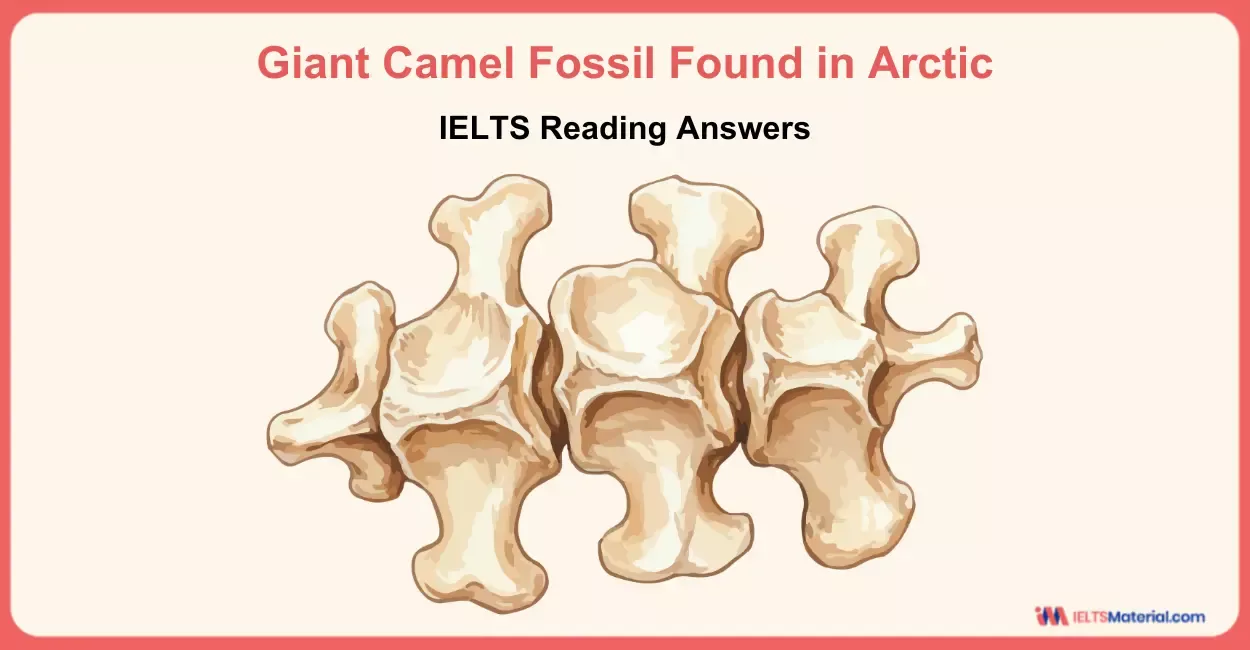
Table of Contents


Limited-Time Offer : Access a FREE 10-Day IELTS Study Plan!
The passage, ‘Giant Camel Fossil Found in Arctic’, gives you an opportunity to practice answering different question types and get familiar with the specific strategies to be used. Mastering these IELTS Reading question types can help increase both accuracy and speed. Through careful analysis of the answers, you can spot the mistakes which you might have made and track your performance consistently. By reviewing your answers, you can sharpen your scanning and skimming techniques while developing reading strategies for scoring a band 8+.
Connect with our band 9 IELTS Trainers to crack your IELTS Reading in no time! Book a FREE Demo.
Types of Questions in ‘Giant Camel Fossil Found in Arctic’
The first strategy to incorporate while attempting the passage ‘Giant Camel Fossil Found in Arctic’ is to look at the question types. In this way, you can decide what information to pay attention to during your reading. Knowing the question types would help you to read the passage strategically and apply the right technique to find the answers. The passage consists of the following question types.
- IELTS Reading Summary Completion [Q.1-Q.18]
- IELTS Reading Note Completion [Q.9-Q.13]
How to Answer Questions in ‘Giant Camel Fossil Found in Arctic’?
The key to attempt the Summary Completion and Notes Completion questions is to identify important terms and understand the information. Therefore, you must use a few IELTS Exam Preparation Tips for Band Score of 8+ so that you can develop your reading skills. A concentrated and methodical approach can help you in finding the information faster which are mentioned in the table given below.
| Questions | Strategy |
|---|---|
|
Summary Completion |
|
|
Notes Completion |
|
Curious to learn how to improve your reading skills to get a band 9? Check out the video below!
IELTS Reading Passage on ‘Giant Camel Fossil Found in Arctic’
You should spend about 20 minutes on Questions 1-13 which are based on the Reading Passage below.
Giant Camel Fossil Found in Arctic
Camels are well known for their ability to survive the hot and dry conditions of the desert but research suggests that they once thrived in a colder climate...
A The idea that giant camels once roamed the Arctic along with polar bears and walruses is startling. Yet this is the key implication of research published by scientists working on Canada's Ellesmere Island. Lying deep inside the Arctic Circle, opposite Greenland's northern coast, Ellesmere is one of the world's coldest, bleakest spots. However, researchers have also found it was the home of a 3.5 million year old species of camel that later evolved into the creatures that now roam the Sahara and other hot spots. It seems that evolution can still throw up surprises.
B However, there is more to the project than merely uncovering the camel's unexpected evolutionary history. The researchers' work has also demonstrated the power of a dramatic new technique for investigating the pre-historic past. It is known as collagen fingerprinting, and many researchers believe it could transform our understanding of life on Earth. 'This is the first time that collagen has been extracted and used to identify a species from such ancient bone fragments' said Dr Mike Buckley of Manchester University's Institute of Biotechnology. 'This unlocks the huge potential of collagen fingerprinting to better identify extinct species’.
Collagen is a protein that forms the connective tissue that holds bones together in an animal’s skeleton, and it was only by analysing scraps of the material, found in the bones on Ellesmere, that scientists were able to identify the remains as those of an ancient camel. Indeed it was not evident at first that the remains were actually fossils. ‘The first time I picked up a piece, I thought that it might be wood’ said expedition leader Dr Natalia Rybczynski of the Canadian Museum of Nature. ‘It was only back at the field camp that I was able to ascertain that it was not only bone, but also from a fossil mammal larger than anything we had seen so far’.
C However, it was the analysis of the collagen attached to the bones that provided proof that these once belonged to the family Paracamelus, from which ' all modem camels are descended. The results show an almost identical match to the modem-day one humped camel, the dromedary. A comparison of the chemical makeup of the collagen with the tissue from Ice Age Yukon camels revealed more than similarities - they were found to be closely related, and possibly the same species. In addition, anatomical data suggest the leg bone found on Ellesmere was one third larger than the same bone in a modem camel indicating that this giant creature would likely have stood about 3.5 metres tall at the hump.The findings suggest that mineralisation worked along with cold temperatures to help preserve the proteins in the bones. ‘This specimen is spectacular and provides important clues about how such exceptional preservation may occur’ said Dr Buckley.
D In the past, scientists have speculated that the camel still bears features that could have evolved to cope with harsh polar winters. Traits found in modern camels, such as their humps which serve as a fat store, would have benefited their ancestors during the deep winters when food was scarce. Other camel characteristics that would have been useful in the frozen conditions include the species’ flat feet, which support the animal on soft ground such as loose sand or in the same way that a snowshoe helps a person walk on snow.Their large eyes would also have helped them peer through low light and forage for food during the long, Arctic winter. At that time, annual average temperatures in the area was about --4 degrees C, barely below freezing but still about 18 degrees C warmer than the modern average. The camels that evolved in North America may have then migrated across Asia via a land bridge between Alaska and Russia.
The Ellesmere Island site is about 1200 kilometres further north than any previous camel find. Fossils unearthed at a location about ten kilometres away from the camel find and from rocks of approximately the same age, reveal that the landscape hosted an open forest inhabited by bears, rabbits, beavers and a pony-sized three-toed horse. The findings indicate that these animals were living, even thriving, at latitudes where few mammals can now exist.
E The idea is intriguing - but it is only the start. Collagen fingerprinting is several orders of magnitude more effective at establishing links between ancient fossils and modern species compared with DNA fingerprinting, which has been used up to now. Collagen does not break down as speedily as DNA and so it can be used to study animals that are millions of years old and establish links with modern species by studying slight changes in their amino acid structure. As a result, scientists are now focussing on a wide range of species, from angelfish to zebras, to uncover links between ancient and modern animals. ‘This is going to provide some startling results’, said Dr Buckley.
Questions 1-8
Complete the summary below.
Choose NO MORE THAN ONE WORD from the passage for each answer.
Write your answers in boxes 1-8 on your answer sheet.
Collagen fingerprinting
Fossil research using collagen fingerprinting shows that camels once lived on Ellesmere Island. By studying fossils, scientists have made surprising discoveries about the animal’s 1 ________ history. The research team took collagen, which is a 2 ________ found in bone, from the fossil and compared it with collagen found in other fossils and modern animals. They found a near perfect 3 ________ between the now extinct camel and the modem one-hump camel. It also shared a number of 4 ________ with the Ice Age Yukon camel. Both the collagen and 5 ________ information demonstrated that the bone fragments belonged to a giant camel. They were approximately three times 6 ________ compared to the same bones in a modem day camel. The protein was able to survive for three and a half million years due to the process of 7 ________ which helped seal the bones. The cold climate of the region also ensured the 8 ________ of the collagen in the fossils.
Questions 9-13
Complete the notes below.
Write TWO WORDS OR A NUMBER ONLY for each answer.
Write your answers in boxes 9-12 on your answer sheet.
Physical characteristics of the Giant Camel
Measured 9 _______ in height
Used its hump as a 10 _______
Had large eyes to cope with 11 ________ in winter
Had ideal feet for 12 __________ terrain so it didn’t sink through 13________
Join our IELTS online classes for expert guidance. Sign up today!
Answer with Explanation for ‘Giant Camel Fossil Found in Arctic’
Well done! Let’s look at the answers now and remember to check the explanation as well. This will help you to understand the keywords and their location for each question. Such a strategy would help in boosting your reading accuracy and improve your confidence for an IELTS Band Score of 8+. The answers to questions 1-13 are given below along with their explanations.
| Question Number | Answer | Keywords | Locations of Keywords |
|---|---|---|---|
| 1 | evolutionary | However, more to the project, uncovering, evolutionary history | Para 2, first 2 lines |
| 2 | protein | Collagen is a protein | Para 3, line 1 |
| 3 | match | results, almost identical match, modem-day, dromedary | Para 4, line 3 |
| 4 | similarities | comparison, makeup, collagen, tissue, Ice Age Yukon camels revealed, similarities, found, closely related | Para 4, lines 4-5 |
| 5 | anatomical | anatomical data suggest, leg bone found on Ellesmere | Para 4, line 6 |
| 6 | larger | one third larger, same bone, modern camel | Para 4, lines 6-7 |
| 7 | mineralisation | findings suggest, mineralisation worked, cold temperature, preserve, proteins, bones | Para 4, lines 8-9 |
| 8 | preservation | specimen is spectacular, provides, clues, how, preservation, occur | Para 4, last 3 lines |
| 9 | 3.5 metres | giant creature, likely, 3.5 metres tall, hump | Para 4, lines 7-8 |
| 10 | fat store | Traits, modern camels, humps, fat store | Para 5, lines 2-3 |
| 11 | low light | large eyes, helped them peer, low light | Para 5, lines 6-7 |
| 12 | soft | Other, characteristics, useful, frozen, flat feet, support, soft ground | Para 5, lines 4-5 |
| 13 | loose sand | such as loose sand, same way, snowshoe helps, walk on snow | Para 5, lines 5-6 |
Join our IELTS webinars to learn master tips for the Reading section! Click here to explore!
Through purposeful practice, you will develop the skills to get a band 8+. Use different types of passages and train yourself to respond to questions within specific time limits. Such a practice would help sharpen your skills and make you learn how to effectively answer questions with ease. Remember to distribute the time well to attempt answering all three sections.
Check More IELTS Reading Answers
Also check :
Practice IELTS Reading based on question types

Start Preparing for IELTS: Get Your 10-Day Study Plan Today!

Explore other Reading Practice Tests

Nehasri Ravishenbagam

Kasturika Samanta
Kasturika Samanta

Kasturika Samanta

Recent Articles

Nehasri Ravishenbagam

Haniya Yashfeen

Haniya Yashfeen

Haniya Yashfeen


Post your Comments