Makete Integrated Rural Transport Project - IELTS Reading Answers
11 min read
Updated On
-
Copy link
Check out the IELTS Reading Passage, ‘Makete Integrated Rural Transport Project’ and note the areas of improvement for acing the IELTS Exam. Attempt different question types, compare your answers, and analyze it with the explanation.
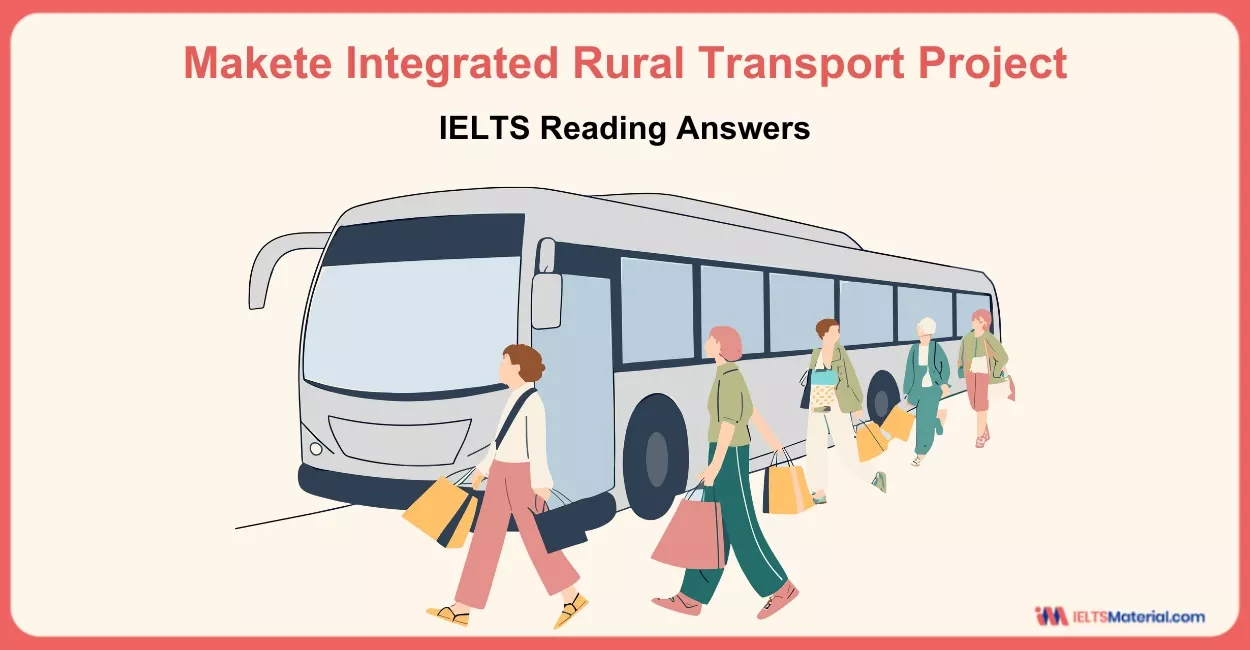
Table of Contents


Limited-Time Offer : Access a FREE 10-Day IELTS Study Plan!
The Academic passage ‘Makete Integrated Rural Transport Project’ is a reading passage for which you should not spend more than 20 minutes on a passage. The IELTS Reading test would challenge you to answer different question types in a limited time frame. Therefore, learning specific strategies based on questions would enhance your language proficiency level. With this passage, you must find out how long you spend on a certain passage, when it is the right time to move on from a difficult question, and the areas of improvement. Such consistent evaluation would help you to acquire the skills and take a step towards achieving your desired band scores of 8+.
Connect with our band 9 IELTS Trainers to crack your IELTS Reading in no time! Book a FREE Demo.
Types of Questions in IELTS Reading Passage ‘Makete Integrated Rural Transport Project’
Achieving a band 8+ requires you to attempt different types of questions. These would be structured in a way where your reading skills will be assessed. Therefore, before moving on to reading the passage, it is necessary to know which questions are being asked for this particular passage. Below are the types of questions which you will encounter for the passage, ‘Makete Integrated Rural Transport Project’.
- IELTS Reading Matching Headings [Q.27-Q.30]
- IELTS Reading Yes, No, Not Given [Q.31-Q.35]
- IELTS Reading Matching Endings [Q.36-Q.39]
- IELTS Reading Multiple Choice Questions [Q.40]
IELTS Reading Passage on ‘Makete Integrated Rural Transport Project’
You should spend about 20 minutes on Questions 27-40 which are based on the Reading Passage below.
Makete Integrated Rural Transport Project
Section A
The disappointing results of many conventional road transport projects in Africa led some experts to rethink the strategy by which rural transport problems were to be tackled at the beginning of the 1980s. A request for help in improving the availability of transport within the remote Makete District of southwestern Tanzania presented the opportunity to try a new approach.
The concept of 'integrated rural transport' was adopted in the task of examining the transport needs of the rural households in the district. The objective was to reduce the time and effort needed to obtain access to essential goods and services through an improved rural transport system. The underlying assumption was that the time saved would be used instead for activities that would improve the social and economic development of the communities. The Makete Integrated Rural Transport Project (MIRTP) started in 1985 with financial support from the Swiss Development Corporation and was co-ordinated with the help of the Tanzanian government.
Section B
When the project began, Makete District was virtually totally isolated during the rainy season.The regional road was in such bad shape that access to the main towns was impossible for about three months of the year Road traffic was extremely rare within the district, and alternative means of transport were restricted to donkeys in the north of the district. People relied primarily on the paths, which were slippery and dangerous during the rains.
Before solutions could be proposed, the problems had to be understood. Little was known about the transport demands of the rural households, so Phase I, between December 1985 and December 1987, focused on research.The socio-economic survey of more than 400 households in the district indicated that a household in Makete spent, on average, seven hours a day on transporting themselves and their goods, a figure which seemed extreme but which has also been obtained in surveys in other rural areas in Africa. Interesting facts regarding transport were found: 95% was on foot; 80% was within the locality; and 70% was related to the collection of water and firewood and travelling to grinding mills.
Section C
Having determined the main transport needs, possible solutions were identified which might reduce the time and burden. During Phase II, from January to February 1991, a number of approaches were implemented in an effort to improve mobility and access to transport.
An improvement of the road network was considered necessary to ensure the import and export of goods to the district. These improvements were carried out using methods that were heavily dependent on labour. In addition to the improvement of roads, these methods provided training in the operation of a mechanical workshop and bus and truck services. However the difference from the conventional approach was that this time consideration was given to local transport needs outside the road network.
Most goods were transported along the paths that provide short-cuts up and down the hillsides, but the paths were a real safety risk and made the journey on foot even more arduous. It made sense to improve the paths by building steps, handrails and footbridges.
It was uncommon to find means of transport that were more efficient than walking but less technologically advanced than motor vehicles. The use of bicycles was constrained by their high cost and the lack of available spare parts. Oxen were not used at all but donkeys were used by a few households in the northern part of the district. MIRTP focused on what would be most appropriate for the inhabitants of Makete in terms of what was available, how much they could afford and what they were willing to accept.
After careful consideration, the project chose the promotion of donkeys - a donkey costs less than a bicycle - and the introduction of a locally manufacturable wheelbarrow.
Section D
At the end of Phase II, it was clear that the selected approaches to Makete’s transport problems had had different degrees of success. Phase III, from March 1991 to March 1993, focused on the refinement and institutionalisation of these activities.
The road improvements and accompanying maintenance system had helped make the district centre accessible throughout the year. Essential goods from outside the district had become more readily available at the market, and prices did not fluctuate as much as they had done before.
Paths and secondary roads were improved only at the request of communities who were willing to participate in construction and maintenance. However the improved paths impressed the inhabitants, and requests for assistance greatly increased soon after only a few improvements had been completed.
The efforts to improve the efficiency of the existing transport services were not very successful because most of the motorised vehicles in the district broke down and there were no resources to repair them. Even the introduction of low-cost means of transport was difficult because of the general poverty of the district.The locally manufactured wheelbarrows were still too expensive for all but a few of the households. Modifications to the original design by local carpenters cut production time and costs. Other local carpenters have been trained in the new design so that they can respond to requests. Nevertheless, a locally produced wooden wheelbarrow which costs around 5000 Tanzanian shillings (less than US$20) in Makete, and is about one quarter the cost of a metal wheelbarrow, is still too expensive for most people.
Donkeys, which were imported to the district, have become more common and contribute, in particular, to the transportation of crops and goods to market. Those who have bought donkeys are mainly from richer households but, with an increased supply through local breeding, donkeys should become more affordable. Meanwhile, local initiatives are promoting the renting out of the existing donkeys.
It should be noted, however, that a donkey, which at 20,000 Tanzanian shillings costs less than a bicycle, is still an investment equal to an average household's income over half a year This clearly illustrates the need for supplementary measures if one wants to assist the rural poor
Section E
It would have been easy to criticise the MIRTP for using in the early phases a 'top-down' approach, in which decisions were made by experts and officials before being handed down to communities, but it was necessary to start the process from the level of the governmental authorities of the district. It would have been difficult to respond to the requests of villagers and other rural inhabitants without the support and understanding of district authorities.
Section F
Today, nobody in the district argues about the importance of improved paths and inexpensive means of transport. But this is the result of dedicated work over a long period, particularly from the officers in charge of community development. They played an essential role in raising awareness and interest among the rural communities.
The concept of integrated rural transport is now well established in Tanzania, where a major program of rural transport is just about to start.The experiences from Makete will help in this initiative, and Makete District will act as a reference for future work.
Questions 27-30
Reading Passage has six sections, A-F.
Choose the correct heading for sections B, C, E and F from the list of headings below.
Write the correct number, i-xi, in boxes 27-30 on your answer sheet.
|
List of Headings
|
27 Section B……………………………………..
28 Section C……………………………………..
29 Section E……………………………………..
30 Section F……………………………………..
Questions 31-35
Do the following statements agree with the claims of the writer in Reading Passage?
In boxes 31-35 on your answer sheet, write
YES if the statement agrees with the claims of the writer
NO if the statement contradicts the claims of the writer
NOT GIVEN if it is impossible to say what the writer thinks about this
31 MIRTP was divided into five phases.
32 Prior to the start of MIRTP the Makete district was almost inaccessible during the rainy season.
33 Phase I of MIRTP consisted of a survey of household expenditure on transport.
34 The survey concluded that one-fifth or 20% of the household transport requirement was outside the local area.
35 MIRTP hoped to improve the movement of goods from Makete district to the country’s capital.
Questions 36-39
Complete each sentence with the correct ending, A-J, below.
Write the correct letter, A-J, in boxes 36-39 on your answer sheet.
36 Construction of footbridges, steps and handrails……………………………………..
37 Frequent breakdown of buses and trucks in Makete……………………………………..
38 The improvement of secondary roads and paths ……………………………………..
39 The isolation of Makete for part of the year……………………………………..
|
Questions 40
Choose the correct letter, A, B, C or D.
Write the correct letter in box 40 on your answer sheet.
Which of the following phrases best describes the main aim of Reading Passage?
- to suggest that projects such as MIRTP are needed in other countries
- to describe how MIRTP was implemented and how successful it was
- to examine how MIRTP promoted the use of donkeys
- to warn that projects such as MIRTP are likely to have serious problems
Join our IELTS online classes for expert guidance. Sign up today!
Answer with Explanation for ‘Makete Integrated Rural Transport Project’
Grasping the reasoning behind the answers would help you to work on your reading techniques for different types of questions. The following explanations for the passage, ‘Makete Integrated Rural Transport Project’, would help you to pinpointing the relevant information and choosing the correct answer. Let’s compare yours against the sample answers while aiming to achieve a higher IELTS Band Score of 8+.
Unlock Answers
The answers with explanations are given below
| Question Number | Answers | Keywords | Location of Keywords |
|---|---|---|---|
| 27. | ii | The problems had to be understood. Little was known about the transport demands of the rural households, so Phase I, focused on research. | Section B, Paragraph 1 & 2 |
| 28. | v | Possible solutions were identified which might reduce the time and burden, to improve mobility and access to transport. | Section C |
| 29. | x | would have been difficult to respond, without the support, of district authorities. | Section E, Last 3 lines |
| 30. | i | The experiences from Makete, act as a reference for future work. | Section F |
| 31. | No | Phase I, Phase II, Phase III | Section B,C & D |
| 32. | Yes | When the project began, totally isolated during the rainy season. | Section B, First 2 Lines |
| 33. | No | survey, on average, seven hours a day on transporting themselves and their goods | Section B, Paragraph 2, Lines 5-7 |
| 34. | Yes | 80%, within the locality | Section B, Paragraph 2, Last 2 lines |
| 35. | Not Given | Not Given | Not Given |
| 36. | D | Improve the paths by building steps, handrails and footbridges. | Section C, Paragraph 3 |
| 37. | I | Not very successful because most of the motorised vehicles, broke down and there were no resources to repair them. | Section D, Paragraph 4, First 4 lines |
| 38. | G | Secondary roads were improved, willing to participate in construction and maintenance | Section D, Paragraph 3 |
| 39. | E | The road improvements, make the district centre accessible throughout the year. | Section D, Paragraph 2 |
| 40. | B | MIRTP | – |
Join our IELTS webinars to learn master tips for the Reading section! Click here to explore!
Identifying the weaker areas would help you to work towards improvement in a very focused manner. By practicing under exam conditions regularly, you can understand the specific strategy that works to build accuracy, confidence, and reading skills. So, practice with real IELTS passages such as ‘Makete Integrated Rural Transport Project’, you can elevate your preparation and learn tips for skimming and scanning techniques while analyzing your answers.
Check More IELTS Reading Answers
Also check :
Practice IELTS Reading based on question types

Start Preparing for IELTS: Get Your 10-Day Study Plan Today!

Explore other Reading Practice Tests
Nehasri Ravishenbagam
Kasturika Samanta
Kasturika Samanta
Kasturika Samanta

Recent Articles
Nehasri Ravishenbagam
Haniya Yashfeen
Haniya Yashfeen

Haniya Yashfeen


Post your Comments