The Anderton Boat Lift – IELTS Reading Answers
10 min read
Updated On
-
Copy link
Improve your skills at answering Matching Headings, Diagram Completion, and Note Completion types of questions with the IELTS Reading passage on ‘The Anderton Boat Lift’. Dive into common mistakes to avoid, answers, explanations, and more.
Table of Contents


Limited-Time Offer : Access a FREE 10-Day IELTS Study Plan!
The passage on ‘The Anderton Boat Lift’ provides you with an opportunity to understand how to approach and answer the different question types. In this way, you can learn to apply specific strategies to each question type and answer them correctly within 20 minutes. Remember to not just attempt the questions but focus on developing skills such as skimming, precise scanning, keyword identification, and efficient time management. With practice, you can hone your skills for the IELTS Reading section and gain confidence while getting closer to your target band score.
Connect with our band 9 IELTS Trainers to crack your IELTS Reading in no time! Book a FREE Demo.
Types of Questions in IELTS Reading Passage ‘The Anderton Boat Lift’
While preparing for IELTS Reading, do not forget to check the question types you will attempt and the skills required for each one. This will help you to do targeted study while understanding the key strategies needed to answer each of them. Remember that concentrated practice would help you to get familiar with the structure of the questions, location of the answers, and the paraphrased meaning of the information. Let’s look at the question types which you will encounter in the passage on ‘The Anderton Boat Lift’.
- IELTS Reading Matching Headings [Q.15-Q.19]
- IELTS Reading Diagram Completion [Q.20-Q.24]
- IELTS Reading Note Completion [Q.25-Q.27]
Common Mistakes to Avoid in the IELTS Reading Passage ‘The Anderton Boat Lift’
The IELTS Reading section might seem difficult because details, paraphrasing and subtle differences in meaning can all lead to mistakes. Such errors can affect your IELTS Band Score since you might assume most of your answers. However, once you become conscious of such mistakes, you will be able to know how to avoid them. This can make a difference in your reading accuracy, time management skills, and overall band score. The table below showcases some of those mistakes and suggests a few ways to avoid them.
|
Common Mistakes |
Strategies to Avoid it |
|
Misreading Instructions |
Before answering, read the instructions thoroughly to know the word limit, the types of questions, and what information is needed. |
|
Ignoring Keywords |
Find and underline the most important words in the question and then look for their synonyms in the passage to make sure that you have the right answers. |
|
Answering from Memory |
Do not rely on your knowledge or assumptions but always refer to the text when formulating your answers. |
|
Paraphrasing of Information |
Pay attention to the meaning, not to the exact words as the information might be paraphrased. |
|
Spending Too Much Time on One Question |
If you have a doubt, move on and come back later. Taking around 20 minutes to answer all the questions given in this passage is your time limit and you should use it wisely. |
|
Confusing Details with Main Ideas |
For every paragraph, point out the main idea. Do not take instances or minor details as answers. |
Curious to learn how to improve your reading skills to get a band 9? Check out the video below!
IELTS Reading Passage on ‘The Anderton Boat Lift’
You should spend about 20 minutes on Questions 15-27 which are based on the Reading Passage below.
The Anderton Boat Lift
Section I
During the Trent and Mersey Canal's opening in 1777, the Cheshre town of Anderson was the obvious location to transport to and from the nearby River Weaver. The only disadvantage was that the canal was 15 metres above the river. The physical effort of moving the cargo was reduced by the creation of chutes, inclined planes, and pathways. To move cargo, primitive railways were built, along with cranes, and steam engines were later installed for powerlifting. When engineers Edward leader Williams and Edwin proposed the "boat caring lift," the early 1870s expenditure, labour, and destruction associated with hand transportation by the Trustees of Weaver Navigation were eliminated.
Section II
‘Victorians' mastery of cast iron and hydraulics had a unique and spectacular design as it was simple and sober in use, above all efficient, elegant in appearance where the lift was hailed as a marvel of era by becoming an instance for larger versions on the waterways of France and Belgium. Two vertical sets of interconnected hydraulic cylinders and pistons were composed in an operating mechanism. The pistons were placed into the bed of the river and both the pistons were supported by the boat - carrying a tank 22.86 length and 4.72 metres breadth. At rest, one tank was levelled with a canal and the other with a river. In order to move the tanks, a small amount of water was removed from the bottom tank. As a result of which the bottom tank used to become lighter than the top tank.
The heavier top tank moved down as the two hydraulic cylinders were attached and forced hydraulic liquid through the connecting pipe into the outer cylinder pushing that piston and lighter tank upwards. While the tanks are moving the major function of the waterlight is to gate both on the tanks and at the entrance to the canal containing the water. The small amount of energy is not only required to effect a reasonably rapid movement by a hydraulic pump driven by steam supplied but is also used to enable the tanks to be precisely levelled at the end of their journey.
Section III
For the first ten years, everything ran without a hitch, but after that, the cylinders and pistons started to groove and pit. Investigations revealed that the damage was brought on by the corrosion-causing chemicals in the canal water used as the hydraulic fluid. The steam engine of the hydraulic pump was immediately replaced by distilled water. Even though there was a significant reduction in corrosion, the harm had already been done. The Trustees decided to construct a new lift in 1906 based on a design by their engineer A Saner because the steam engine's boiler needed to be replaced as well.
Section IV
By using Victorian front and rear columns a new lift was formed over the top of the Victorian structure. The major function of the A-frames on either side of the new lift which is held by the main building is to support the enormous weight of the platform which has formed the recent framework: on it was located a new operating mechanism, which included seventy-two pulleys weighing up to 35 tonnes each.
Each boat-carrying tank was now suspended on wire ropes that ran from the tank to the top of the lift, around pulleys, and down to cast-iron weights on the structure's side. These weighed the same as the water-filled tank. Turning the pulleys one way or the other caused the ropes to move, allowing one tank to be raised or lowered independently of the other. Because the weights counterbalanced the tanks, only a small electrical motor was needed to turn the pulleys and thus move the tanks up and down. The reliable lift was completed in 1908 which was not only cheap but also easy to operate in comparison with the Victorian lift as it is less elegant but functional and worked well.
Section V
In both 1875 and 1908, larger versions were used for commercial traffic. where the main cargoes transported were coal, clay, salt, manufactured goods, agricultural products, and chinaware. Unfortunately, in the 1950s, trade in inland waterways in the United Kingdom drastically decreased. Additionally, in the 1960s, goods traffic using the lifts effectively came to an end. The "Cathedral of the Canals" was finally closed in 1982, despite a brief extension of its active life during the 1970s due to a boom in pleasure boating. In 1875 and 1908, commercial traffic was transported in larger versions. Where, coal, clay, salt, manufactured goods, agricultural products, and chinaware were the main cargoes transported. Unfortunately, since the 1950s, trade on inland waterways in Britain has rapidly decreased. Additionally, since the 1960s, the movement of goods through the lifts has essentially ceased. The popularity of pleasure boating during the 1970s briefly extended its operational lifespan; however, in 1982, the "Cathedral of the Canals" was finally shut down.
Section VI
The demolition seemed unavoidable, but after a long campaign by concerned groups, British Waterways agreed to save the lift in 1999. Some wanted it to be "conserved as found," but that would require replacing much of the existing structure, effectively creating a replica lift. The steel of the 1908 structure had been severely corroded by pollutants from the local chemical industries and would need to be replaced if the overhead machinery and 500-tonne counterweights were to be supported. Furthermore, safety considerations would necessitate the installation of a backup braking system.
As a result, it was decided to use the original cast-iron structure and revert to the 1875 hydraulically operated system. Despite the removal of the counterweights, the 1908 framework and pulleys would be preserved as a static monument. It was a massive and costly project fraught with difficulties. The Anderton Boat Lift was eventually reopened in 2002. Boat owners and visitors can ride 'the world's first boat lift' once more.
Questions 15-19
Match the heading, a-j, below with the correct sections II - VI.
Write the correct letter, a-j. in boxes 15-19 on your answer sheet.
|
List of headings :
|
15 Section II …………………………………………
16 Section III …………………………………………
17 Section IV …………………………………………
18 Section V …………………………………………
19 Section VI …………………………………………
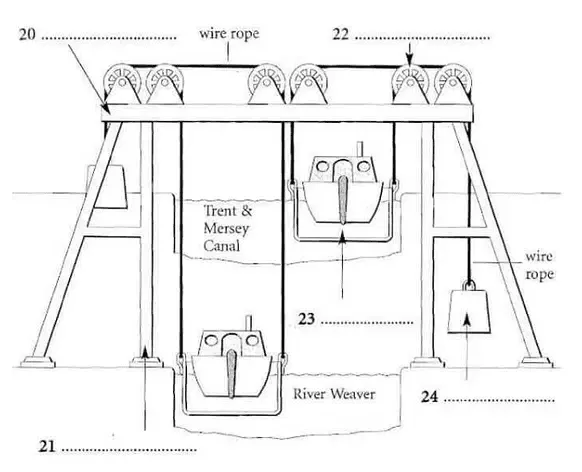
Questions 20-24
Complete the diagram below.
Choose NO MORE THAN THREE WORDS from the passage for each answer.
Write your answers in boxes 20—24 on your answer sheet.
Questions 25-27
Complete the notes below
Choose NO MORE THAN THREE WORDS from Reading Passage for each
Write your answers in boxes 25-27 on your answer sheet.
25 Similar lifts to the Anderton were later constructed in …………………………………………
26 The additional power that was used to move the tanks came from …………………………………………
27 Making use of canal water caused harm to the …………………………………………
Answer with Explanation for ‘The Anderton Boat Lift’
Always attempt answering the questions first by yourself so that you can track your progress level. In this way, you can note the areas of improvement and work towards that while focusing on specific strategies to elevate your band scores. The answers with explanations for the passage on ‘The Anderton Boat Lift’ are given below.
| Question Number | Answers | Keywords | Location of Keywords |
|---|---|---|---|
| 15. | i | Simple in use, and above all efficient, the lift was hailed as a marvel of the era | Section II, Lines 3 – 4 |
| 16. | e | pitting and grooving of the cylinders and pistons occurred, the hydraulic liquid was contaminated by chemicals | Section III, First 5 lines |
| 17. | h | The main structure had strong A-frames at either side of the new lift to support the enormous weight of the platform that now formed the top of the framework. | Section IV, Lines 2 – 5 |
| 18. | a | carried large volumes of commercial traffic and the principal cargoes transported were coal, china clay, salt, manufactured goods | Section V, First 3 lines |
| 19. | c | the Anderton Boat Lift was officially reopened. | Section VI, Lines 17 – 18 |
| 20. | Platform | the platform that now formed the top of the framework: | Section II, Lines 5-6 |
| 21. | A-frame | A-frames at either side of the new lift | Section IV, Line 3 |
| 22. | pulley(s) | two pulleys weighing up to 35 tonnes each. | Section IV, Lines 6-7 |
| 23. | (boat carrying) tank | Each of the boat-carrying tanks was now suspended on wire ropes | Section IV, Line 8 |
| 24. | (cast iron) weights | to cast-iron weights at the side of the structure | Section IV, Line 10 |
| 25. | France & Belgium | prototype for larger versions on the waterways of France and Belgium. | Section IV, Lines 5-6 |
| 26. | A hydraulic pump | A hydraulic pump driven by steam supplied the small amount of additional energy | Section II, Last 3 lines |
| 27. | Cylinders & pistons | Pitting and grooving of the cylinders and pistons occurred. | Section III, First 4 lines |
Join our IELTS webinars to learn master tips for the Reading section! Click here to explore!
The passage on ‘The Anderton Boat Lift’ consists of the combination of consistent practice and thorough review. Remember that getting familiar with different question types is crucial to elevate your confidence for the exam day. By the development of reading skills such as skimming for the main idea, scanning for specific information, identifying keywords and recognizing paraphrased content, you will improve accuracy and comprehension of the reading passage.
Check More IELTS Reading Answers
Also check :
Practice IELTS Reading based on question types

Start Preparing for IELTS: Get Your 10-Day Study Plan Today!

Explore other IELTS Articles

Kasturika Samanta

Haniya Yashfeen

Kasturika Samanta


Recent Articles

Nehasri Ravishenbagam

Haniya Yashfeen

Haniya Yashfeen

Haniya Yashfeen


Post your Comments