The Construction of Roads and Bridges - IELTS Reading Answers
10 min read
Updated On
-
Copy link
Ace your IELTS Reading test by practicing the ‘The Construction of Roads and Bridges - IELTS Reading Answers’, with locations. Additionally, learn to tackle various IELTS reading questions with the tips provided here and refine your reading strategy.
Table of Contents
- Passage for The Construction of Roads and Bridges IELTS Reading Answers
- Questions for The Construction of Roads and Bridges Reading Answers
- Answers and Explanations of The Construction of Roads and Bridges IELTS Reading Passage
- Tips for Answering the Question Types in The Construction of Roads and Bridges Reading Passage


Limited-Time Offer : Access a FREE 10-Day IELTS Study Plan!
Completing a single passage, such as ‘The Construction of Roads and Bridges IELTS Reading Answers,’ can significantly boost confidence, especially for beginners. These small, consistent victories help keep you motivated and make the full-length IELTS Reading practice tests seem less daunting. Over time, this newfound confidence becomes a powerful asset on exam day.
Take up the questions for The Construction of Roads and Bridges reading passage and then check your answers against the provided answer key to improve your performance in the reading module.
Passage for The Construction of Roads and Bridges IELTS Reading Answers
Now go through the passage for ‘The Construction of Roads and Bridges’ Reading Answers given below, and be prepared to solve similar topics for the IELTS Reading section.
You should spend about 20 minutes on Questions 1-13, which are based on the Reading Passage below.
The Construction of Roads and Bridges
Roads
A Although there were highway links in Mesopotamia from as early as 3500 bc, the Romans were probably the first road-builders with fixed engineering standards. At the peak of the Roman Empire in the first century ad, Rome had road connections totalling about 85,000 kilometres. Roman roads were constructed with a deep stone surface for stability and load-bearing. They had straight alignments and therefore were often hilly. The Roman roads remained the main arteries of European transport for many centuries, and even today many roads follow the Roman routes. New roads were generally of inferior quality, and the achievements of Roman builders were largely unsurpassed until the resurgence of road-building in the eighteenth century.
B With horse-drawn coaches in mind, eighteenth-century engineers preferred to curve their roads to avoid hills. The road surface was regarded as merely a face to absorb wear, the load-bearing strength being obtained from a properly prepared and well-drained foundation. Immediately above this, the Scottish engineer John McAdam (1756-1836) typically laid crushed stone, to which stone dust mixed with water was added, and which was compacted to a thickness of just five centimetres, and then rolled. McAdam’s surface layer - hot tar onto which a layer of stone chips was laid - became known as ‘tarmacadam’, or tarmac. Roads of this kind were known as flexible pavements.
C By the early nineteenth century - the start of the railway age - men such as John McAdam and Thomas Telford had created a British road network totalling some 200,000 km, of which about one sixth was privately owned toll roads called turnpikes. In the first half of the nineteenth century, many roads in the US were built to the new standards, of which the National Pike from West Virginia to Illinois was perhaps the most notable. In the twentieth century, the ever-increasing use of motor vehicles threatened to break up roads built to nineteenth-century standards, so new techniques had to be developed.
D On routes with heavy traffic, flexible pavements were replaced by rigid pavements, in which the top layer was concrete, 15 to 30 centimetres thick, laid on a prepared bed. Nowadays steel bars are laid within the concrete. This not only restrains shrinkage during setting, but also reduces expansion in warm weather. As a result, it is, possible to lay long slabs without danger of cracking.
E The demands of heavy traffic led to the concept of high-speed, long-'distance roads, with access - or slip-lanes - spaced widely apart. The US Bronx River Parkway of 1925 was followed by several variants - Germany’s autobahns and the Pan American Highway. Such roads - especially the intercity autobahns with their separate multi-lane carriageways for each direction - were the predecessors of today’s motorways.
Bridges
F The development by the Romans of the arched bridge marked the beginning of scientific bridge-building; hitherto, bridges had generally been crossings in the form of felled trees or flat stone blocks. Absorbing the load by compression, arched bridges are very strong. Most were built of stone, but brick and timber were also used. A fine early example is at Alcantara in Spain, built of granite by the Romans in AD 105 to span the River Tagus. In modern times, metal and concrete arched bridges have been constructed. The first significant metal bridge, built of cast iron in 1779, still stands at Ironbridge in England.
G Steel, with its superior strength-to-weight ratio, soon replaced iron in metal bridge-work. In the railway age, the truss (or girder) bridge became popular. Built of wood or metal, the truss beam consists of upper and lower horizontal booms joined by vertical or inclined members.
H The suspension bridge has a deck supported by suspenders that drop from one or more overhead cables. It requires strong anchorage at each end to resist the inward tension of the cables, and the deck is strengthened to control distortion by moving loads or high winds. Such bridges are nevertheless light, and therefore the most suitable for very long spans. The Clifton Suspension Bridge in the UK, designed by Isambard Kingdom Brunei (1806—59) to span the Avon Gorge in England, is famous both for its beautiful setting and for its elegant design. The 1998 Akashi Kaikyo Bridge in Japan has a span of 1,991 metres, which is the longest to date.
I Cantilever bridges, such as the 1889 Forth Rail Bridge in Scotland, exploit the potential of steel construction to produce a wide clearwater space. The spans have a central supporting pier and meet midstream. The downward thrust, where the spans meet, is countered by firm anchorage of the spans at their other ends. Although the suspension bridge can span a wider gap, the cantilever is relatively stable, and this was important for nineteenth-century railway builders. The world’s longest cantilever span - 549 metres - is that of the Quebec rail bridge in Canada, constructed in 1918.
Questions for The Construction of Roads and Bridges Reading Answers
The passage, The Construction of Roads and Bridges Reading Answers, consists of 13 questions, which showcase three different IELTS Reading question types. They are:
- IELTS Reading Diagram Completion (Q. 1-3)
- IELTS Reading True False Not Given (Q. 4-7)
- IELTS Reading Table Completion (Q. 8-13)
Questions 1-3
Label the diagram below.
Choose NO MORE THAN TWO WORDS AND/OR A NUMBER from the passage for each answer.
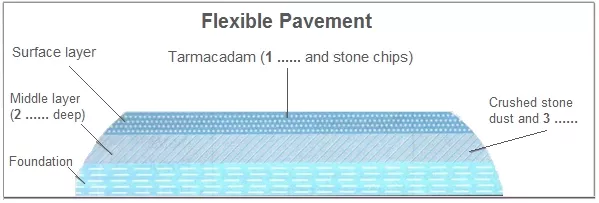
1 ……………..
2 ……………
3 ……………
Questions 4-7
Do the following statements agree with the information given in the Reading Passage?
Write
TRUE if the statement agrees with the information
FALSE if the statement contradicts the information
NOT GIVEN if there is no information on this
4 Road construction improved continuously between the first and eighteenth centuries.
5 In Britain, during the nineteenth century, only the very rich could afford to use toll roads.
6 Nineteenth-century road surfaces were inadequate for heavy motor traffic.
7 Traffic speeds on long-distance highways were unregulated in the early part of the twentieth century.
Questions 8-13
Complete the table below.
Use ONE WORD ONLY from the passage for each answer.
Bridges
|
Type of bridge |
Features |
Example(s) |
|---|---|---|
|
Arched bridge |
|
Alcantara, Spain Ironbridge, UK |
|
Truss bridge |
|
- |
|
Suspension bridge |
|
Clifton, UK Akashi Kaikyo, Japan (currently the 11 …………… span) |
|
Cantilever bridge |
|
Quebec, Canada |
Learn quick methods to conquer passages like this within 20 minutes.
Join our FREE IELTS webinars!
Answers and Explanations of The Construction of Roads and Bridges IELTS Reading Passage
Within this section, you can go through the provided answers, along with their precise locations within the given passage, and the important keywords that will help you find the answers. Check out 'The Construction of Roads and Bridges' answers and assess your improvement for a high IELTS band score.
Unlock Explanations
| Question number | Answer | Keywords | Location of keywords |
|---|---|---|---|
| 1 | Hot tar | McAdam’s surface layer – hot tar onto which a layer of stone chips was laid – became known as ‘tarmacadam’, or tarmac. | Paragraph B;
Line 4 |
| 2 | Five centimetres | Immediately above this, the Scottish engineer John McAdam (1756-1836) typically laid crushed stone, to which stone dust mixed with water was added, and which was compacted to a thickness of just five centimetres, | Paragraph B;
Line 3 |
| 3 | Water | Immediately above this, the Scottish engineer John McAdam (1756-1836) typically laid crushed stone, to which stone dust mixed with water was added, and which was compacted to a thickness of just five centimetres, | Paragraph B;
Line 3 |
| 4 | FALSE | New roads were generally of inferior quality, and the achievements of Roman builders were largely unsurpassed until the resurgence of road-building in the eighteenth century. | Paragraph A;
Last line |
| 5 | NOT GIVEN | – | – |
| 6 | TRUE | In the twentieth century, the ever-increasing use of motor vehicles threatened to break up roads built to nineteenth-century standards, | Paragraph C;
Last line |
| 7 | NOT GIVEN | – | – |
| 8 | Romans | The development by the Romans of the arched bridge | Paragraph F;
Line 1 |
| 9 | Stone | Most were built of stone | Paragraph F;
Line 3 |
| 10 | Light | Such bridges are nevertheless light, and therefore the most suitable for very long spans. | Paragraph H;
Line 3 |
| 11 | longest | he 1998 Akashi Kaikyo Bridge in Japan has a span of 1,991 metres, which is the longest to date. | Paragraph H;
Last line |
| 12 | steel | Cantilever bridges, such as the 1889 Forth Rail Bridge in Scotland, exploit the potential of steel construction | Paragraph I;
Line 1 |
| 13 | stable | Although the suspension bridge can span a wider gap, the cantilever is relatively stable, | Paragraph I;
Line 4 |
Learn quick solving tips and reading techniques from experts!
Connect with us through our FREE IELTS online classes!
Tips for Answering the Question Types in The Construction of Roads and Bridges Reading Passage
Given below are some IELTS exam preparation tips for band score of 8+ by helping you answer the types of questions in the ‘The Construction of Roads and Bridges’ Reading Answers.
Diagram Completion
- Identify which paragraph explains the diagram before reading in detail: Scan the passage for a paragraph describing layers, thickness, or materials of road construction, as diagrams usually match a technical explanation rather than general history.
- Match diagram labels with vertical position words: Words such as ‘above’, ‘below’, ‘layer’, ‘thickness’, ‘surface’ in the text help you align each numbered label with the correct part of the diagram.
- Copy answers exactly as written in the passage: Even if you understand the diagram clearly, you must lift the exact term (e.g. a material or measurement) from the passage and stay within the word/number limit.
- Watch measurement details closely: When a number is involved (e.g. thickness), ensure units and spelling are identical and do not add extra words.
True/False/Not Given
- Treat each statement as a claim about time or comparison: Always check whether the passage confirms, contradicts, or ignores that time period, as the statements include time-based claims (e.g., between centuries, during the nineteenth century).
- Use writer’s comparison language as a clue: Words like ‘inferior’, ‘unsurpassed’, or ‘threatened’ clearly signal contradiction or confirmation, which helps decide between TRUE and FALSE precisely.
- TRUE requires full agreement, not partial similarity: For example, if the passage suggests stagnation or decline while the statement claims improvement, the answer must be FALSE.
- FALSE requires direct contradiction, not weakness: For Question 6, the passage explicitly states that nineteenth-century roads could not cope with motor traffic. This clear opposition makes the answer TRUE, not an inference.
- Use NOT GIVEN only when the idea is completely absent: If the passage mentions roads or traffic but says nothing about regulation or who could afford them (as in Questions 5 and 7), the correct answer is NOT GIVEN.
Table Completion
- Read the table vertically, not row by row: Each row focuses on one bridge type, so locate the paragraph discussing that structure before searching for missing features or examples.
- Use headings to predict word type: For example, ‘Introduced by’ requires a group or civilisation, while ‘Made of’ requires a material.
- Look for definition-style sentences: Answers to Questions 8–13 come from sentences that explain who introduced, what materials were used, or what property distinguishes one bridge from another.
- Be alert to comparative language: Words such as ‘more’, ‘less’, ‘strong’, or ‘stable’ signal that the answer is likely an adjective used to compare bridge types (as in Questions 10 and 13).
- Check grammar after inserting the word: The completed table entry must make grammatical sense; for example, Question 11 requires a superlative adjective that fits “the … span”.
To conclude, we have explored ‘The Construction of Roads and Bridges’ Reading Answers, including specific locations and keywords, to help you confidently answer those often challenging questions. However, it would be beneficial for you to practice a variety of IELTS Reading practice tests and improve your weak areas on the IELTS Academic Reading exam.
Useful Links:
- Finding the Lost Freedom - IELTS Reading Answers
- Timekeeper: Invention of the Marine Chronometer IELTS Reading Answers
- The Grand Banks - IELTS Reading Answers With Location
- Driving on Air IELTS Reading Answers
- Fun for the Masses IELTS Reading Answers
- The Search for the Anti-aging Pill IELTS Reading Answers
- How to Complete IELTS Reading in Less than an Hour?
Practice IELTS Reading based on question types

Start Preparing for IELTS: Get Your 10-Day Study Plan Today!

Explore other Reading Actual Tests

Kasturika Samanta
Prity Mallick
Kasturika Samanta

Kasturika Samanta

Recent Articles

Nehasri Ravishenbagam

Haniya Yashfeen

Haniya Yashfeen

Haniya Yashfeen


Post your Comments