The History of Papermaking in the United Kingdom - IELTS Reading Answers
9 min read
Updated On
-
Copy link
Prepare for IELTS Academic Reading with topics like ‘The History of Papermaking in the United Kingdom Reading Answers’, and significantly improve your IELTS reading band score. This blog provides tips, answers & explanations for those aiming for a Band 9.
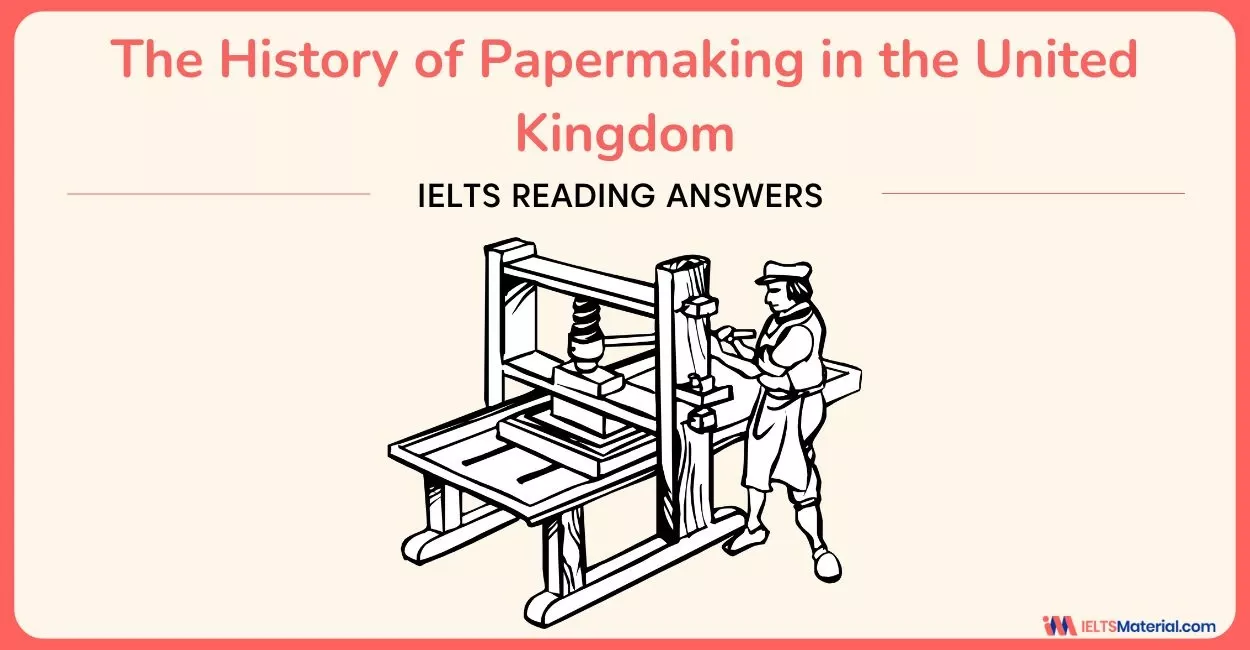
Table of Contents
- Passage for The History of Papermaking in the United Kingdom IELTS Reading Answers
- Questions for The History of Papermaking in the United Kingdom Reading Answers
- Answers and Explanations of The History of Papermaking in the United Kingdom IELTS Reading Passage
- Tips for Answering the Question Types in The History of Papermaking in the United Kingdom Reading Passage


Limited-Time Offer : Access a FREE 10-Day IELTS Study Plan!
Not everyone has an hour to sit down for a full reading practice test every day. Single passages like ‘The History of Papermaking in the United Kingdom IELTS Reading Answers’ fit easily into tight schedules. Practicing one passage at a time ensures consistency, helping you continue improving even when you are short on time.
So. take the passage, ‘The History of Papermaking in the United Kingdom’ below, and try more IELTS Reading practice tests. We have provided explanations, locations for the answers, and tips to help you handle the two different types of reading questions here.
Passage for The History of Papermaking in the United Kingdom IELTS Reading Answers
Go through The History of Papermaking in the United Kingdom IELTS Reading Answers passage given below, and prepare yourself for the reading section with this passage from one of the IELTS recent actual tests.
You should spend about 20 minutes on Questions 28-40, which are based on the Reading Passage below.
The History of Papermaking in the United Kingdom
1 The first reference to a paper mill in the United Kingdom was in a book printed by Wynken de Worde in about 1495. This mill belonged to a certain John Tate and was near Hertford. Other early mills included one at Dartford, owned by Sir John Speilman, who was granted special privileges for the collection of rags by Queen Elizabeth and one built in Buckinghamshire before the end of the sixteenth century. During the first half of the seventeenth century, mills were established near Edinburgh, at Cannock Chase in Staffordshire, and several in Buckinghamshire, Oxfordshire and Surrey.
2 The Bank of England has been issuing bank notes since 1694, with simple watermarks in them since at least 1697. Henri de Portal was awarded the contract in December 1724 for producing the Bank of England watermarked bank-note paper at Bere Mill in Hampshire. Portals have retained this contract ever since but production is no longer at Bere Mill. There were two major developments at about the middle of the eighteenth century in the paper industry in the UK.
The first was the introduction of the rag engine or Hollander, invented in Holland sometime before 1670, which replaced the stamping mills, which had previously been used, for the disintegration of the rags and beating of the pulp. The second was in the design and construction of the mould used for forming the sheet. Early moulds had straight wires sewn down on to the wooden foundation, this produced an irregular surface showing the characteristic "laid" marks, and, when printed on, the ink did not give clear, sharp lines. Baskerville, a Birmingham printer, wanted a smoother paper. James Whatman the Elder developed a woven wire fabric, thus leading to his production of the first woven paper in 1757. Increasing demands for more paper during the late eighteenth and early nineteenth centuries led to shortages of the rags needed to produce the paper.
3 Part of the problem was that no satisfactory method of bleaching pulp had yet been devised, and so only white rags could be used to produce white paper. Chlorine bleaching was being used by the end of the eighteenth century, but excessive use produced papers that were of poor quality and deteriorated quickly.
By 1800 up to 24 million pounds of rags were being used annually, to produce 10,000 tons of paper in England and Wales, and 1000 tons in Scotland, the home market being supplemented by imports, mainly from the continent. Experiments in using other materials, such as sawdust, rye straw, cabbage stumps and spruce wood had been conducted in 1765 by Jacob Christian Schäffer. Similarly, Matthias Koops carried out many experiments on straw and other materials at the Neckinger Mill, Bermondsey around 1800, but it was not until the middle of the nineteenth century that pulp produced using straw or wood was utilised in the production of paper.
4 By 1800 there were 430 (564 in 1821) paper mills in England and Wales (mostly single vat mills), under 50 (74 in 1823) in Scotland and 60 in Ireland, but all the production was by hand and the output was low. The first attempt at a paper machine to mechanise the process was patented in 1799 by Frenchman Nicholas Louis Robert, but it was not a success.
5 However, the drawings were brought to England by John Gamble in 1801 and passed on to the brother's Henry and Sealy Fourdrinier, who financed the engineer Henry Donkin to build the machine.
The first successful machine was installed at Frogmore, Hertfordshire, in 1803. The paper was pressed onto an endless wire cloth, transferred to a continuous felt blanket and then pressed again. Finally it was cut off the reel into sheets and loft dried in the same way as hand made paper. In 1809 John Dickinson patented a machine that that used a wire cloth covered cylinder revolving in a pulp suspension, the water being removed through the centre of the cylinder and the layer of pulp removed from the surface by a felt covered roller (later replaced by a continuous felt passing round a roller).
This machine was the forerunner of the present day cylinder mould or vat machine, used mainly for the production of boards. Both these machines produced paper as a wet sheet, which require drying after removal from the machine, but in 1821 T B Crompton patented a method of drying the paper continuously, using a woven fabric to hold the sheet against steam heated drying cylinders. After it had been pressed, the paper was cut into sheets by a cutter fixed at the end of the last cylinder. By the middle of the nineteenth century the pattern for the mechanised production of paper had been set. Subsequent developments concentrated on increasing the size and production of the machines. Similarly, developments in alternative pulps to rags, mainly wood and esparto grass, enabled production increases.
6 Conversely, despite the increase in paper production, there was a decrease, by 1884, in the number of paper mills in England and Wales to 250 and in Ireland to 14 (Scotland increased to 60), production being concentrated into fewer, larger units. Geographical changes also took place as many of the early mills were small and had been situated in rural areas. The change was to larger mills in, or near, urban areas closer to suppliers of the raw materials (esparto mills were generally situated near a port as the raw material was brought in by ship) and the paper markets.
Questions for The History of Papermaking in the United Kingdom Reading Answers
The Academic Reading passage, The History of Papermaking in the United Kingdom, which is the third text of a complete reading test, comes with 13 questions and showcases two different IELTS Reading question types with examples.
The question types found in this reading passage are:
- IELTS Reading True False Not Given (Q. 28-34)
- IELTS Reading Matching Features (Q. 35-40)
Questions 28-34
Do the following statements agree with the views of the writer of the reading passage on The History of Papermaking in the U.K.? In boxes 28-34, write:
TRUE if the statement agrees with the writer
FALSE if the statement doesn't agree with the writer
NOT GIVEN if it is impossible to say what the writer thinks about this.
28 The printing of paper money in the UK has always been done by the same company.
29 Early paper making in Europe was at its peak in Holland in the 18th century.
30 18th Century developments in molds led to the improvement of a flatter, more even paper.
31 Chlorine bleaching proved the answer to the need for more white paper in the 18th and 19th centuries.
32 The first mechanized process that had any success still used elements of the handmade paper-making process.
33 Modern paper making machines are still based on John Dickinson's 1809 patent.
34 The development of bigger mills near larger towns was so that mill owners could take advantage of potential larger workforces.
Questions 35-40
Match the events (35 - 40) with the dates (A - G) listed below.
Write the appropriate letters in boxes 35 - 40 on your answer sheet.
35 Invention of the rag engine.
36 A new method for drying paper patented.
37 First successful machine for making paper put into production.
38 Manufacture of the first woven paper.
39 Watermarks first used for paper money.
40 The first machine for making paper patented.
Dates
A 1803
B 1757
C 1821
D 1697
E 1799
F 1670
G 1694
Book a FREE Demo with our experts to learn tricks and techniques to ace the IELTS Reading!
Answers and Explanations of The History of Papermaking in the United Kingdom IELTS Reading Passage
Check out the answer key for this IELTS Academic Reading passage, The History of Papermaking in the United Kingdom, with detailed explanations.
Unlock Answer Key
| Question Number | Answer | Keywords | Locations of Keywords |
|---|---|---|---|
| 28 | TRUE | Portals have retained this contract | Para 2, lines 3-4 |
| 29 | NOT GIVEN | ||
| 30 | TRUE | Baskerville, a Birmingham printer, wanted a smoother paper | Para 2, lines 11-12 |
| 31 | FALSE | Chlorine bleaching, excessive use produced papers, poor quality, deteriorated quickly | Para 3, lines 2-4 |
| 32 | TRUE | first successful machine, Frogmore, paper was pressed, endless wire cloth, transferred, continuous felt blanket, pressed again | Para 5, line 3-5 |
| 33 | TRUE | This machine was the forerunner of the present day cylinder mould or vat machine | Para 5, lines 9-10 |
| 34 | FALSE | change, larger mills in, near, urban, closer to suppliers, raw materials, paper markets | Para 6, last 4 lines |
| 35 | F | rag engine or hollander, invented in Holland sometime before 1670 | Para 2, lines 6-7 |
| 36 | C | 1821 T B Crompton patented a method of drying the paper continuously | Para 5, line 12 |
| 37 | A | The first successful machine, installed, Frogmore, 1803 | Para 5, line 3 |
| 38 | B | production, first woven paper, 1757 | Para 2, line 13 |
| 39 | D | simple watermarks, 1697 | Para 2, first 2 lines |
| 40 | E | first attempt at a paper machine to mechanise the process was patented in 1799 | Para 4, last 2 lines |
Learn quick solving tips and reading techniques from experts!
Connect with us through our FREE IELTS online classes!
Tips for Answering the Question Types in The History of Papermaking in the United Kingdom Reading Passage
Let us check out some quick IELTS exam preparation tips for band score of 8+ and to answer the types of questions in the ‘The History of Papermaking in the United Kingdom Reading Answers’.
True/False/Not Given
- Identify the writer’s view, not real-world facts: These questions test whether the writer explicitly agrees or disagrees, so rely only on what is stated or clearly implied in the passage—not background knowledge.
- Match meaning, not words: Statements are usually paraphrased; scan the relevant paragraph and compare ideas, not identical vocabulary, to determine agreement or contradiction.
- Be careful with NOT GIVEN: If the passage mentions the topic but gives no clear opinion, comparison, or conclusion, the correct answer is NOT GIVEN—even if the statement sounds logical.
- Distinguish FALSE from NOT GIVEN carefully: Choose FALSE only when the passage clearly contradicts the statement; absence of information always means NOT GIVEN.
- Watch for cause–effect traps: Statements often add a reason (e.g., “so that mill owners could…”); if the passage gives a different reason, the answer is FALSE.
- Pay attention to qualifiers and time references: Words like ‘always’, ‘first’, ‘still’, ‘modern’, ‘early’ must exactly match the time frame discussed in the passage.
- Read beyond the keyword sentence: The correct answer often depends on explanation spread across two lines, so read the surrounding sentences to confirm the writer’s stance.
Matching Features
- Turn events into mini-questions: Before scanning, rephrase each event into a question (e.g., “When was the rag engine invented?”) to focus your search.
- Scan for dates first, then events: Dates stand out visually; once located, read the sentence carefully to confirm which event is being described.
- Don’t assume chronological order: The events are not listed in time order, so match each one independently rather than sequentially.
- Watch for synonyms of ‘invented’ and ‘patented’: Words like developed, introduced, first attempt, put into production may signal different stages—read precisely.
- Use elimination strategically: As each date is used only once, crossing off confirmed options helps reduce confusion with similar historical developments.
- Be cautious with similar inventions: Multiple machines or processes may be mentioned; ensure the event matches the exact description (e.g., first successful vs first patented).
To conclude, IELTS reading samples, such as The History of Papermaking in the United Kingdom IELTS Reading Answers are crucial. They facilitate your progress in improving your skills. reading speed, identifying your areas of weakness, and getting more used to the many kinds of reading questions. Thus, keep solving similar IELTS Reading topics for General and Academic for the reading section and get the outcomes you want.
Useful Links:
- Making Time for Science - IELTS Reading Answers
- The History Of The Poster - IELTS Reading Answers
- Examining The Placebo Effect IELTS Reading Answers
- Garbage In, Garbage Out – IELTS Reading Answers
- Keeping Cut Flowers – IELTS Reading Answers
- A Gentle Giant And A Pint-Sized Bully Reading Answers
- How to Ace IELTS Reading with 'Keyword Technique'
Practice IELTS Reading based on question types

Start Preparing for IELTS: Get Your 10-Day Study Plan Today!

Explore other Reading Actual Tests
Kasturika Samanta
Prity Mallick
Kasturika Samanta
Kasturika Samanta

Recent Articles
Nehasri Ravishenbagam
Haniya Yashfeen

Haniya Yashfeen
Haniya Yashfeen


Post your Comments