Today More and More Tourists are Visiting Places Where Conditions are Difficult - IELTS Writing Task 2
8 min read
Updated On
-
Copy link
Examine the sample answers for the IELTS advantages and disadvantages essay 'Today more and more tourists are visiting places where conditions are difficult'. Go through the outline & vocabulary to write an essay that can help you achieve a Band 7+ score.
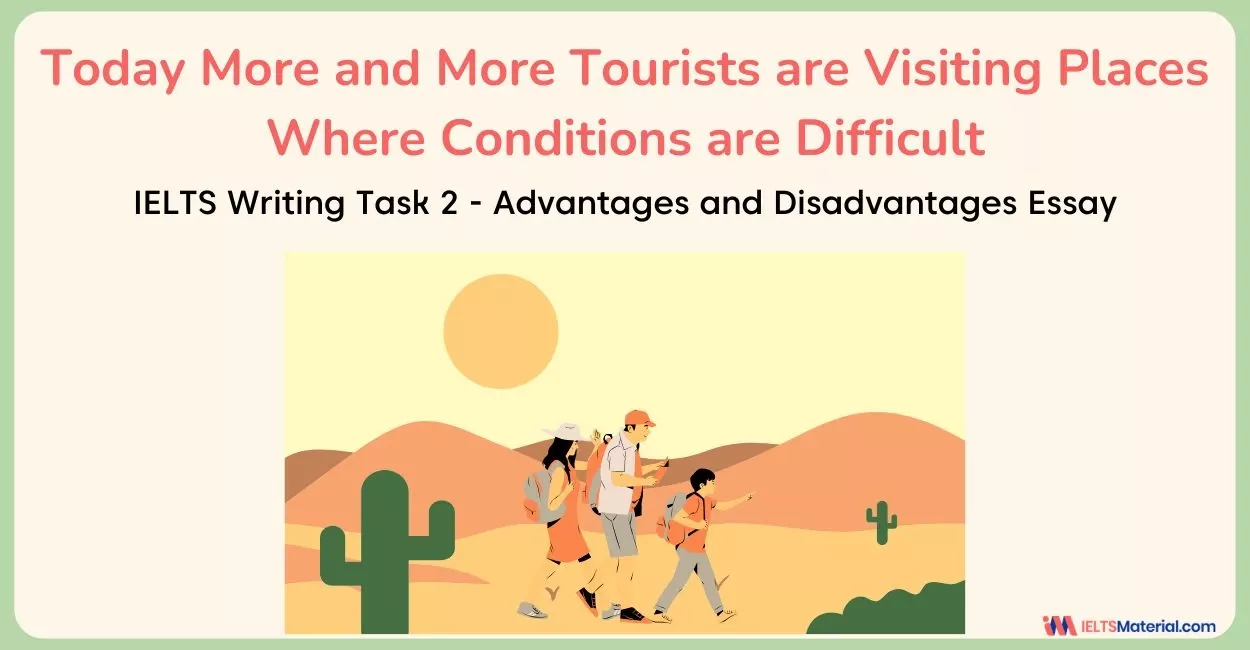
Table of Contents
- Essay Question for ‘Today More and More Tourists are Visiting Places Where Conditions are Difficult’
- Outline for IELTS Advantages and Disadvantages Essay
- Sample Answers for Today More and More Tourists are Visiting Places Where Conditions are Difficult IELTS Writing Task 2
- Vocabulary to Use for Today More and More Tourists are Visiting Places Where Conditions are Difficult - IELTS Writing Task 2


Try AI Essay Checker for Instant Band Score
From scorching deserts to frozen continents, modern tourists are increasingly drawn to harsh and remote landscapes. This trend reflects a shift in travel motivations, from relaxation to exploration, self-discovery, and prestige. However, while such journeys may be transformative, they are not without significant drawbacks. Understanding both sides is essential for crafting a high-scoring IELTS response for the essay ‘Today more and more tourists are visiting places where conditions are difficult’.
In this blog, we will explore sample answers for the IELTS Writing Task 2 essay on the topic ‘Today more and more tourists are visiting places where conditions are difficult’. We will also provide an outline and relevant vocabulary that are essential for achieving a high band score.
Essay Question for ‘Today More and More Tourists are Visiting Places Where Conditions are Difficult’
You should spend about 40 minutes on this task.
Today more and more tourists are visiting places where conditions are difficult, such as the Sahara desert or the Antarctic. What are the benefits and disadvantages for tourists who visit such places? Give reasons for your answer and include any relevant examples from your own knowledge or experience.
You should write at least 250 words.
Outline for IELTS Advantages and Disadvantages Essay
Below is an outline that will assist you in crafting an IELTS Advantages Disadvantages essay, similar to ‘Today more and more tourists are visiting places where conditions are difficult’.
|
Introduction
Body Paragraph 1 – Discuss the Advantages
Body Paragraph 2 – Explain the Disadvantages
Conclusion
|
Sample Answers for Today More and More Tourists are Visiting Places Where Conditions are Difficult IELTS Writing Task 2
Here are three IELTS Band 9 essay samples on the topic, ‘Today more and more tourists are visiting places where conditions are difficult’, that will help you write your own essay and achieve a high band score.
Today More and More Tourists are Visiting Places Where Conditions are Difficult - Sample Answer 1
In recent decades, increasing numbers of tourists have chosen to visit remote and inhospitable regions such as the Sahara Desert and Antarctica. While these expeditions promise once-in-a-lifetime experiences, they also involve considerable risks and ethical concerns. This essay will examine both the advantages and disadvantages of traveling to such extreme destinations.
One significant advantage is the opportunity for unparalleled adventure and personal development. Traveling through the vast dunes of the Sahara on a guided camel trek, for instance, enables visitors to immerse themselves in a landscape that is both historically and geographically unique. Similarly, tourists in Antarctica can witness towering glaciers and observe penguins and seals in their natural habitat. Such encounters foster a deeper appreciation for the planet’s diversity. In addition, enduring physical challenges, such as sub-zero temperatures or long desert crossings, often cultivates resilience, adaptability, and self-confidence. Many travellers report that these demanding experiences transform their perspective on comfort and modern convenience.
However, extreme climates present challenges like genuine health and safety hazards. In desert regions, dehydration and heatstroke are common threats, whereas polar environments expose visitors to frostbite and hypothermia. Rescue missions in isolated areas are logistically difficult and financially burdensome, sometimes costing governments substantial resources. Secondly, evironmental damage is another serious concern. Fragile ecosystems, particularly in Antarctica, can be easily disrupted by human presence. Increased cruise tourism has raised fears about oil spills, wildlife disturbance, and carbon emissions. Even small amounts of litter can have long-lasting ecological consequences in such pristine environments.
In conclusion, although travel to extreme locations offers extraordinary experiences and personal growth, the associated health risks and environmental impacts must be carefully considered before embarking on such journeys.
Join our IELTS online classes and discuss your writing queries with the best experts!
Today More and More Tourists are Visiting Places Where Conditions are Difficult - Sample Answer 2
Adventure tourism to destinations such as the Sahara Desert and Antarctica has become increasingly popular in recent years. Improved transport links and social media exposure have encouraged travellers to seek experiences beyond conventional holidays. While these remote regions offer extraordinary encounters, they also involve substantial risks and environmental concerns.
On the positive side, such travel provides significant educational and cultural value. Visitors to the Sahara often learn about nomadic communities such as the Tuareg people and gain insight into traditional survival techniques in arid climates. Similarly, guided expeditions in Antarctica allow tourists to study glaciers, observe penguin colonies, and understand the scientific research conducted at international stations. Experiencing extreme climates firsthand can foster a deeper appreciation for the fragility of global ecosystems and the urgency of climate conservation. Moreover, responsible tourism can generate income for local guides, transport providers, and hospitality services, creating employment opportunities in otherwise economically limited regions.
Despite these advantages, harsh weather conditions, including sandstorms in the desert or blizzards in polar areas, may lead to serious injuries or even fatalities. Many travellers underestimate the physical endurance required for such expeditions, which can result in dehydration, hypothermia, or psychological stress. In some cases, emergency evacuations by helicopter or specialised rescue teams are required, imposing hefty financial burdens on governments or insurance systems. Environmental sustainability is another pressing concern. Increased cruise tourism to Antarctica, for instance, has raised fears about oil spills and wildlife disturbance. Even minimal infrastructure development or littering can permanently damage delicate habitats that take decades to recover.
Overall, although tourism in extreme environments can be educational and economically beneficial, the associated safety risks and ecological consequences demand careful regulation and responsible travel practices.
Book a FREE Demo to learn tips and writing techniques from experts!
Today More and More Tourists are Visiting Places Where Conditions are Difficult - Sample Answer 3
Recently, it has been observed that there is a surge among tourists visiting isolated natural regions with harsh weather conditions. However, in my perspective, it has more disadvantages because it may have a harmful impact on people. In the forthcoming paragraphs, I shall discuss the advantages and disadvantages of the issue and explain why I believe in the latter.
On the one hand, people have become more adventurous nowadays. Tourists are driven by their desire to achieve something and experience an adrenaline rush during the expeditions. Despite being aware of the harsh weather conditions in places like the Sahara desert and Mt. Everest, they desire exhilarating experiences. The journeys to these destinations allow tourists to partake in adventurous and thrilling activities. As these places test people’s physical and mental stamina, overcoming these difficulties help people gain confidence. Also, tourists are now becoming bored of visiting the common cities, mountains and beaches. Besides that, these places offer lasting memories and priceless experiences to tourists.
On the other hand, the most significant downside is that travelling to difficult natural regions might be perilous if travellers are not adequately equipped. The temperature in these areas is frequently below zero degrees or extremely high, putting people’s health at risk. For example, many people have died due to extreme weather conditions while making the trek to Mt. Everest. Due to global warming, icebergs in places like Antarctica are melting, releasing harmful gases and substances.
To summarise, while exploring areas with difficult conditions may entice some people, I feel the drawbacks of people being able to go to these areas outweigh the benefits since it puts people’s lives in jeopardy.
Vocabulary to Use for Today More and More Tourists are Visiting Places Where Conditions are Difficult - IELTS Writing Task 2
Below is an advanced vocabulary word list for IELTS related to the topic ‘Today more and more tourists are visiting places where conditions are difficult’ that will help you boost your overall lexical resources.
|
Word |
Meaning |
Example Sentence |
|---|---|---|
|
Inhospitable |
harsh and difficult to live in or visit |
The inhospitable climate of the polar region makes survival extremely challenging. |
|
Expeditions |
organised journeys undertaken for a specific purpose, often exploration |
Scientific expeditions to remote glaciers help researchers monitor climate change. |
|
Unparalleled |
having no equal; unmatched |
Travellers described the desert sunset as an unparalleled visual experience. |
|
Sub-zero |
below zero degrees in temperature |
Tourists must prepare carefully for sub-zero temperatures in polar regions. |
|
Resilience |
the ability to recover quickly from difficulties |
Trekking across rough terrain builds both physical and mental resilience. |
|
Hypothermia |
a dangerous condition caused by abnormally low body temperature |
Without proper clothing, hikers risk hypothermia in freezing winds. |
|
Litter |
rubbish left lying in an open or public place |
Even small amounts of litter can damage fragile ecosystems. |
|
Pristine |
in its original condition; unspoiled |
Antarctica remains one of the most pristine environments on Earth. |
|
Nomadic |
living a lifestyle that involves moving from place to place |
Nomadic tribes have adapted to survive in harsh desert conditions. |
|
Arid |
extremely dry; lacking rainfall |
The arid landscape of the desert supports only limited vegetation. |
|
Fragility |
the quality of being delicate or easily damaged |
The fragility of coral reefs makes them vulnerable to human interference. |
|
Hefty |
large in amount, size, or degree |
Tourists may face hefty evacuation costs in emergency situations. |
|
Adrenaline rush |
a sudden feeling of intense excitement caused by adrenaline release |
Standing at the edge of a glacier gave her an unforgettable adrenaline rush. |
|
Downside |
the negative aspect of something generally positive |
The downside of extreme tourism is the environmental pressure it creates. |
|
Exhilarating |
making one feel extremely happy or thrilled |
Climbing sand dunes at sunrise was an exhilarating experience. |
|
Partake |
to join in or participate in an activity |
Visitors can partake in guided wildlife observation tours. |
|
Perilous |
full of danger or risk |
Crossing icy terrain without expert guidance can be perilous. |
|
Equipped |
supplied with the necessary items for a specific purpose |
Travellers should be properly equipped with thermal clothing and safety gear. |
|
Jeopardy |
exposure to danger or risk |
Poor planning can place both tourists and rescue teams in jeopardy. |
|
Isolated |
remote and separated from other places or people |
Research stations in Antarctica are among the most isolated workplaces in the world. |
In conclusion, tourism remains a compelling global trend, which makes this topic essential for practice. It requires balanced analysis, precise IELTS vocabulary, and well-structured arguments. By presenting clear advantages and disadvantages with relevant examples, you can effectively demonstrate critical thinking and achieve a Band 7+ score in Writing Task 2.
Useful Links:
- Describe the Advantages and Disadvantages of Tourism in the Modern World - IELTS Writing Task 2
- Tourism is Encouraged in Many Countries - IELTS Writing Task 2 Advantage/Disadvantage Essay
- A Lot of Places in the World Rely on Tourism as a Main Source of Income - IELTS Writing Task 2
- Most Countries Believe that International Tourism has Harmful Effects - IELTS Writing Task 2
- The Development of Tourism Contributed to English Becoming the most Prominent Language in the World IELTS Writing Task 2
- International Tourism has Become More Popular in Recent Decades - IELTS Writing Task 2
- IELTS Writing Penalty for Word Count | Avoid Losing Marks
Practice IELTS Writing Task 2 based on Essay types

Start Preparing for IELTS: Get Your 10-Day Study Plan Today!

Explore other Advantage Disadvantage Essays





Recent Articles

Haniya Yashfeen


Prity Mallick

Kasturika Samanta


Post your Comments
1 Comment