When Evolution Runs Backwards - IELTS Reading Answers
13 min read
Updated On
-
Copy link
Get ready for the IELTS Academic Reading section with topics like ‘When Evolution Runs Backwards IELTS Reading Answers’ with location and improve your comprehension skills. This blog provides explanations for those aiming for an IELTS reading score of 8+.
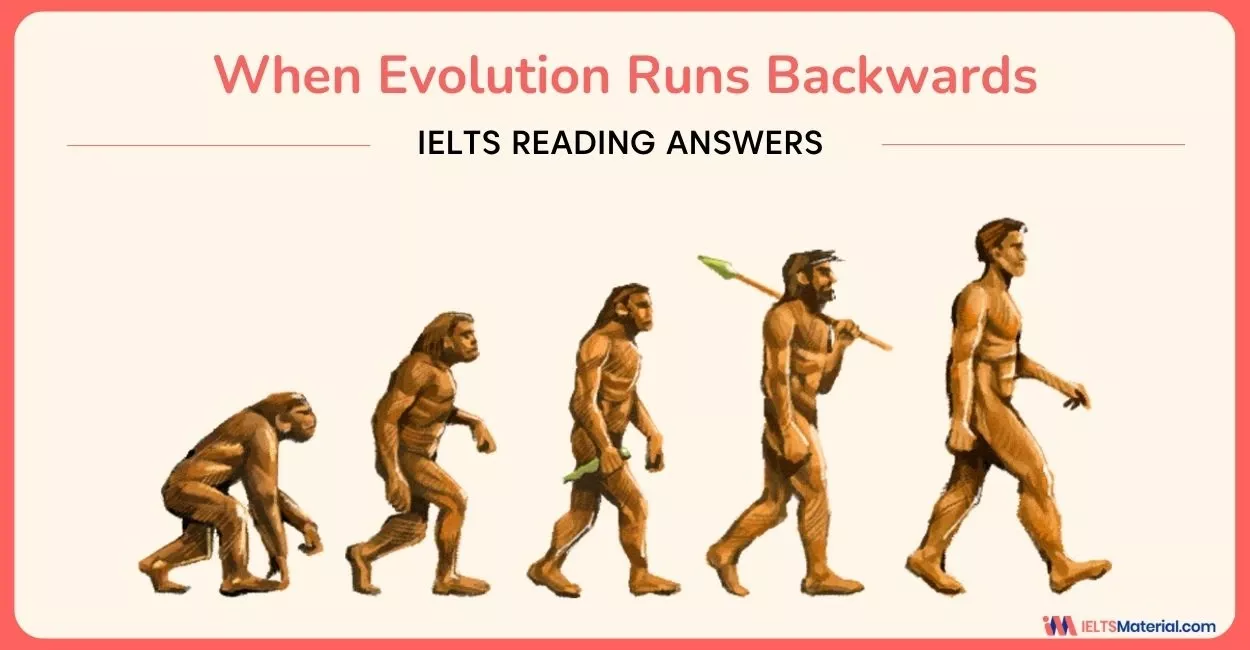
Table of Contents


Limited-Time Offer : Access a FREE 10-Day IELTS Study Plan!
When you have just one passage, it is easier to go over mistakes. So, begin by practicing with a single passage from IELTS Reading recent actual tests like ‘When Evolution Runs Backwards IELTS Reading Answers’ as it allows for comparing questions to the text, analyzing incorrect answers, and grasping IELTS paraphrasing techniques for improved long-term learning.
With explanations and tips to improve your reading module performance, this blog allows you to check your answers using the When Evolution Runs Backwards Reading Answers.
Passage for When Evolution Runs Backwards IELTS Reading Answers
Now read through the passage ‘When Evolution Runs Backwards’ and review the answers provided. Be prepared to tackle similar IELTS Reading topics for General and Academic.
You should spend about 20 minutes on Questions 1-14, which are based on the Reading Passage below.
When Evolution Runs Backwards
Evolution isn’t supposed to run backwards - yet an increasing number of examples show that it does and that it can sometimes represent the future of a species.
A The description of any animal as an ‘evolutionary throwback’ is controversial. For the better part of a century, most biologists have been reluctant to use those words, mindful of a principle of evolution that says ‘evolution cannot run backwards’. But as more and more examples come to light and modern genetics enters the scene, that principle has to be rewritten. Not only are evolutionary throwbacks possible, they sometimes play an important role in the forward march of evolution.
B The technical term for an evolutionary throwback is an ‘atavism’, from the Latin atavus, meaning forefather. The word has ugly connotations thanks largely to Cesare Lombroso, a 19th-century Italian medic who argued that criminals were born not made and could be identified by certain physical features that were throwbacks to a primitive, sub-human state.
C While Lombroso was measuring criminals, a Belgian palaeontologist called Louis Dollo was studying fossil records and coming to the opposite conclusion. In 1890 he proposed that evolution was irreversible: that ‘an organism is unable to return, even partially, to a previous stage already realised in the ranks of its ancestors. Early 20th-century biologists came to a similar conclusion, though they qualified it in terms of probability, stating that there is no reason why evolution cannot run backwards -it is just very unlikely. And so the idea of irreversibility in evolution stuck and came to be known as ‘Dollo’s law.
D If Dollo’s law is right, atavisms should occur only very rarely, if at all. Yet almost since the idea took root, exceptions have been cropping up. In 1919, for example, a humpback whale with a pair of leglike appendages over a metre long, complete with a full set of limb bones, was caught off Vancouver Island in Canada. Explorer Roy Chapman Andrews argued at the time that the whale must be a throwback to a land-living ancestor. ‘I can see no other explanation, he wrote in 1921.
E Since then, so many other examples have been discovered that it no longer makes sense to say that evolution is as good as irreversible. And this poses a puzzle: how can characteristics that disappeared millions of years ago suddenly reappear?
In 1994, Rudolf Raff and colleagues at Indiana University in the USA decided to use genetics to put a number on the probability of evolution going into reverse. They reasoned that while some evolutionary changes involve the loss of genes and are therefore irreversible, others may be the result of genes being switched off. If these silent genes are somehow switched back on, they argued, longlost traits could reappear.
F Raff’s team went on to calculate the likelihood of it happening. Silent genes accumulate random mutations, they reasoned, eventually rendering them useless. So how long can a gene survive in a species if it is no longer used? The team calculated that there is a good chance of silent genes surviving for up to 6 million years in at least a few individuals in a population, and that some might survive as long as 10 million years. In other words, throwbacks are possible, but only to the relatively recent evolutionary past.
G As a possible example, the team pointed to the mole salamanders of Mexico and California. Like most amphibians these begin life in a juvenile ‘tadpole’ state, then metamorphose into the adult form – except for one species, the axolotl, which famously lives its entire life as a juvenile. The simplest explanation for this is that the axolotl lineage alone lost the ability to metamorphose, while others retained it. From a detailed analysis of the salamanders’ family tree, however, it is clear that the other lineages evolved from an ancestor that itself had lost the ability to metamorphose. In other words, metamorphosis in mole salamanders is an atavism. The salamander example fits with Raff’s 10million-year time frame.
H More recently, however, examples have been reported that break the time limit, suggesting that silent genes may not be the whole story. In a paper published last year, biologist Gunter Wagner of Yale University reported some work on the evolutionary history of a group of South American lizards called Bachia. Many of these have minuscule limbs; some look more like snakes than lizards, and a few have completely lost the toes on their hind limbs. Other species, however, sport up to four toes on their hind legs. The simplest explanation is that the toed lineages never lost their toes, but Wagner begs to differ. According to his analysis of the Bachia family tree, the toed species re-evolved toes from toeless ancestors, and, what is more, digit loss and gain have occurred on more than one occasion over tens of millions of years.
I So what’s going on? One possibility is that these traits are lost and then simply reappear, in much the same way that similar structures can independently arise in unrelated species, such as the dorsal fins of sharks and killer whales. Another, more intriguing possibility is that the genetic information needed to make toes somehow survived for tens or perhaps hundreds of millions of years in the lizards and was reactivated. These atavistic traits provided an advantage and spread through the population, effectively reversing evolution.
J But if silent genes degrade within 6 million years, how can long-lost traits be reactivated over longer timescales? The answer may lie in the womb. Early embryos of many species develop ancestral features. Snake embryos, for example, sprout hind limb buds. Later in development, these features disappear thanks to developmental programs that say ‘lose the leg’. If, for any reason, this does not happen, the ancestral feature may not disappear, leading to an atavism.
Questions for When Evolution Runs Backwards Reading Answers
The passage, When Evolution Runs Backwards Reading Answers from Cambridge 10 Test 4, consists of 14 questions, which showcase three different IELTS Reading question types. They are:
- IELTS Reading Multiple Choice Questions (Q. 1-5)
- IELTS Reading Matching Endings (Q. 6-10)
- IELTS Reading Yes, No, Not Given (Q. 11-14)
Questions 1-5
Choose the correct letter, A, B, C or D.
Write the correct letter in boxes 1-5 on your answer sheet.
1 When discussing the theory developed by Louis Dollo, the writer says that
A it was immediately referred to as Dollo’s law.
B it supported the possibility of evolutionary throwbacks.
C it was modified by biologists in the early twentieth century.
D it was based on many years of research.
2 The humpback whale caught off Vancouver Island is mentioned because of
A the exceptional size of its body.
B the way it exemplifies Dollo’s law.
C the amount of local controversy it caused.
D the reason given for its unusual features.
3 What is said about ‘silent genes’?
A Their numbers vary according to species.
B Raff disagreed with the use of the term.
C They could lead to the re-emergence of certain characteristics.
D They can have an unlimited life span.
4 The writer mentions the mole salamander because
A it exemplifies what happens in the development of most amphibians.
B it suggests that Raffs theory is correct.
C it has lost and regained more than one ability.
D its ancestors have become the subject of extensive research.
5 Which of the following does Wagner claim?
A Members of the Bachia lizard family have lost and regained certain features several times.
B Evidence shows that the evolution of the Bachia lizard is due to the environment.
C His research into South American lizards supports Raffs assertions.
D His findings will apply to other species of South American lizards.
Questions 6-10
Complete each sentence with the correct ending, A-G, below.
Write the correct letter, A-G, in boxes 6-10 on your answer sheet.
6 For a long time biologists rejected
7 Opposing views on evolutionary throwbacks are represented by
8 Examples of evolutionary throwbacks have led to
9 The shark and killer whale are mentioned to exemplify
10 One explanation for the findings of Wagner’s research is
|
A the question of how certain long-lost traits could reappear. B the occurrence of a particular feature in different species. C parallels drawn between behaviour and appearance. D the continued existence of certain genetic information. E the doubts felt about evolutionary throwbacks. F the possibility of evolution being reversible. G Dollo's findings and the convictions held by Lombroso. |
Questions 11-14
Do the following statements agree with the claims of the writer in the Reading Passage?
In boxes 11-14 on your answer sheet, write
YES if the statement agrees with the claims of the writer
NO if the statement contradicts the claims of the writer
NOT GIVEN if it is impossible to say what the writer thinks about this
11 Wagner was the first person to do research on South American lizards.
12 Wagner believes that Bachia lizards with toes had toeless ancestors.
13 The temporary occurrence of long-lost traits in embryos is rare.
14 Evolutionary throwbacks might be caused by developmental problems in the womb.
Learn quick methods to conquer passages like this within 20 minutes.
Join our FREE IELTS webinars!
Answers and Explanations of When Evolution Runs Backwards IELTS Reading Passage
It's time to check your work by comparing your answers to the key for the ‘When Evolution Runs Backwards’ IELTS Reading. You will learn to conquer different IELTS Reading question types with examples.
| Question number | Answer | Keywords | Location of keywords |
|---|---|---|---|
| 1 | C | Early 20th-century biologists came to a similar conclusion, though they qualified it in terms of probability, stating that there is no reason why evolution cannot run backwards -it is just very unlikely | Paragraph C; Line 3 |
| 2 | D | Explorer Roy Chapman Andrews argued at the time that the whale must be a throwback to a land-living ancestor. | Paragraph D; Line 4 |
| 3 | C | If these silent genes are somehow switched back on, they argued, longlost traits could reappear. | Paragraph E; Last line |
| 4 | B | The salamander example fits with Raff’s 10million-year time frame. | Paragraph G; Last line |
| 5 | A | According to his analysis of the Bachia family tree, the toed species re-evolved toes from toeless ancestors and, what is more, digit loss and gain has occurred on more than one occasion over tens of millions of years. | Paragraph H; Last line |
| 6 | F | For the better part of a century, most biologists have been reluctant to use those words, mindful of a principle of evolution that says ‘evolution cannot run backwards | Paragraph A; Line 2 |
| 7 | G | While Lombroso was measuring criminals, a Belgian palaeontologist called Louis Dollo was studying fossil records and coming to the opposite conclusion | Paragraph C; Line 1 |
| 8 | A | so many other examples have been discovered that it no longer makes sense to say that evolution is as good as irreversible. | Paragraph E; Line 1 |
| 9 | B | similar structures can independently arise in unrelated species, such as the dorsal fins of sharks and killer whales. | Paragraph I; Line 2 |
| 10 | D | Another more intriguing possibility is that the genetic information needed to make toes somehow survived for tens or perhaps hundreds of millions of years in the lizards and was reactivated. | Paragraph I; Line 3 |
| 11 | NOT GIVEN | – | – |
| 12 | YES | the toed species re-evolved toes from toeless ancestors and, what is more, digit loss and gain has occurred on more than one occasion over tens of millions of years. | Paragraph H; Last line |
| 13 | NO | Early embryos of many species develop ancestral features. | Paragraph J; Line 3 |
| 14 | YES | The answer may lie in the womb. | Paragraph J; Line 2 |
Learn quick solving tips and reading techniques from experts!
Connect with us through our FREE IELTS online classes!
Tips for Answering the Question Types in the When Evolution Runs Backwards Reading Passage
Here are some IELTS exam preparation tips for band score of 8+ for passage question types within the ‘When Evolution Runs Backwards’ reading passage, designed to help you develop your own strategy.
Multiple Choice Questions
- Identify the focus of the question (person, example, or concept): Each question begins with a clear reference, such as “the theory developed by…”, “the humpback whale…”, or “silent genes”. Your first task is to find where that specific topic appears in the passage. Proper nouns (names, species, theories) act as strong scanning anchors.
- Locate the relevant paragraph before reading answer options: For example, Q. 1 is about the theory developed by Louis Dollo, Q. 4 is about the mole salamander, and Q. 5 refers to the claim made by Wagner. So, find where the passage discusses that reference, then read 2–3 surrounding sentences carefully.
- Understand the writer’s purpose for mentioning the example: Many questions ask why something is mentioned (e.g., Q. 2: “the humpback whale… is mentioned because…”). IELTS passages often test function, like illustration, evidence, explanation, or contrast, and not just factual description. So, ask yourself: What idea does this example support?
- Match paraphrasing, not identical wording: Answer choices rarely repeat the text exactly. For instance, the passage might say “traits could reappear if genes reactivate, while the option says “re-emergence of certain characteristics” (Q. 3: silent genes). Recognising synonyms is essential to choosing correctly.
- Eliminate distractors that are partially true: Some options may reflect background information but not the specific claim asked. For example, a question about what a researcher claims must match their conclusion, not general information about their research area. Only choose the option that precisely matches the passage statement.
- Pay attention to opinion vs fact questions: If the question says “the writer says…” or “What is said about…”, focus on the interpretation of the text. If it says “Which does X claim?”, you must identify that individual’s viewpoint.
Matching Endings
- Read only the sentence stem first: Focus on the meaning of the unfinished sentence and understand what kind of idea must logically complete the sentence.
- Predict the meaning before looking at answer options: For Q. 6, the stem suggests biologists rejected a concept or belief. For Q. 10, the phrase “One explanation for…” suggests a scientific reason or mechanism. Prediction helps you avoid choosing options that merely share vocabulary.
- Identify keywords and scan the passage: Look for phrases like ‘rejected’, ‘opposing views’, ‘examples discovered’, ‘explanation for findings’. These signal a discussion of scientific debate or interpretation. Read the relevant sentence fully to understand cause-and-effect logic.
- Match logical meaning, not just similar words: Some endings may contain similar vocabulary but incorrect logic. For example, a sentence about examples leading to new conclusions must match an option describing changed understanding, not general uncertainty. Always check if the completed sentence makes a coherent scientific statement.
- Check that the completed sentence is grammatically and logically complete: After choosing an ending, reread the full sentence. It should read smoothly and express one clear idea. If it sounds awkward or vague, reconsider.
- Watch for contrasting viewpoints between researchers: Some stems refer to disagreement or debate (e.g., opposing views). These often involve comparisons between thinkers such as Cesare Lombroso and Louis Dollo. Look for passages where two perspectives are compared directly.
Yes/No/Not Given
- Identify the exact claim in the question: For example, Q. 11 is the first person to do research, Q. 13 is a rare occurrence of traits, and Q. 14 is a possible cause in the womb. So, focus on the precise claim, like time, frequency, cause, or belief.
- Locate the relevant section and read carefully: Find where the topic is discussed and read the full explanation. Look for clear statements of agreement, contradiction, or uncertainty. Never answer based on general knowledge of evolution.
- Apply the strict ‘Yes/No/Not Given’ logic:
- YES → same meaning expressed
- NO → opposite meaning stated
- NOT GIVEN → topic mentioned but claim not addressed
For example, if research is described but the passage never says who did it first. So, the answer is NOT GIVEN.
- Watch for paraphrasing and subtle contrast: The passage may use indirect wording such as “common in many embryos”, which contradicts a claim that something is rare (Q13). Words like ‘many’, ‘frequent’, ‘typical’, or ‘unlikely’ are strong indicators. Meaning comparison is more important than vocabulary matching.
- Distinguish possibility from certainty: If the passage says something might happen, it does not confirm that it definitely happens. For example, a suggestion about developmental problems in the womb indicates a possible cause (Q. 14).
- Do not infer beyond the text: Even if something seems logical (e.g., who started research first), if the writer does not state it clearly, the answer is NOT GIVEN. IELTS texts test textual evidence, not logical deduction.
Great job finishing the passage ‘When Evolution Runs Backwards’! Now, using the feedback and IELTS Reading tips and techniques to increase your reading speed, continue practicing with more recent IELTS Reading tests, strengthen your comprehension skills, and develop your own effective reading strategy.
Useful Links:
- Going Nowhere Fast – IELTS Reading Answers
- The Art of Healing - IELTS Reading Answers
- Olive Oil Production IELTS Reading Answers
- The Problem Of Scarce Resources IELTS Reading Answers
- An Assessment Of Micro-wind Turbines IELTS Reading Answers
- The Benefits of Being Bilingual IELTS Reading Answers
- How to Complete IELTS Reading in Less than an Hour?
Practice IELTS Reading based on question types

Start Preparing for IELTS: Get Your 10-Day Study Plan Today!

Explore other Reading Actual Tests
Kasturika Samanta
Prity Mallick
Kasturika Samanta
Kasturika Samanta

Recent Articles
Nehasri Ravishenbagam
Haniya Yashfeen
Haniya Yashfeen
Haniya Yashfeen


Post your Comments