Absenteeism In Nursing: A Longitudinal Study - IELTS Reading Answers
9 min read
Updated On
-
Copy link
Boost your band scores with the IELTS Reading passage on ‘Absenteeism In Nursing: A Longitudinal Study’. Dive into Yes/ No/ Not given and Note Completion type of questions and compare the correct answers against yours to improve reading accuracy.
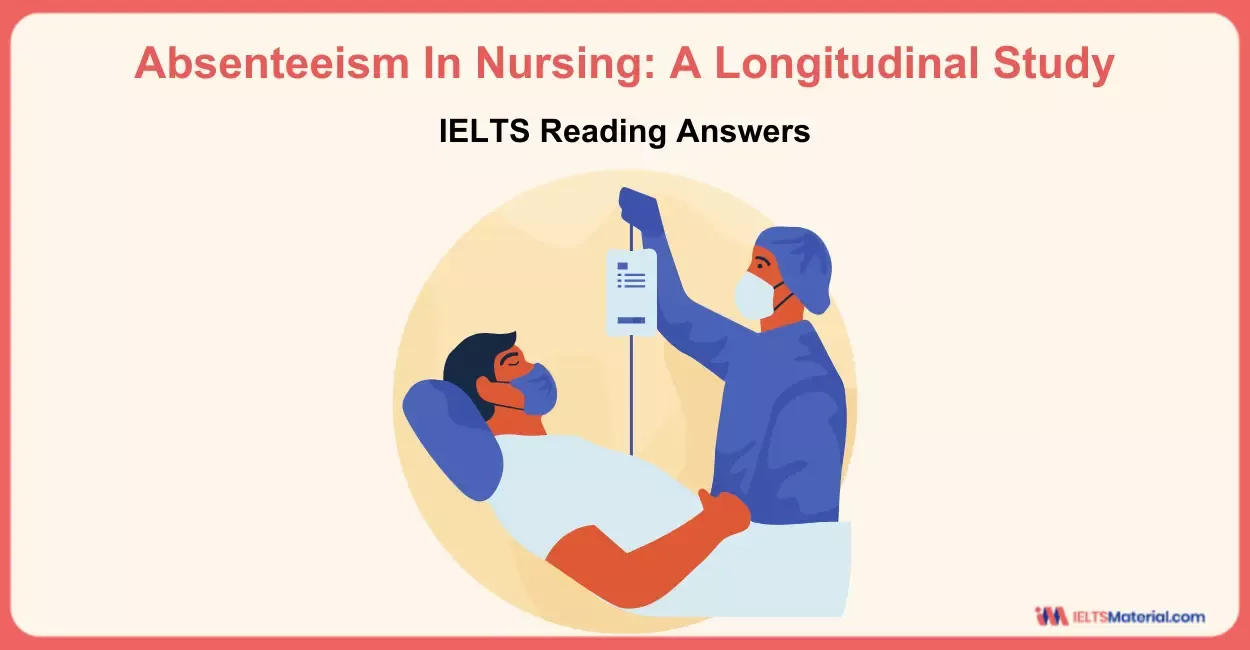
Table of Contents


Limited-Time Offer : Access a FREE 10-Day IELTS Study Plan!
The Academic passage ‘Absenteeism In Nursing: A Longitudinal Study’ is a reading passage that appeared in an IELTS Test. This passage would assess your ability to use appropriate strategies where you need to combine your reading skills with precise comprehension because you have to read such IELTS Reading passages within a short time frame. By simulating exam conditions, you get an opportunity to answer all questions with certainty. Focus on staying focused while you quickly organize information and understand the specific tricks to answer different question types.
Connect with our band 9 IELTS Trainers to crack your IELTS Reading in no time! Book a FREE Demo.
Types of Questions in ‘Absenteeism In Nursing: A Longitudinal Study’
The first step of an efficient reading strategy to look at all the question types before you start reading the passage . The study process would help you to choose appropriate methods such as skimming, scanning, and critical reading skills. The two question types in the passage on 'Absenteeism In Nursing: A Longitudinal Study’ are presented below which would guide you to enhance reading accuracy and speed.
- IELTS Reading Yes, No, Not Given [Q.1-Q.7]
- IELTS Reading Note Completion [Q.8-Q.13]
IELTS Reading Passage on ‘Absenteeism In Nursing: A Longitudinal Study’
You should spend about 20 minutes on Questions 1-13 which are based on the Reading Passage below.
Absenteeism In Nursing: A Longitudinal Study
A Absence from work is a costly and disruptive problem for any organisation. The cost of absenteeism in Australia has been put at 1.8 million hours per day or $1400 million annually. The study reported here was conducted in the Prince William Hospital in Brisbane, Australia, where, prior to this time, few active steps had been taken to measure, understand or manage the occurrence of absenteeism.
Nursing Absenteeism
B A prevalent attitude amongst many nurses in the group selected for study was that there was no reward or recognition for not utilising the paid sick leave entitlement allowed them in their employment conditions. Therefore, they believed they may as well take the days off sick or otherwise. Similar attitudes have been noted by James (1989), who noted that sick leave is seen by many workers as a right, like annual holiday leave.
C Miller and Norton (1986), in their survey of 865 nursing personnel, found that 73 per cent felt they should be rewarded for not taking sick leave, because some employees always used their sick leave. Further, 67 per cent of nurses felt that administration was not sympathetic to the problems shift work causes to employees' personal and social lives. Only 53 per cent of the respondents felt that every effort was made to schedule staff fairly.
D In another longitudinal study of nurses working in two Canadian hospitals, Hacket Bycio and Guion (1989) examined the reasons why nurses took absence from work. The most frequent reason stated for absence was minor illness to self. Other causes, in decreasing order of frequency, were illness in family, family social function, work to do at home and bereavement.
Method
E In an attempt to reduce the level of absenteeism amongst the 250 Registered an Enrolled Nurses in the present study, the Prince William management introduced three different, yet potentially complementary, strategies over 18 months.
Strategy 1: Non-financial (material) incentives
F Within the established wage and salary system it was not possible to use hospital funds to support this strategy. However, it was possible to secure incentives from local businesses, including free passes to entertainment parks, theatres, restaurants, etc. At the end of each roster period, the ward with the lowest absence rate would win the prize.
Strategy 2: Flexible fair rostering
G Where possible, staff were given the opportunity to determine their working schedule within the limits of clinical needs.
Strategy 3: Individual absenteeism and counselling
H Each month, managers would analyse the pattern of absence of staff with excessive sick leave (greater than ten days per year for full-time employees). Characteristic patterns of potential 'voluntary absenteeism' such as absence before and after days off, excessive weekend and night duty absence and multiple single days off were communicated to all ward nurses and then, as necessary, followed up by action.
Results
I Absence rates for the six months prior to the Incentive scheme ranged from 3.69 per cent to 4.32 per cent. In the following six months they ranged between 2.87 per cent and 3.96 per cent. This represents a 20 percent improvement. However, analysing the absence rates on a year-to-year basis, the overall absence rate was 3.60 per cent in the first year and 3.43 per cent in the following year. This represents a 5 per cent decrease from the first to the second year of the study. A significant decrease in absence over the two-year period could not be demonstrated.
Discussion
J The non-financial incentive scheme did appear to assist in controlling absenteeism in the short term. As the scheme progressed it became harder to secure prizes and this contributed to the program's losing momentum and finally ceasing. There were mixed results across wards as well. For example, in wards with staff members who had long-term genuine illness, there was little chance of winning, and to some extent the staff on those wards were disempowered. Our experience would suggest that the long-term effects of incentive awards on absenteeism are questionable.
K Over the time of the study, staff were given a larger degree of control in their rosters. This led to significant improvements in communication between managers and staff. A similar effect was found from the implementation of the third strategy. Many of the nurses had not realised the impact their behaviour was having on the organisation and their colleagues but there were also staff members who felt that talking to them about their absenteeism was 'picking' on them and this usually had a negative effect on management—employee relationships.
Conclusion
L Although there has been some decrease in absence rates, no single strategy or combination of strategies has had a significant impact on absenteeism per se. Notwithstanding the disappointing results, it is our contention that the strategies were not in vain. A shared ownership of absenteeism and a collaborative approach to problem solving has facilitated improved cooperation and communication between management and staff. It is our belief that this improvement alone, while not tangibly measurable, has increased the ability of management to manage the effects of absenteeism more effectively since this study.
M This article has been adapted and condensed from the article by G. William and K. Slater (1996), 'Absenteeism in nursing: A longitudinal study', Asia Pacific Journal of Human Resources, 34(1): 111-21. Names and other details have been changed and report findings may have been given a different emphasis from the original. We are grateful to the authors and Asia Pacific Journal of Human Resources for allowing us to use the material in this way.
Questions 1-7
Do the following statements agree with the information given in Reading Passage 1
In boxes 1-7 on your answer sheet write
YES if the statement agrees with the information
NO if the statement contradicts the information
NOT GIVEN if there is no information on this in the passage
1 The Prince William Hospital has been trying to reduce absenteeism amongst nurses for many years.
2 Nurses in the Prince William Hospital study believed that there were benefits in taking as little sick leave as possible.
3 Just over half the nurses in the 1986 study believed that management understood the effects that shift work had on them.
4 The Canadian study found that 'illness in the family' was a greater cause of absenteeism than 'work to do at home'.
5 In relation to management attitude to absenteeism the study at the Prince William Hospital found similar results to the two 1989 studies.
6 The study at the Prince William Hospital aimed to find out the causes of absenteeism amongst 250 nurses.
7 The study at the Prince William Hospital involved changes in management practices.
Questions 8-13
Complete the notes below.
Choose ONE OR TWO WORDS from the passage, for each answer.
Write your answers in boxes 8-13 on your answer sheet.
In the first strategy, wards with the lowest absenteeism in different periods would win prizes donated by 8 ……………………………………..
In the second strategy, staff were given more control over their 9 ……………………………………..
In the third strategy, nurses who appeared to be taking 10 ……………………………………..sick leave or 11 …………………………………….. were identified and counselled.
Initially, there was a 12 ……………………………………..per cent decrease in absenteeism.
The first strategy was considered ineffective and stopped. The second and third strategies generally resulted in better 13 …………………………………….. among staff.
Join our IELTS online classes for expert guidance. Sign up today!
Answer with Explanation for ‘Absenteeism In Nursing: A Longitudinal Study’
Now it is time to verify your answers! The table below includes the answers along with the analysis of these explanations for the passage on ‘Absenteeism In Nursing: A Longitudinal Study’. This will help you become familiar with the information on the placement of distractors in the passages and the types of strategies you should use to avoid making common mistakes. Let’s take a look and remember to note down the IELTS Band Score for tracking your improvement.
Unlock Answers
| Question number | Answer | Keywords | Location of keywords |
|---|---|---|---|
| 1 | NO | The study reported here was conducted in the Prince William Hospital in Brisbane, Australia, where, prior to this time, few active steps had been taken to measure, understand or manage the occurrence of absenteeism. | Paragraph A;
Line 3 |
| 2 | NO | there was no reward or recognition for not utilizing the paid sick leave entitlement allowed them in their employment conditions. | Paragraph B;
Line 1 |
| 3 | NO | 67 per cent of nurses felt that administration was not sympathetic to the problems shift work causes to employees’ personal and social lives. | Paragraph C;
Line 2 |
| 4 | YES | Other causes, in decreasing order of frequency, were illness in family, family social function, work to do at home and bereavement. | Paragraph D;
Last line |
| 5 | NOT GIVEN | – | – |
| 6 | NO | In an attempt to reduce the level of absenteeism amongst the 250 Registered an Enrolled Nurses in the present study, | Paragraph E;
Line 1 |
| 7 | YES | the Prince William management introduced three different, yet potentially complementary, strategies over 18 months. | Paragraph E;
Line 1 |
| 8 | (local) businesses | it was possible to secure incentives from local businesses, including free passes to entertainment parks, theatres, restaurants, etc. | Paragraph F;
Line 2 |
| 9 | (work/working) schedule/ | staff were given the opportunity to determine their working schedule within the limits of clinical needs. | The whole of paragraph G |
| 10 | excessive | Each month, managers would analyse the pattern of absence of staff with excessive sick leave (greater than ten days per year for full-time employees). | Paragraph H;
Line 1 |
| 11 | voluntary absence/absenteeism | Characteristic patterns of potential ‘voluntary absenteeism’ such as absence before and after days off, excessive weekend and night duty absence and multiple single days off were communicated to all ward nurses and then, as necessary, followed up by action. | Paragraph H;
Line 2 |
| 12 | twenty/ 20 | This represents a 20 percent improvement. | Paragraph I;
Line 3 |
| 13 | communication | This led to significant improvements in communication between managers and staff. | Paragraph K;
Line 2 |
Join our IELTS webinars to learn master tips for the Reading section! Click here to explore!
Remember to compare both correct and incorrect answers so that you get to see the repeated patterns, the specific errors which you make, and the areas you need to improve. Such a process of reflection would help you develop your skimming and scanning abilities while focusing on your time management skills. With consistent practice, you would be able to understand difficult texts in the passages.
Check More IELTS Reading Answers
Also check :
Practice IELTS Reading based on question types

Start Preparing for IELTS: Get Your 10-Day Study Plan Today!

Explore other Reading Practice Tests

Nehasri Ravishenbagam
Kasturika Samanta
Kasturika Samanta

Kasturika Samanta

Recent Articles

Nehasri Ravishenbagam
Haniya Yashfeen

Haniya Yashfeen

Haniya Yashfeen


Post your Comments